Key takeaways
- Stated accuracy: Look for a rated tolerance around plus or minus 3 percent, as offered by wrenches like the PUIBERS and Roartisa sets, so your applied torque matches the spec closely.
- Dual scales: A wrench reading both ft-lbs and Nm, and one showing inch-pounds for small fasteners, saves conversion errors when your manual lists a different unit.
- 72-tooth gearing: A fine 72-tooth ratchet head, common on these sets, lets you work in tight spaces with a small swing arc, useful around a crowded motorcycle frame.
On a motorcycle, torque is not a suggestion, it is safety. Overtighten an axle pinch bolt and you can crack a casting; undertighten a caliper bracket and it can back out on the road. Bikes use smaller fasteners and lighter torque figures than cars, which means the giant 1/2-inch click wrench in your garage is often the wrong tool. Choosing a torque wrench sized correctly for motorcycle work is what protects both your engine and your ride.
This guide explains how to pick the right torque wrench for motorcycle maintenance, covering drive size, torque range, accuracy, and the click-versus-digital decision. Get these four factors right and you will tighten every fastener to spec with confidence, from a bar clamp to an oil drain plug.
Our top picks




As an Amazon Associate we earn from qualifying purchases at no extra cost to you. Ratings are shown as listed on Amazon.
⚡ Save on Your Next PC — Amazon Prime
Prime members get fast free shipping on the systems above, plus early access to Prime Day & Black Friday PC deals. New members get a 30-day free trial.
Watch: How to Choose the Right Torque Wrench for Motorcycle Maintenance — Video Review
Match the Drive Size to Motorcycle Fasteners
Most motorcycle fasteners fall in the low-to-mid torque range, so a 1/4-inch or 3/8-inch drive covers the majority of jobs. A 1/4-inch wrench, like the YIYEIE 50-piece bike torque set or the LEXIVON 1/4-inch kit, is ideal for small bolts on controls, bodywork, and brake components. Step up to a 3/8-inch drive, such as the PUIBERS or HERONIX wrenches, for axle nuts and engine fasteners that need more torque. A full 1/2-inch drive is usually overkill and lacks the low-end precision bike work demands.
Choose the Correct Torque Range
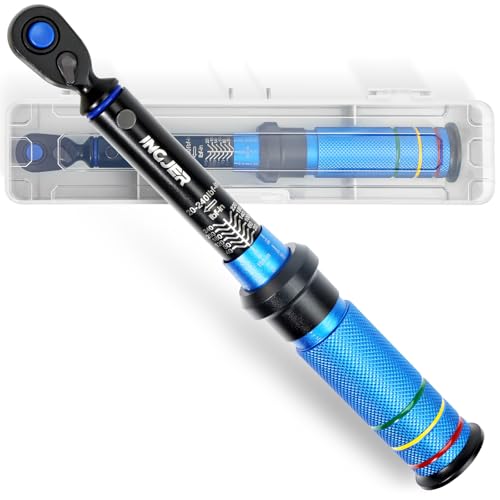
The single most common mistake is buying a wrench whose range does not overlap your fasteners. Torque wrenches are least accurate at the extreme ends of their scale, so you want your target values to sit in the middle. Many motorcycle bolts call for figures in the 5 to 50 ft-lb band, while smaller fasteners are specified in inch-pounds. Sets like the INGJER 20 to 240 in-lb wrench cover the small stuff, and a 3/8-inch wrench spanning roughly 5 to 50 ft-lbs handles axle and engine bolts. Check your service manual and pick a wrench whose mid-range matches your most frequent values.
Prioritize Accuracy and Dual Scales
- Stated accuracy: Look for a rated tolerance around plus or minus 3 percent, as offered by wrenches like the PUIBERS and Roartisa sets, so your applied torque matches the spec closely.
- Dual scales: A wrench reading both ft-lbs and Nm, and one showing inch-pounds for small fasteners, saves conversion errors when your manual lists a different unit.
- 72-tooth gearing: A fine 72-tooth ratchet head, common on these sets, lets you work in tight spaces with a small swing arc, useful around a crowded motorcycle frame.
Decide Between Click and Digital
Click-type wrenches, like the LEXIVON dual-direction click set, are the proven standard: you set the value, and the wrench clicks and breaks slightly when you reach it. They are affordable, reliable, and need no batteries. Digital wrenches, such as the coobeast 3/8-inch digital model reading 1.5 to 99.5 ft-lbs, add a readout and often a beep or buzz at the target, which helps beginners and lets you track angle. For most home riders a quality click wrench is enough; choose digital if you want the numeric feedback and can keep it charged.
Care for the Wrench So It Stays Accurate
A torque wrench is a precision instrument, and misuse drifts its calibration. Always store a click wrench dialed down to its lowest setting to relax the internal spring, never use it to loosen bolts or as a breaker bar, and avoid dropping it. With care, a quality wrench holds its accuracy for years; if it takes a hard knock or you rely on it heavily, have it recalibrated periodically so your torque figures stay honest.
Tips
- Always look up the exact torque spec in your bike’s service manual before tightening; guessing defeats the purpose.
- Approach the target smoothly and stop the instant a click wrench breaks, rather than continuing to pull.
- Keep an inch-pound wrench for small fasteners and a ft-lb wrench for axles, since one range cannot cover both accurately.
- Store the wrench backed off to its lowest setting to preserve the spring and calibration.
Frequently Asked Questions
What torque wrench size is best for motorcycles?
A 1/4-inch drive covers small bolts on controls and bodywork, while a 3/8-inch drive handles axle and engine fasteners. Together they cover nearly all motorcycle maintenance; a 1/2-inch drive is usually too coarse.
Do I need both an inch-pound and a foot-pound wrench?
For thorough work, yes. Small motorcycle fasteners are specified in inch-pounds and larger ones in foot-pounds, and a single wrench cannot cover both ranges accurately, so many riders keep one of each.
Are click or digital torque wrenches better for bikes?
Click wrenches are reliable, affordable, and need no power, making them the standard choice. Digital wrenches add a numeric readout and target alert that helps beginners, at a higher price and with a battery to maintain.
How do I keep a torque wrench accurate?
Store a click wrench dialed to its lowest setting, never use it to loosen bolts or as a breaker bar, and avoid dropping it. Have it recalibrated periodically if used heavily to keep readings honest.
Conclusion
Choosing a motorcycle torque wrench comes down to four things: a drive size matched to the bike’s smaller fasteners, a torque range whose middle overlaps your specs, an accuracy rating around plus or minus 3 percent, and the click-versus-digital choice that suits your workflow. Keep a 1/4-inch wrench for small bolts and a 3/8-inch for axles, always work to the manual’s figures, and care for the tool so it stays true. Do that and every fastener on your bike goes to spec, keeping both the machine and the rider safe.