Key takeaways
- Using the orange 16-gauge cord from the shed. It is rated 13 amps and drops 4 to 6 percent of voltage over 50 feet at 15 amps. The saw bogs in hardwood, the motor runs hot, and the cord itself can get warm enough to soften the jacket.
- Daisy-chaining two cords. Two 25-foot 14-gauge cords are a 50-foot 14-gauge cord with an extra connection point. Buy one cord of the right gauge and length.
- Leaving the excess coiled. A coiled cord under load traps heat. Lay out the full length in a loose S-pattern rather than a tight coil.
- Trusting “heavy duty” on the label. The phrase has no standard meaning. Read the gauge stamped on the jacket: 12/3 or 10/3 for a saw.
- Buying by wattage alone. A cord marked 1,875 watts is a 15-amp cord, but that rating assumes a short length. Length still governs the voltage drop.
- Running a cord through a doorway or under a rug. Doors pinch conductors and rugs trap heat. Use a cord protector or a cable ramp where foot traffic crosses.
- Ignoring the plug and receptacle rating. A cord with a 15-amp plug will fit a 20-amp receptacle, but a saw with a 20-amp plug (one blade turned sideways) needs a 20-amp cord and outlet. Budget $40 to $60 for a proper 50-foot 12-gauge cord in 2026 rather than forcing a mismatch.
The Short Answer
A heavy-duty 120-volt table saw drawing 13 to 15 amps needs a 12-gauge extension cord for runs up to 50 feet and a 10-gauge cord for 50 to 100 feet. Never use 16-gauge, and only use 14-gauge if the cord is 25 feet or shorter. The cord must be rated for at least 15 amps, carry a three-prong grounded plug, and have an SJTW or SJTOW jacket for shop and outdoor use. If your saw is a 240-volt cabinet model, it belongs on a dedicated circuit with a 10-gauge cord no longer than 25 feet, and most manufacturers would rather you hardwire it or plug it directly into the outlet. The cheapest fix for a long run is to move the saw closer to the outlet, not to buy a longer cord.
Standard Sizes
Extension cord capacity depends on two things: conductor gauge and length. A thinner or longer cord drops more voltage under load, and a motor running on low voltage draws more current, overheats, loses power, and trips breakers on startup. The table uses a 3 percent voltage drop as the limit, which is the figure most motor manufacturers consider safe.
Our top picks

As an Amazon Associate we earn from qualifying purchases at no extra cost to you.
| Cord gauge (AWG) | Conductor area | Rated amps | Max length for a 15 A table saw | Cord outer diameter (approx.) | Weight per 50 ft | Typical price, 50 ft |
|---|---|---|---|---|---|---|
| 16/3 | 1.3 mm² | 13 A | Not recommended for any table saw | 0.30 in (7.6 mm) | 3 to 4 lb (1.4 to 1.8 kg) | $20 to $30 |
| 14/3 | 2.1 mm² | 15 A | 25 ft (7.6 m) | 0.35 in (8.9 mm) | 4 to 6 lb (1.8 to 2.7 kg) | $25 to $40 |
| 12/3 | 3.3 mm² | 20 A | 50 ft (15 m) | 0.45 in (11.4 mm) | 7 to 9 lb (3.2 to 4.1 kg) | $35 to $60 |
| 10/3 | 5.3 mm² | 30 A | 100 ft (30 m) | 0.55 in (14 mm) | 12 to 15 lb (5.4 to 6.8 kg) | $70 to $120 |
| 8/3 | 8.4 mm² | 40 A | 150 ft (46 m) | 0.70 in (17.8 mm) | 20 to 25 lb (9 to 11 kg) | $150 to $250 |
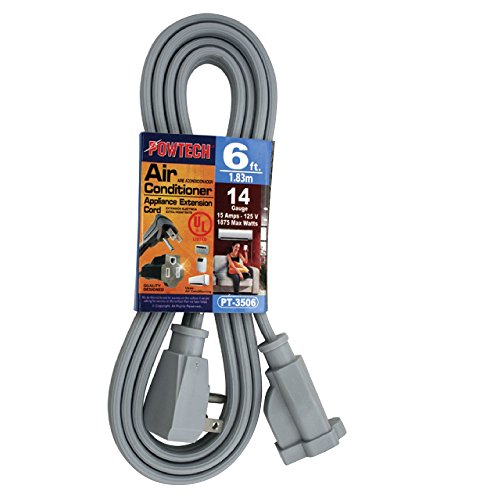
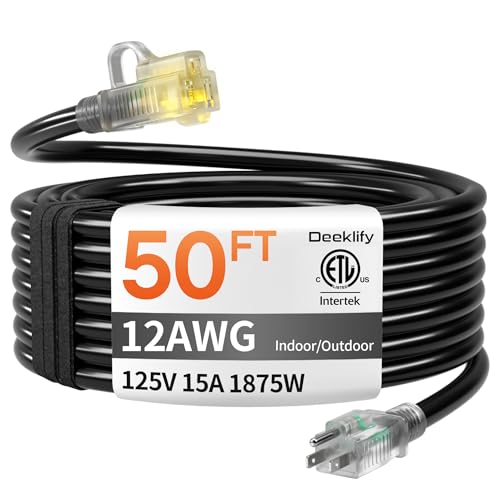
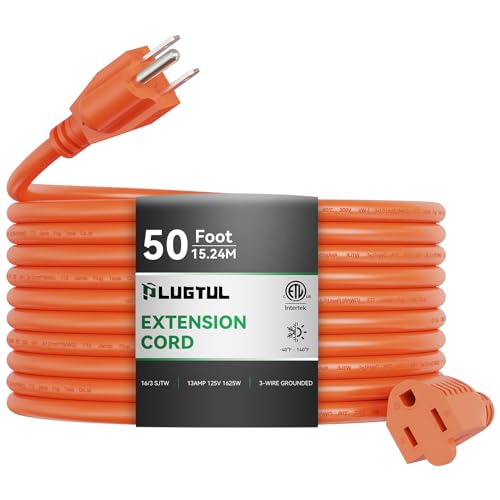
The products people compare illustrate the spread. A 50-foot 16/3 cord rated 13 amps and 1,625 watts, about $27, is a garden cord; it belongs on a hedge trimmer, not a saw. A 50-foot 12-gauge outdoor cord, such as the Deeklify at about $41, is the correct minimum for a 15-amp saw at that distance. For very short hops, a 6-foot 14-gauge appliance cord rated 15 amps and 1,875 watts (POWTECH, about $12) or a 9-foot 14/3 SJTW appliance cord (Gardner Bender PS915143, about $11) will feed a jobsite saw sitting a few feet from the wall without meaningful voltage drop.
How to Measure Your Space
- Read the saw’s amperage. Check the motor plate or manual. Jobsite and contractor saws are typically 13 to 15 amps at 120 volts. Hybrid and cabinet saws are 12 to 18 amps at 240 volts. Note also the saw’s own cord length, usually 6 to 8 feet.
- Measure the actual cord path. Walk the route from outlet to saw with a tape, following walls and floors, not the straight line across the room. Add 5 feet (1.5 m) of slack so the plug is not under tension.
- Subtract the saw’s cord. If the saw’s cord is 6 feet and your path is 30 feet, you need a 25-foot extension, not a 50.
- Choose the shortest standard length that covers it. Cords come in 6, 9, 10, 15, 25, 50, and 100 feet. Every extra foot adds voltage drop; do not buy 100 feet “just in case” and leave 70 feet coiled.
- Pick the gauge from the table. For a 15-amp saw: 14 gauge to 25 feet, 12 gauge to 50 feet, 10 gauge to 100 feet.
- Check the outlet and breaker. A 15-amp saw on a 15-amp circuit will run but may trip on startup if anything else is on. A 20-amp circuit with a 5-20 receptacle is better. Never adapt a 240-volt saw to a 120-volt outlet.
- Verify the jacket rating. Look for SJTW (hard service, thermoplastic, weather-resistant) or SJTOW (oil-resistant) printed on the cord. Indoor-only SPT cords do not belong in a shop.
By Room or Use Case
Garage shop with the saw near an outlet
If the saw sits within 10 feet of a receptacle, a 6- to 10-foot 14-gauge appliance cord rated 15 amps is fine and keeps the floor clear. Better still, position the saw so its own 6- to 8-foot cord reaches and skip the extension entirely.
Garage shop with the saw in the middle of the floor
Most two-car garages put the saw 20 to 40 feet from the nearest outlet by cord path. Use a 25- or 50-foot 12-gauge cord. Route it along the wall and across the floor where you will not trip on it, or drop it from a ceiling-mounted retractable reel rated 12 gauge and 15 amps ($80 to $150).
Driveway or backyard cutting
Outdoor runs of 50 to 75 feet are common. Use 10 gauge for anything over 50 feet, and plug into a GFCI-protected receptacle. Keep connections off wet ground; a cord connector cover or simply elevating the plug junction on a block prevents nuisance GFCI trips.
Jobsite with a generator
A 15-amp table saw needs roughly 1,800 running watts and 3,000 to 4,000 starting watts. Pair a 3,500-watt or larger generator with a 12-gauge cord up to 50 feet. Voltage from small generators already sags under load, so a thin cord makes it worse.
Basement or detached shop with a 240-volt cabinet saw
Cabinet saws pulling 12 to 18 amps at 240 volts should plug directly into a dedicated 20- or 30-amp receptacle (NEMA 6-20 or 6-30). If an extension is unavoidable, use a 10-gauge, 3-conductor cord with matching 240-volt ends, no longer than 25 feet, and treat it as temporary. Many manuals void the warranty for extended cord use on these motors.
Shared circuit with dust collection
A 15-amp saw and a 10-amp dust collector on the same 20-amp circuit will trip it. Run them on separate circuits and separate cords. If you have only one outlet, plug the saw into the wall and run the collector from a different room on its own 12-gauge cord.
Common Sizing Mistakes
- Using the orange 16-gauge cord from the shed. It is rated 13 amps and drops 4 to 6 percent of voltage over 50 feet at 15 amps. The saw bogs in hardwood, the motor runs hot, and the cord itself can get warm enough to soften the jacket.
- Daisy-chaining two cords. Two 25-foot 14-gauge cords are a 50-foot 14-gauge cord with an extra connection point. Buy one cord of the right gauge and length.
- Leaving the excess coiled. A coiled cord under load traps heat. Lay out the full length in a loose S-pattern rather than a tight coil.
- Trusting “heavy duty” on the label. The phrase has no standard meaning. Read the gauge stamped on the jacket: 12/3 or 10/3 for a saw.
- Buying by wattage alone. A cord marked 1,875 watts is a 15-amp cord, but that rating assumes a short length. Length still governs the voltage drop.
- Running a cord through a doorway or under a rug. Doors pinch conductors and rugs trap heat. Use a cord protector or a cable ramp where foot traffic crosses.
- Ignoring the plug and receptacle rating. A cord with a 15-amp plug will fit a 20-amp receptacle, but a saw with a 20-amp plug (one blade turned sideways) needs a 20-amp cord and outlet. Budget $40 to $60 for a proper 50-foot 12-gauge cord in 2026 rather than forcing a mismatch.
FAQ
Can I use a 14-gauge extension cord for a table saw?
Yes, if the cord is 25 feet or shorter and the saw draws 15 amps or less. Voltage drop stays under 3 percent at that length. Beyond 25 feet, move to 12 gauge. For 100 feet, 10 gauge is required.
What does 12/3 mean on an extension cord?
The first number is the wire gauge (12 AWG, about 3.3 mm²); the second is the number of conductors (three: hot, neutral, and ground). A 12/3 cord is rated 20 amps and is the standard choice for 15-amp power tools at 25 to 50 feet.
Is a longer cord always worse?
For voltage drop, yes. Resistance scales with length, so a 100-foot cord drops twice as much voltage as a 50-foot cord of the same gauge. That is why the gauge requirement steps up as length increases. Buy the shortest cord that reaches with a few feet of slack.
Why does my table saw trip the breaker on startup when I use an extension cord?
A universal or induction motor draws two to three times its running current for a fraction of a second when it starts. A thin or long cord lowers the voltage at the motor, which raises the current draw and lengthens the startup surge, and that combination trips the breaker. Switching to a 12- or 10-gauge cord, shortening the run, and using a 20-amp circuit usually solves it.