Key takeaways
- Minimum elbow room per player: 24 inches wide x 15 inches deep. Anything less than 22 inches and players will bump elbows every time they reach for pieces.
- Central play area: Most modern hobby games (like Catan, Ticket to Ride, Wingspan) need a 24 x 24 inch to 30 x 30 inch center zone. Campaign games like Gloomhaven need 36 x 30 inches or more.
- Why 6-foot rectangular wins: A 72″ x 30″ table seats 3 per side comfortably for 6 players. A 60″ round table (seats 6 technically) only gives each person about 31 inches of arc length but leaves a small 28-inch diameter center, so large boards hang over. A 48″ x 48″ square card table is great for 4, but cramped for 6.
What's inside
- How Much Table Space You Actually Need for 6 Players
- Surface Grip vs. Plastic: The Most Overlooked Spec
- Weight Capacity and Stability: What Heavy Games Really Weigh
- Best Folding Table for Board Games by Situation
- Decision Matrix: Match Your Situation to the Right Type
- Assembly, Moving and What Wears Out First
- FAQ
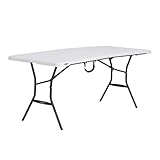
The best folding table for board games for most 6-player groups in 2026 is a 72 x 30 inch rectangular folding table with a textured high-density polyethylene (HDPE) top and a steel frame rated for 300+ lbs of evenly distributed weight, because it gives each player 24 inches of elbow room, stops cards and boards from sliding, and still folds to 2-3 inches thick for closet storage in a small living room.
- How Much Table Space You Actually Need for 6 Players
- Surface Grip vs. Plastic: The Most Overlooked Spec
- Weight Capacity and Stability: What Heavy Games Really Weigh
- Best Folding Table for Board Games by Situation
- Decision Matrix: Match Your Situation to the Right Type
- Assembly, Moving and What Wears Out First
- FAQ
As an Amazon Associate we earn from qualifying purchases at no extra cost to you.


How Much Table Space You Actually Need for 6 Players
Board games fail on small tables not because of the board itself, but because of player zones. You need space for the central board, plus each player’s personal area for cards, tokens, resources, and drinks.
- Minimum elbow room per player: 24 inches wide x 15 inches deep. Anything less than 22 inches and players will bump elbows every time they reach for pieces.
- Central play area: Most modern hobby games (like Catan, Ticket to Ride, Wingspan) need a 24 x 24 inch to 30 x 30 inch center zone. Campaign games like Gloomhaven need 36 x 30 inches or more.
- Why 6-foot rectangular wins: A 72″ x 30″ table seats 3 per side comfortably for 6 players. A 60″ round table (seats 6 technically) only gives each person about 31 inches of arc length but leaves a small 28-inch diameter center, so large boards hang over. A 48″ x 48″ square card table is great for 4, but cramped for 6.
Room-Size Fit: Will It Fit Your Living Room?
Folding tables solve storage, but you still need clearance to play. You need at least 36 inches from the table edge to the wall or sofa to pull out a chair and stand up. 42 inches is better if someone needs to walk behind seated players.
| Table Size | Footprint | Room Needed With Chairs (36″ clearance all sides) | Best For |
|---|---|---|---|
| 48″ x 30″ (4-foot) | 10 sq ft | 10 ft x 9 ft (90 sq ft) | 2-4 players in studio / 10×10 ft room |
| 72″ x 30″ (6-foot) | 15 sq ft | 12 ft x 9 ft (108 sq ft) | 4-6 players in standard 10×12 ft or 12×12 ft living room |
| 60″ Round | 19.6 sq ft | 11 ft x 11 ft (121 sq ft) | 4-6 players where everyone needs to reach the center equally |
| 96″ x 30″ (8-foot) | 20 sq ft | 14 ft x 9 ft (126 sq ft) | 6-8 players, needs dedicated dining or game room |
If your living room is 10×12 ft, a 72 x 30 inch table is the largest you can use without blocking pathways. Place the long side against the wall when not in use, then pull it out 3 feet for game night. Standard doorway width is 30-32 inches and hallway width is 36 inches, so any folding table under 30 inches wide will pass through without tilting.
Surface Grip vs. Plastic: The Most Overlooked Spec
The classic folding table material is blow-molded high-density polyethylene (HDPE) — the speckled plastic top you see on Lifetime, Cosco, and MainStay tables. The alternative is a bare smooth plastic or a vinyl-covered particleboard top. For board games, texture matters more than looks.
| Surface Type | Grip & Play Feel | Durability | Trade-Off |
|---|---|---|---|
| Textured HDPE (Lifetime, Cosco Centerfold) | High grip. Cards stay put, neoprene mats don’t slide, dice don’t bounce off. | Waterproof, stain-resistant, won’t dent. Wipe clean. UV-resistant. | Light surface texture can make very small tokens wobble slightly. Usually $70-$150. |
| Smooth HDPE / Smooth Polypropylene | Low grip. Boards and playmats slide when leaning. Feels slippery with sweaty hands. | Same waterproof durability, but shows scratches more clearly on glossy surface. | Looks cleaner for dining, worse for gaming. Avoid if you play card-heavy games. |
| Vinyl-Covered Plywood / Particleboard (Flash Furniture, National Public Seating) | Medium grip. Slightly softer, quieter for dice rolling. | Vinyl can tear or peel at edges after 2-3 years. Particleboard swells if liquid seeps into seams. | More solid feel and less flex, but heavier and not fully waterproof. |
| MDF with Laminate + Folding Legs | High grip if matte laminate. Very flat and stable. | Heavy. Laminate chips on corners. Not designed to fold flat for long-term storage. | Best as permanent game table, not a true space-saving folding option. |
Practical tip: If you already own a smooth plastic table, a 3mm neoprene playmat (usually $40-$80 for a 72 x 30 inch size) completely fixes the grip problem, dampens dice noise for apartments, and protects the table from scratches. It also adds a slight lip that keeps cards from sliding off.
Weight Capacity and Stability: What Heavy Games Really Weigh
A single large board game like Gloomhaven: Jaws of the Lion or Twilight Imperium weighs 10-15 lbs. Add drinks, snacks, elbows leaning, and someone leaning on the table to reach, and the load adds up fast.
- Weight rating to look for: 300 lbs evenly distributed for HDPE tables with steel frames, 500+ lbs for commercial-grade steel edge models like National Public Seating or Lifetime commercial series. Centerfold tables (hinged in the middle) are usually rated lower — 200-250 lbs — and will sag slightly at the center seam under heavy load.
- What causes wobble: Not weight, but frame design. Look for wishbone or straight leg braces that lock with a ring, and non-marring foot caps that level on carpet. Tables with gravity locks only (no manual lock) tend to collapse if bumped from the side.
- Table height matters: Standard folding table height is 29 inches, which matches a dining chair seat height of 18-19 inches for 10-11 inches of knee clearance. Card table height is often 28 inches — fine for low chairs, but tall players will hunch. Avoid 34-inch counter-height folding tables for board games; they force you to raise your arms and fatigue shoulders during long games.
Box weight and setup reality: A 6-foot HDPE folding table ships at 32-38 lbs in a box roughly 73 x 31 x 3.5 inches. One person can carry it, but you will need a wall space 75 inches long to store it upright. Centerfold 6-foot tables fold to 36 x 30 x 3.5 inches and fit in most closets but weigh the same and have that center seam.
Best Folding Table for Board Games by Situation
There is no single best model — the right choice depends on your space and group size.
For Small Apartments and Weekly Storage: 6-Foot HDPE Rectangular Table
Models like the Lifetime 80305 (72 x 30 inch) or Cosco 6-Foot Centerfold are the default recommendation. They offer the 24-inch per player standard, a textured top that holds boards in place, and a 300 lb capacity while folding flat. Usually $70-$130. The one-piece top version is more stable for heavy games than the centerfold; choose centerfold only if you absolutely must store it in a coat closet or car trunk.
For 4 Players Who Want a Permanent Feel: 48-Inch Square Folding Card Table
A 48 x 48 inch square table like the Flash Furniture 48″ Square Folding Card Table gives each of 4 players a true 24 x 24 inch personal zone and a symmetrical reach to the center. It needs a 10 x 10 ft room and folds to half the length of a 6-foot table, so it is easier to carry up stairs. Usually $90-$180. Not ideal for 6 — adding two people to the corners leaves no central board space.
For Large Campaign Games and D&D: 6-Foot Table + 18-Inch Folding Bench Extension
If you play games with huge maps, use a standard 72 x 30 inch table and add a matching 72 x 18 inch narrow folding table along one long side to create a 72 x 48 inch surface for the map, keeping player zones clear. National Public Seating and Lifetime both make 18-inch wide seminar tables designed for this. Total weight capacity remains high because you are not overloading one seam, and you can still store both tables flat.
For Renters and People Who Need Quiet: HDPE Table + Neoprene Mat
If you have downstairs neighbors or thin floors, the combination of a textured HDPE top and a full-size neoprene mat reduces dice clatter by more than half compared to bare plastic or wood. It also prevents the table from scratching rental floors when dragged, and protects the table from hot mugs.
Decision Matrix: Match Your Situation to the Right Type
| Your Situation | Choose This | Why |
|---|---|---|
| 10×12 ft living room, 5-6 players weekly | 72 x 30″ one-piece HDPE, steel wishbone legs | Fits with 36″ clearance, 24″ per player, no center sag |
| Studio apartment, must store in closet | 72 x 30″ centerfold HDPE | Folds to 36″ long, fits closet, still seats 6 |
| Kids and pets, spills likely | Textured HDPE, not vinyl or particleboard | Truly waterproof, bleach-cleanable, no swelling |
| Back pain, long 3+ hour sessions | 29″ height + padded folding chairs (18″ seat height) | Maintains 10″ knee clearance and 90-degree elbow angle |
| Heavy miniatures / legacy games (15+ lbs per game) | Commercial-grade 300+ lb rated frame, avoid centerfold | Prevents center seam deflection and leg wobble |
Assembly, Moving and What Wears Out First
Most HDPE folding tables come fully assembled — you just unfold the legs until they lock. No tools needed. The first thing to wear is not the top but the leg brace locks and foot caps. On sub-$80 tables, the plastic gravity ring can crack after a year of weekly folding; steel ring locks last longer. The second wear point is the edge: blow-molded edges can crack if dropped on a corner when moving. Carry it vertically with the legs locked closed, not flat like a tray, to avoid flexing the center.
For durability, store it vertically leaning against a wall rather than flat under a bed with weight on top, which can warp the plastic over time in heat. If you transport it often, measure your car: a one-piece 6-foot table needs an SUV or pickup with at least 73 inches of cargo length; a centerfold fits in most sedan backseats at 36 inches.
FAQ
Is a 6-foot folding table too big for a small living room?
Not if your room is at least 10×12 ft. With 36 inches of clearance on all sides for chairs, a 72 x 30 inch table needs a 12 x 9 ft open area. In a smaller room, use the table with one long side against the wall for 4 players, then pull it out for 6.
Do I need a table with adjustable height?
Usually no. Adjustable-height tables (22″ to 29″) are designed for kids or standing crafts and introduce more wobble points. Fixed 29-inch height is more stable and ergonomically correct for adult dining chairs.
Can I use two 4-foot tables pushed together for 6 players?
You can, but the seam down the middle will be right where the central board sits, causing it to rock. One 6-foot one-piece table is more stable and often cheaper than two smaller tables.