Key takeaways
- Pass planning: For tall growth, mow in controlled strips with overlap rather than trying to clear the full deck width through a dense wall of vegetation. Slow down when the engine labors, and stop if the blade repeatedly stalls.
- Hidden obstacles: Walk the area first and remove wire, branches, and loose debris. Tall grass can conceal fence remnants and rocks that damage blades or become dangerous projectiles.
- Access and transport: Measure gates, storage doors, and trailer ramps. Compare those dimensions with the assembled mower, and check the owner’s instructions for safe loading and transport.
- Maintenance reality: Blades, belts, tires, and cutting components wear with use. Ask whether replacement parts are available and how difficult it is to inspect the blade, clean the deck, and service the drive.
- Operator protection: Wear eye and hearing protection, sturdy footwear, and long clothing. Keep people and pets well away from the work area, and use the machine only as directed by its manual.
The best brush mower for overgrown fields and rough ground is usually a walk-behind model with a 24–30-inch deck, a high-torque four-stroke engine, large traction tires, and a blade system rated for woody growth. Choose a narrower deck for tight access and uneven ground; choose a wider one when you have open acreage and need to cover it efficiently. Before buying, check the manufacturer’s maximum sapling diameter, cutting-height range, terrain guidance, and whether the machine is self-propelled.
Our top picks


As an Amazon Associate we earn from qualifying purchases at no extra cost to you. Ratings are shown as listed on Amazon.
Brush mower picks by property and job
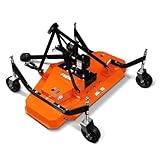
“Brush mower” can mean anything from a heavy-duty walk-behind brush cutter to a tow-behind attachment or a compact tractor implement. These are not interchangeable: match the machine to the area you need to clear, the slope, and the vegetation rather than choosing by deck width alone.
| Situation | Useful starting specification | Why it fits | Check before buying |
|---|---|---|---|
| Trails, gates, and irregular ground | Walk-behind; 24–26-inch deck; large drive wheels | Narrower machines are easier to steer around trees and keep aligned on uneven passes. | Overall width, turning clearance, and minimum cutting height |
| Open field with tall grass and brambles | Walk-behind; 26–30-inch deck; self-propelled drive | A wider deck covers more ground per pass, while powered wheels reduce pushing effort. | Engine torque, ground speed, and blade engagement method |
| Occasional clearing on a small property | Compact walk-behind; moderate deck width; adjustable handle | Easier to store and maneuver than a tractor-mounted or tow-behind machine. | Storage footprint, transport weight, and service access |
| Repeated work across several acres | Heavy-duty walk-behind, tow-behind, or tractor implement | A larger machine can reduce the number of passes, but needs suitable access and transport. | Tractor power and hitch requirements, or towing vehicle and trailer capacity |
| Frequent saplings or dense woody stems | Model explicitly rated for woody growth | A grass-focused mower may stall or suffer blade and deck damage in material beyond its rating. | Maximum stem diameter and whether the rating depends on species or conditions |
How to compare the features that matter
Deck width: reach versus control
A wider deck reduces passes in open ground, but adds bulk and can be harder to guide between trees, fence posts, and rocks. Measure the narrowest gate or passage on your route, then compare it with the machine’s overall width, not just the advertised cutting width. Leave room to turn and avoid scraping the deck against obstacles. On rough terrain, a manageable deck that tracks steadily may finish a job faster than a wider machine that needs constant correction.
Cutting height: clearing now versus maintaining later
Adjustable cutting height is useful when growth is tall, tangled, or hiding debris. A higher first pass helps the blade avoid repeatedly swallowing long stems and reduces the chance of hitting concealed rocks. Lower passes can follow once the ground is visible and the remaining vegetation is manageable. Check the actual adjustment range and whether it can be changed easily between passes; some machines offer stepped settings rather than continuous adjustment.
Cutting height is not the same as ground clearance. If you expect to cross ruts or mounds, look for information about the frame and deck clearance as well as the blade setting. A low-hanging deck can catch even when the blade is raised.
Engine torque: sustained load beats headline power
Dense brush places a prolonged load on the engine. Torque and the manufacturer’s intended duty matter more than comparing peak horsepower in isolation. A machine that can keep the blade turning through thick grass and brambles is more useful than one that sounds powerful but bogs down when material is wet or woody. For demanding work, favor a design with a robust blade drive, accessible service points, and a clear maintenance schedule. Keep the blade sharp: a dull edge takes more effort to cut and puts extra strain on the machine.
Terrain handling: wheels, drive, and balance
Large, widely spaced wheels generally roll over small bumps better than small wheels, while a tread suited to the ground improves traction on loose or grassy slopes. Self-propelled drive is a major advantage on larger properties, but it does not make a steep slope safe. Confirm the maker’s limits for grade and operating direction, and avoid mowing wet, slippery ground. On uneven land, a stable stance and predictable steering can matter more than maximum speed.
Consider how the machine moves when the blade is off, too. A heavy unit may be difficult to reposition around a shed or load into a vehicle. Check weight, handle folding, tie-down points, and whether the mower’s controls remain reachable while wearing gloves.
Saplings and dense growth: read the cutting limit closely
Brush mowers can handle vegetation that would overwhelm many lawn mowers, but their limits vary. “Brush” may mean tall weeds and brambles on one machine and substantial woody stems on another. Look for a stated maximum sapling diameter and follow it; do not treat it as a promise for every tree species or every condition. Hard, dry stems can be more demanding than young, green growth of the same diameter. Larger trees, hidden stumps, and woody debris may call for a chainsaw or a different clearing method rather than repeated mower passes.
What the specifications don’t tell you
- Pass planning: For tall growth, mow in controlled strips with overlap rather than trying to clear the full deck width through a dense wall of vegetation. Slow down when the engine labors, and stop if the blade repeatedly stalls.
- Hidden obstacles: Walk the area first and remove wire, branches, and loose debris. Tall grass can conceal fence remnants and rocks that damage blades or become dangerous projectiles.
- Access and transport: Measure gates, storage doors, and trailer ramps. Compare those dimensions with the assembled mower, and check the owner’s instructions for safe loading and transport.
- Maintenance reality: Blades, belts, tires, and cutting components wear with use. Ask whether replacement parts are available and how difficult it is to inspect the blade, clean the deck, and service the drive.
- Operator protection: Wear eye and hearing protection, sturdy footwear, and long clothing. Keep people and pets well away from the work area, and use the machine only as directed by its manual.
Which brush mower should you buy?
For a property with narrow paths, gates, or frequent turns, start with a 24–26-inch walk-behind and prioritize traction, balance, and easy height adjustment. For open ground with heavy grass and brambles, a self-propelled 26–30-inch model is a more efficient starting point. If woody saplings are part of the job, put the published stem limit and blade design ahead of deck width. For repeated clearing over several acres, compare the cost and logistics of a walk-behind with a suitable tow-behind or tractor-mounted machine.
Before settling on any model, verify four details in its current manufacturer specifications: cutting width, height range, terrain or slope guidance, and maximum vegetation size. Those figures—and the machine’s actual width and weight—are the best basis for choosing among the best brush mowers for your particular field.