Key takeaways
- Tractor match: Confirm PTO horsepower, hitch category, lift capacity, PTO speed, and tire clearance against the mower manual.
- Cutting width: Choose for your narrowest gate and tightest turning area, not just the acreage.
- Deck access: Check how easily you can clean the underside and remove or sharpen blades.
- Wear items: Ask about replacement blades, spindle assemblies, belts if fitted, wheels, and PTO-shaft parts.
- Storage and transport: Measure the mower’s overall width and consider how you will lift, store, and service it safely.
- Terrain: For steep slopes or uneven ground, follow the tractor and mower safety guidance; a finishing mower is not a substitute for suitable slope-rated equipment.
The best finishing mowers depend on your tractor, lawn size, and desired cut
For a large, mostly open lawn, the best finishing mowers are usually rear-discharge, three-point-hitch rotary cutters with a 60- to 72-inch cutting width, a smooth-running PTO shaft, and a deck sturdy enough for the terrain. Choose a narrower deck if your tractor is compact or the lawn has tight turns; choose a wider one only if your tractor can lift and power it comfortably. A finishing mower is designed for regularly maintained grass—not brush, saplings, or rough field clearing.
First, make sure a finishing mower fits your tractor
Most tractor-mounted finishing mowers connect to a Category 1 or Category 2 three-point hitch and run from a rear PTO, commonly at 540 rpm. Check the mower’s manual for the required PTO horsepower, hitch category, PTO speed, and minimum tractor weight. Engine horsepower alone is not enough: the tractor must also safely lift the mower, maintain traction, and turn it without the deck striking tires or other obstacles.
Our top picks


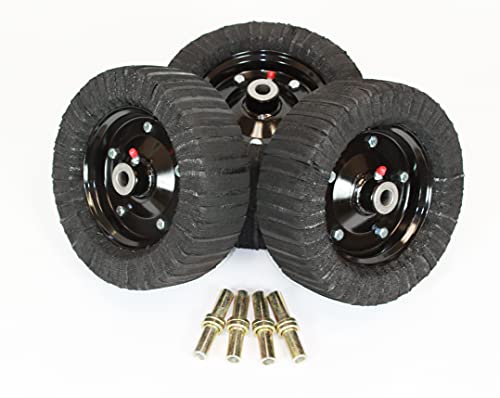

As an Amazon Associate we earn from qualifying purchases at no extra cost to you. Ratings are shown as listed on Amazon.
Measure the tractor’s rear tire width, hitch geometry, and available lift capacity. Confirm that the PTO shaft can be cut to the correct length if the manufacturer requires it; a shaft that bottoms out as the hitch rises can damage the tractor or mower. Some mowers are sold with a PTO shaft, while others require one to be purchased separately. Verify before buying.
Choose by lawn size and maneuverability
| Cutting width | Typical use | Practical trade-off | Illustrative mowing time for 5 acres |
|---|---|---|---|
| 48 inches | Compact tractors, smaller lawns, gates and landscaping | Easy to position, but more passes over open ground | About 3.8 hours |
| 60 inches | Medium to large lawns with some trees or beds | A useful balance of coverage and turning room | About 3.0 hours |
| 72 inches | Large open lawns and maintained fields | Fewer passes, but needs more lift and turning space | About 2.5 hours |
| 84 inches | Broad, open areas and suitably sized tractors | Fast coverage; cumbersome near trees, ditches, and gates | About 2.1 hours |
Times are estimates, not manufacturer claims. They assume 4 mph ground speed and 80% field efficiency to account for overlap, turns, and repositioning: acres per hour ≈ width in feet × speed in mph × efficiency ÷ 8.25. Wet grass, slopes, uneven ground, and frequent obstacles reduce output substantially.
A wider deck does not always finish faster. If it forces you to slow down, make awkward turns, or leave uncut strips around obstacles, a 60-inch mower may be more productive than an 84-inch one. Allow room for the mower to swing behind the tractor at the ends of rows, and check the transport width against gates and storage openings.
Deck material and construction affect longevity and cut quality
| Construction | Advantages | What to check | Best fit |
|---|---|---|---|
| Welded steel deck | Rigid, repairable, and common across a wide range of widths | Steel thickness, reinforcement near spindle mounts, and paint or coating | Frequent use and buyers who value serviceability |
| Formed or stamped steel deck | Can have fewer seams and a smooth underside for grass flow | How well the shell is braced and whether the underside is accessible for cleaning | Regular lawn care where a clean finish matters |
| Heavier reinforced steel deck | More resistant to dents and vibration in demanding use | Added weight and whether the tractor can lift it with adequate stability | Large properties and longer service hours |
Deck material alone does not determine how well a mower cuts. Spindle alignment, blade condition, deck level, discharge design, and ground-following wheels all matter. A heavy deck can last longer but may exceed a compact tractor’s lift capacity; a lighter deck is easier to handle but deserves careful inspection around welds and spindle supports.
Rear discharge, turning, and the finish you can expect
Rear-discharge finishing mowers spread clippings behind the deck, which can make mowing patterns more flexible than side discharge around paths or planting beds. They still need dry-enough grass and sharp, balanced blades for an even result. If grass is tall, wet, or matted, clippings may clump rather than disperse. Raising the deck for the first pass and lowering it for a later pass is often better than removing too much leaf height at once.
Most tractor-mounted finishing mowers trail behind the tractor, so they cut a different path during a turn. This “tail swing” can catch a tree trunk, fence, or bed edge even when the tractor clears it. Check whether the mower has adjustable anti-scalp wheels or rollers, and look for a hitch arrangement that allows the deck to follow modest ground contours. On uneven ground, slower turns and a slightly higher cut help prevent scalping.
For an even finish, set the deck level according to the manual, inspect blade sharpness, and maintain consistent ground speed. After the first mowing, inspect for missed strips and scalped patches; those patterns can reveal an uneven deck or excessive overlap. A finishing mower is not a flail mower or rotary brush cutter, and its lighter blades and open deck are not intended for woody growth or hidden debris.
Shortlist by situation
| Your situation | What to prioritize | Likely starting point |
|---|---|---|
| Compact tractor and landscaped yard | Low weight, narrower width, easy access to blades | 48- to 60-inch deck, if tractor specifications allow |
| Large lawn with trees and garden borders | Manageable tail swing, anti-scalp wheels, moderate width | 60- to 72-inch deck |
| Open field kept regularly mowed | Coverage, robust spindle support, suitable tractor lift capacity | 72- to 84-inch deck, matched to the tractor |
| Rough field with brush or saplings | Cutting tool designed for rough vegetation—not a fine lawn finish | Consider a rotary cutter instead |
These are starting points, not universal fit guarantees. Before choosing a specific model, compare the manufacturer’s width, weight, hitch category, PTO requirements, cutting-height range, and parts availability with your tractor and property.
What to check before buying
- Tractor match: Confirm PTO horsepower, hitch category, lift capacity, PTO speed, and tire clearance against the mower manual.
- Cutting width: Choose for your narrowest gate and tightest turning area, not just the acreage.
- Deck access: Check how easily you can clean the underside and remove or sharpen blades.
- Wear items: Ask about replacement blades, spindle assemblies, belts if fitted, wheels, and PTO-shaft parts.
- Storage and transport: Measure the mower’s overall width and consider how you will lift, store, and service it safely.
- Terrain: For steep slopes or uneven ground, follow the tractor and mower safety guidance; a finishing mower is not a substitute for suitable slope-rated equipment.
The best finishing mower is the widest, well-built model your tractor can safely handle while still maneuvering around your property. For many mixed-use lawns, 60 to 72 inches offers a practical balance; open fields can justify more width, while tight landscapes reward a smaller deck and careful turning.