Key takeaways
- Doorways and gates: a 14-inch mower generally passes through narrow gates with room to spare; an 18- or 20-inch mower needs a clear opening wider than its deck plus hand clearance.
- Storage: confirm the folded or upright dimensions before buying. A heavier model may be difficult to hang safely, especially on a shed wall that is not framed for the load.
- What wears first: wheels, wheel gears, reel bearings, and the bed-knife adjustment hardware usually need attention before the steel reel itself. Keep the mower dry and remove clippings after use.
- Moving it: basic 14-inch reels are often around 20–25 pounds; wider or easier-push designs can approach 50 pounds. That difference matters when carrying the mower up stairs or loading it into a car.
The best reel push mowers for small and medium lawns are the American Lawn Mower 1204-14 for compact, level yards, the Scotts 20-Inch 5-Blade Classic for wider coverage at a moderate price, and the Fiskars StaySharp Max for homeowners who want easier pushing and fewer blade-sharpening chores.
A reel mower cuts with a rotating cylinder of blades against a fixed bed knife, rather than tearing grass with a powered rotary blade. That design can leave a very clean finish, but it rewards regular mowing, reasonably level ground, and grass that is not excessively tall. The right choice depends less on the highest blade count than on cutting width, height control, handle comfort, and how often you maintain the lawn.
Our top picks



As an Amazon Associate we earn from qualifying purchases at no extra cost to you. Ratings are shown as listed on Amazon.
Quick comparison of the best reel push mowers
| Mower | Cutting width | Typical cutting-height range | Blade adjustment | Best fit |
|---|---|---|---|---|
| American Lawn Mower 1204-14 | 14 inches | About 0.5–1.75 inches | Lever or wheel-position adjustment, depending on production version | Small, flat lawns and narrow side yards |
| American Lawn Mower 1415-16 | 16 inches | About 0.5–2 inches | Adjustable cutting-height wheels | Small to medium lawns with frequent mowing |
| Scotts 20-Inch 5-Blade Classic | 20 inches | About 1–3 inches | Adjustable height levers at the wheels | Medium, open lawns where fewer passes matter |
| Fiskars StaySharp Max | 18 inches | About 1–4 inches | Central single-lever adjustment | Thicker grass, taller mowing, and easier pushing |
| Great States 18-Inch 5-Blade | 18 inches | About 0.5–2.75 inches | Adjustable wheel-height levers | Budget-conscious small and medium lawns |
Specifications can vary slightly by revision and seller, so check the label or manual before buying replacement parts. The important practical distinction is that the 14-inch models are easier to turn and store, while the 18- and 20-inch models reduce the number of overlapping passes across an open lawn.
Best choices by lawn and mowing situation
Best for a small, uncomplicated lawn: American Lawn Mower 1204-14
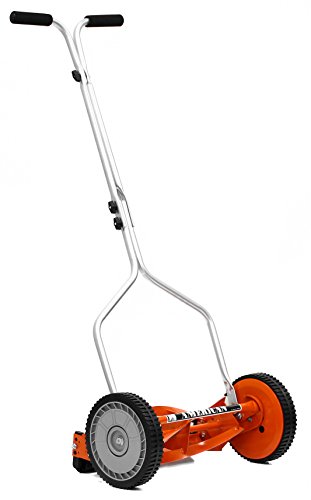
The 14-inch American Lawn Mower 1204-14 is a sensible match for a modest, mostly level lawn with flower beds, trees, and tight corners. Its narrow deck can pass through gates and around garden furniture more easily than a 20-inch mower. It is also relatively light, commonly around 20 pounds, so carrying it up a few steps or hanging it in a shed is less troublesome.
The trade-off is coverage. A 14-inch cutting path covers only about 70% of the width of a 20-inch model, so a larger lawn requires noticeably more passes. Its lower height range also favors a regularly maintained lawn rather than overgrown grass. Choose it when maneuverability and storage matter more than speed.
Best value for an open medium lawn: Scotts 20-Inch 5-Blade Classic
The Scotts 20-Inch 5-Blade Classic is the practical head-to-head choice against narrower five-blade mowers. Its 20-inch width covers roughly 25% more area per pass than a 16-inch mower, assuming similar overlap. On a rectangular 60-by-80-foot lawn, that difference can remove several dozen passes over the season.
Its approximate 1-to-3-inch adjustment range is useful for ordinary cool-season turf and many warm-season grasses kept at a moderate height. The limitation is the low end: it is not the best option if you want an especially short, golf-like cut. A broad reel also takes more effort to turn around obstacles and may feel awkward in a narrow side yard.
Best for easier pushing and taller grass: Fiskars StaySharp Max
The Fiskars StaySharp Max uses an InertiaDrive design intended to make the reel easier to push through resistance, and its StaySharp system is designed to reduce routine sharpening. Its 18-inch width is a useful middle ground: substantially faster than a 14-inch mower but easier to place around trees and beds than a 20-inch model.
The wide adjustment range, approximately 1 to 4 inches, is its major advantage for owners who do not mow every few days or who keep grass taller during hot weather. The mower is also heavier than basic compact reels, commonly around 50 pounds. That extra mass can improve stability, but moving it through a house, lifting it into a vehicle, or storing it on a wall requires more planning.
Best budget middle size: Great States 18-Inch 5-Blade
An 18-inch Great States five-blade mower suits a small-to-medium lawn when you want more coverage than a compact 14-inch model without paying for a specialized easier-push mechanism. Its height range, generally around 0.5 to 2.75 inches, accommodates a broad range of routine lawn heights.
Basic reel mowers in this category tend to have simpler handles, wheel adjustments, and bearings than premium designs. That is not necessarily a problem, but expect to spend more time checking reel-to-bed-knife alignment and clearing packed grass. It is a better fit for a homeowner willing to perform occasional adjustments than for someone seeking minimal maintenance.
How cutting width changes the work
| Width | Approximate mowing area per 100 linear feet | Practical advantage | Practical drawback |
|---|---|---|---|
| 14 inches | About 117 square feet | Easy around beds, posts, and narrow gates | Many more passes on open grass |
| 16 inches | About 133 square feet | Balanced maneuverability and coverage | Still slow on a broad rectangular lawn |
| 18 inches | About 150 square feet | Good compromise for medium yards | More difficult to turn in confined spaces |
| 20 inches | About 167 square feet | Fewest passes on open lawn | Heavier-feeling and less nimble around obstacles |
These figures are theoretical cutting widths before overlap. In practice, allow a few inches of overlap so uncut strips do not remain between passes. For a lawn under roughly 1,500 square feet with several obstacles, a 14- or 16-inch mower can be quicker overall because it turns and repositions easily. For an open lawn of roughly 2,000 to 5,000 square feet, an 18- or 20-inch model usually makes better use of your time.
Blade height and grass-height limits matter more than blade count
Reel mowers work best when removing no more than about one-third of the grass blade at a time. If the lawn has grown from 2 inches to 5 inches, repeatedly pushing a reel mower across it may cause missed strips, clogging, and excessive effort. Mow in stages or use a rotary mower for the initial reduction, then maintain the lawn with the reel mower.
Low-cut models are suitable for short, frequently mowed turf. A mower that starts around 1 inch is not automatically superior; it may be poorly suited to tall fescue, coarse weeds, or a lawn that is mowed weekly rather than every few days. If you want a taller, drought-tolerant lawn, prioritize a mower with a 3- or 4-inch upper setting.
Handle comfort, storage, and durability
Handle design determines whether the mower feels manageable after 20 minutes rather than during a quick test push in a shop. Look for a padded or textured grip, a handle height that lets you keep your elbows slightly bent, and a crossbar that does not force your wrists into an angled position. Tall users may find low, fixed handles uncomfortable; adjustable or higher handles are worth prioritizing if back or shoulder strain is a concern.
- Doorways and gates: a 14-inch mower generally passes through narrow gates with room to spare; an 18- or 20-inch mower needs a clear opening wider than its deck plus hand clearance.
- Storage: confirm the folded or upright dimensions before buying. A heavier model may be difficult to hang safely, especially on a shed wall that is not framed for the load.
- What wears first: wheels, wheel gears, reel bearings, and the bed-knife adjustment hardware usually need attention before the steel reel itself. Keep the mower dry and remove clippings after use.
- Moving it: basic 14-inch reels are often around 20–25 pounds; wider or easier-push designs can approach 50 pounds. That difference matters when carrying the mower up stairs or loading it into a car.
Decision guide: which mower fits your situation?
| Your situation | Best direction | Why |
|---|---|---|
| Small yard with trees and garden borders | 14-inch compact reel | Turns easily and stores in less space |
| Open lawn of 2,000–5,000 square feet | 18- or 20-inch reel | Reduces overlapping passes |
| Grass often reaches 3–4 inches before mowing | Fiskars StaySharp Max | Higher setting and easier-push design are better suited |
| Frequent mowing for a short, tidy finish | American Lawn Mower 1204-14 or 1415-16 | Lower cutting settings and compact handling |
| Limited storage or a narrow gate | 14- or 16-inch model | Smaller footprint and easier carrying |
| Back, shoulder, or grip concerns | Fiskars or another easier-push 18-inch design | Reduced pushing resistance is more valuable than maximum width |
Bottom line
Choose the American Lawn Mower 1204-14 when your lawn is small and obstacle-filled. Choose the Scotts 20-Inch 5-Blade Classic for the most efficient coverage on a reasonably level, regularly mowed lawn. Choose the Fiskars StaySharp Max when taller grass, reduced sharpening, or easier pushing matters most. For a middle path, the American Lawn Mower 1415-16 or Great States 18-inch model provides useful width without the bulk of the largest reel mowers.