Key takeaways
- Gaming at 1080p with a fast monitor: A strong CPU can help maintain high frame rates, particularly in CPU-heavy games. The 9800X3D is a premium option; a 9600X can leave more budget for a stronger GPU.
- Gaming at 1440p or 4K: The graphics card often becomes the main performance limit. Don’t spend heavily on a flagship CPU if it forces a major GPU downgrade.
- Video editing, 3D rendering, or compiling: Favor the 9900X or 9950X when your software can use additional cores. Check application benchmarks for your specific workflow; more cores do not speed up every task equally.
- Everyday browsing, office work, and light gaming: A Ryzen 5 is generally ample. Put savings toward 32 GB of RAM if your multitasking needs it, a larger SSD, or a better display.
- Small or quiet PC: Consider a lower-power model, an efficient cooler, and a case with unobstructed airflow. A powerful CPU in a cramped case can require louder fans to keep temperatures under control.
Best AMD CPUs for Your Next PC Build
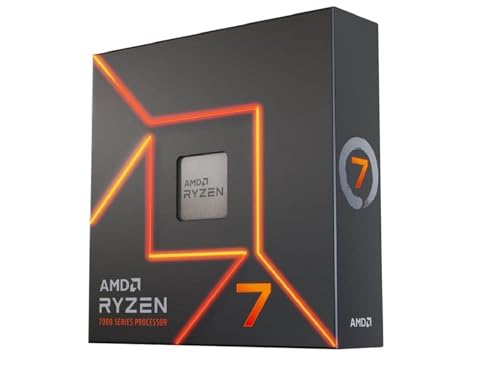
The best AMD CPU for most new gaming PCs is the Ryzen 7 9800X3D, while the Ryzen 9 9950X3D better suits people who combine high-end gaming with demanding creative work. For a lower-cost gaming or everyday build, consider a Ryzen 5 9600X; for heavily threaded productivity, compare Ryzen 9 models such as the 9900X and 9950X. The right choice depends as much on your graphics card, motherboard socket, cooler, and upgrade plans as on the processor itself.
Choose by what you do most
| Build situation | Processor to consider | Why it fits | Plan for |
|---|---|---|---|
| High-refresh-rate gaming | Ryzen 7 9800X3D | Eight cores and 3D V-Cache make it a strong choice for games that benefit from a large cache and high frame rates. | A capable cooler and a discrete graphics card; at 4K, the GPU often matters more. |
| Gaming plus rendering or streaming | Ryzen 9 9950X3D | Combines 16 cores with 3D V-Cache, giving demanding workloads more parallel processing headroom than an eight-core gaming chip. | Higher system cost, a robust cooler, and enough case airflow. |
| Midrange gaming and general use | Ryzen 5 9600X | Six cores are sufficient for many gaming and everyday builds, leaving more budget for a graphics card or storage. | For CPU-heavy editing, compiling, or frequent streaming, consider more cores. |
| Productivity first, gaming second | Ryzen 9 9900X or 9950X | The 12- and 16-core options suit workloads that can use many threads, such as rendering and media encoding. | Check the software you use: not every application scales with extra cores. |
| Low-cost upgrade on an existing system | A compatible Ryzen 5000-series processor | May provide a substantial improvement without replacing an AM4 motherboard and DDR4 memory. | Verify the exact board’s CPU support list and BIOS version before buying. |
Names and prices change over time, and stock varies by region. Treat these as model-family recommendations: compare current local prices and check the exact processor specification before ordering.
Our top picks



As an Amazon Associate we earn from qualifying purchases at no extra cost to you. Ratings are shown as listed on Amazon.
What the headline specs don’t tell you
Socket and memory decide the shape of the build
Current Ryzen 9000 desktop processors use the AM5 socket and DDR5 memory. They require an AM5 motherboard; an older AM4 board cannot take an AM5 CPU, and DDR4 memory does not fit AM5 boards. Ryzen 5000 desktop processors use AM4 and DDR4, which can make them attractive as drop-in upgrades for an existing system—but only when the motherboard supports the specific chip.
AM5 is the more flexible starting point if you expect to upgrade later. AMD has committed to supporting AM5 through 2027 and beyond, but that does not guarantee every future processor will work in every AM5 board. Check the motherboard maker’s CPU support list, BIOS requirements, and power-delivery specifications rather than relying on socket fit alone.
Cooling and power affect noise, cost, and case choice
Thermal Design Power (TDP) is a useful class indicator, not a promise of exact wall-socket consumption or cooler temperature. Ryzen 5 9600X is a 65 W TDP processor, while the Ryzen 9 9950X is rated at 170 W TDP. Actual power depends on workload, motherboard settings, and system components. X3D processors also have model-specific thermal and voltage behavior, so follow AMD’s specifications and cooler guidance for the exact CPU.
A quality tower air cooler can be a sensible match for many midrange processors. For a high-core-count Ryzen 9, choose a strong air cooler or a compatible liquid cooler based on the processor’s specifications, case airflow, noise preference, and budget. Before buying, check cooler clearance against the case’s maximum cooler height, RAM height, and graphics card space. A large cooler that technically fits can still make memory installation or maintenance awkward.
AM5 versus AM4: a practical comparison
| Consideration | AM5 build | AM4 upgrade |
|---|---|---|
| Compatible memory | DDR5 | DDR4 |
| New platform parts | Requires an AM5 motherboard and DDR5 memory | May reuse a supported AM4 board and existing DDR4 |
| Upgrade path | Better prospects for future CPU upgrades, subject to board and BIOS support | Useful for extending an existing system; platform is older |
| Best reason to choose it | Building new and prioritizing a current platform | Improving an existing PC without replacing its core platform |
For a new PC, compare the total platform cost—not just CPU prices. An AM4 chip may look inexpensive, but buying a new AM4 motherboard and memory can undermine the savings. Conversely, replacing a compatible AM4 processor may be far cheaper than starting over.
Match the processor to the whole system
- Gaming at 1080p with a fast monitor: A strong CPU can help maintain high frame rates, particularly in CPU-heavy games. The 9800X3D is a premium option; a 9600X can leave more budget for a stronger GPU.
- Gaming at 1440p or 4K: The graphics card often becomes the main performance limit. Don’t spend heavily on a flagship CPU if it forces a major GPU downgrade.
- Video editing, 3D rendering, or compiling: Favor the 9900X or 9950X when your software can use additional cores. Check application benchmarks for your specific workflow; more cores do not speed up every task equally.
- Everyday browsing, office work, and light gaming: A Ryzen 5 is generally ample. Put savings toward 32 GB of RAM if your multitasking needs it, a larger SSD, or a better display.
- Small or quiet PC: Consider a lower-power model, an efficient cooler, and a case with unobstructed airflow. A powerful CPU in a cramped case can require louder fans to keep temperatures under control.
Before you buy: a five-minute compatibility check
- Confirm the exact CPU and socket. AM5 and AM4 processors are not interchangeable.
- Check the motherboard’s support page. Find the CPU support list and note any required BIOS version. If the board needs an update, confirm that you can update it without an already compatible CPU.
- Choose the right memory. Match DDR5 or DDR4 to the platform, then follow the motherboard’s recommended slots and memory configuration.
- Measure cooler and case clearance. Compare the cooler’s height or radiator size with the case limits. Allow room for fans, cables, and airflow—not just a paper-thin fit.
- Budget for the full platform. Include motherboard, memory, cooler, and potentially a power-supply upgrade. A CPU-only price comparison can hide the actual cost of a new build.
So, which AMD CPU should you choose?
Choose the Ryzen 7 9800X3D when gaming performance is the priority and your budget can support a strong GPU and cooler. Choose the Ryzen 9 9950X3D for a premium PC that needs both high-end gaming and substantial multithreaded performance. For a balanced build, the Ryzen 5 9600X is a sensible starting point; for core-heavy work, compare the Ryzen 9 9900X and 9950X against benchmarks for your applications. If you already own an AM4 system, first check whether a supported Ryzen 5000-series upgrade can meet your needs before replacing the entire platform.