Key takeaways
- At least 800–1,000 MB/s sustained: suitable for ordinary 4K editing, proxies, and occasional exports.
- About 1,500–2,000 MB/s sustained: a better target for multicamera 4K, large media copies, and frequent render work.
- Above 2,000 MB/s sustained: useful for high-bitrate formats and fast workstation storage, provided the computer, cable, and enclosure all support it.
The best high capacity NVMe external SSD for video editing is usually a 4TB or 8TB USB4/Thunderbolt drive with at least 2,000 MB/s sustained writing, a heat-spreading enclosure, and enough free space to keep the drive below roughly 80% full.
For most editors, choose the LaCie Rugged SSD Pro5 for a Thunderbolt 5 workstation, the SanDisk Professional PRO-G40 for a Thunderbolt 3/4 and USB-C mixed setup, or a high-capacity USB 3.2 Gen 2×2 model such as the Crucial X10 Pro when broad compatibility matters more than maximum timeline performance. The right choice depends less on the headline read speed than on usable capacity, sustained writes, connection standards, and how your footage moves through the workflow.
Our top picks


As an Amazon Associate we earn from qualifying purchases at no extra cost to you. Ratings are shown as listed on Amazon.
What “high capacity” actually means for video editing
A drive advertised as 4TB does not provide 4,000GB of usable space. After decimal-to-operating-system conversion, formatting, and overprovisioning, expect approximately 3.6TB to 3.7TB available. Video projects also need working space for cache files, optimized media, render files, and exports.
| Advertised capacity | Approximate formatted capacity | Comfortable active-project capacity | Typical fit |
|---|---|---|---|
| 2TB | 1.8TB–1.9TB | About 1.4TB | Short-form work, proxies, or one moderate project |
| 4TB | 3.6TB–3.7TB | About 2.9TB | Most solo 4K editing workflows |
| 8TB | 7.2TB–7.4TB | About 5.8TB | Large multicamera, RAW, or several concurrent projects |
Keeping 20% to 25% free is not wasted capacity. It gives the controller room for garbage collection and helps reduce performance drops during long transfers. If an 8TB drive is nearly full, it may perform worse than a less crowded 4TB drive during sustained editing work.
Best high-capacity NVMe external SSDs by situation
Best for Thunderbolt 5 workstations: LaCie Rugged SSD Pro5
The LaCie Rugged SSD Pro5 is designed for very high-speed Thunderbolt 5 workflows and is available in large capacities, including 4TB and 8TB configurations. It is a strong fit for editors working with high-bitrate 4K, 6K, and 8K media who have a recent Thunderbolt 5 computer and want a single portable project drive.
Its main advantage is bandwidth headroom: Thunderbolt 5 can move data much faster than ordinary USB 10Gbps connections, particularly when reading large media files and moving project folders. It is also built as a rugged portable drive rather than a bare SSD in a lightweight plastic shell.
The limitation is compatibility. A Thunderbolt 5 drive can connect to older Thunderbolt systems in some configurations, but performance may fall to the older connection’s limits. It is a poor value if your computer has only USB-C without Thunderbolt, because the port shape alone does not guarantee Thunderbolt support. Expect a premium market price, commonly around $700–$1,200 for 4TB–8TB models.
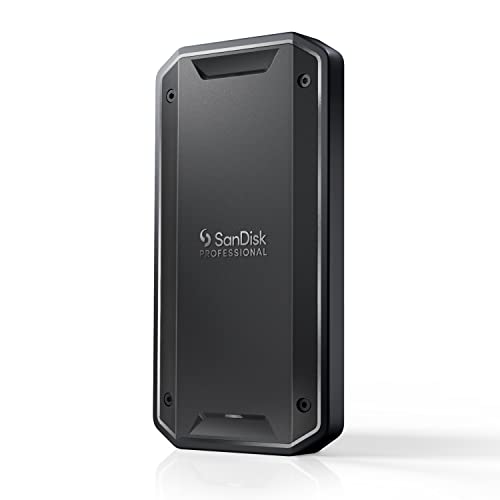
Best mixed Thunderbolt and USB workflow: SanDisk Professional PRO-G40
The SanDisk Professional PRO-G40 is a practical choice for editors who move between a Thunderbolt-equipped desktop and ordinary USB-C laptops. It supports Thunderbolt 3 and USB 3.2 Gen 2, so it can serve as a fast scratch or project drive in a studio while remaining usable on a wider range of computers.
Its Thunderbolt connection is the important part for editing: the drive can approach much higher real-world transfer rates on a suitable Thunderbolt host than it can over USB. On a USB connection, the same enclosure is substantially slower. That makes it useful for a mixed household or team environment, but you should label the cable and ports carefully; plugging it into a slower USB port changes the result.
It is available in capacities up to 4TB, which is sufficient for many 4K projects but less comfortable for extensive 8K footage. It usually costs roughly $300–$700 depending on capacity and sales.
Best USB-only value: Crucial X10 Pro
The Crucial X10 Pro is a sensible pick when your computers support USB 3.2 Gen 2×2. Its rated interface speed is up to 20Gbps, and its compact NVMe design is well suited to large transfers, portable editing, and daily project backups.
The important catch is that USB 3.2 Gen 2×2 is not universal. Many laptops have USB-C connectors but support only 5Gbps or 10Gbps USB, in which case the X10 Pro will work but will not reach its advertised performance. It also does not become a Thunderbolt drive simply because it uses USB-C.
Choose it for a modern Windows desktop, compatible laptop, or editing system where USB 20Gbps is confirmed. It is commonly available in 4TB and often costs around $250–$450, making it less expensive than many Thunderbolt alternatives.
Best compact general-purpose option: Samsung T7 Shield
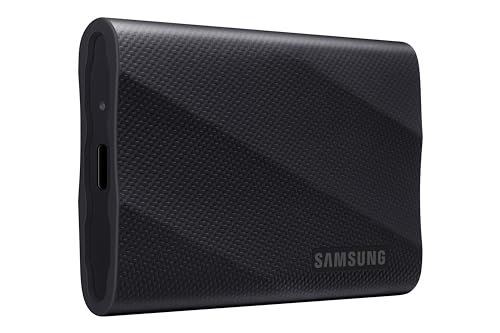
The Samsung T7 Shield is not the fastest choice for long 8K media transfers, but it remains a dependable portable option for proxies, project libraries, travel editing, and backup copies. Its USB 3.2 Gen 2 interface tops out below 1,000 MB/s in ideal conditions, so it is more appropriate for moderate 4K workloads than for repeatedly writing hundreds of gigabytes of camera originals.
Its rubberized exterior and compact body make it easier to carry than many larger Thunderbolt enclosures. Capacities up to 4TB are widely available, and prices generally fall around $200–$350. Buy it when portability, simple USB compatibility, and physical protection matter more than peak sustained speed.
Sustained write speed matters more than the box maximum
Drive manufacturers normally advertise peak sequential read and write speeds measured in short bursts. Video editing can generate much longer writes: copying camera cards, recording screen captures, generating optimized media, rendering, and exporting. Once an SSD’s fast cache fills, write speed can fall sharply.
For a large-file workflow, use these practical targets:
- At least 800–1,000 MB/s sustained: suitable for ordinary 4K editing, proxies, and occasional exports.
- About 1,500–2,000 MB/s sustained: a better target for multicamera 4K, large media copies, and frequent render work.
- Above 2,000 MB/s sustained: useful for high-bitrate formats and fast workstation storage, provided the computer, cable, and enclosure all support it.
Read speed is important when scrubbing several streams, but the source media and editing software also matter. A high-speed drive cannot eliminate dropped frames caused by demanding codecs, insufficient memory, or a weak CPU/GPU.
Thermal throttling: the hidden limit in portable SSDs
NVMe flash and its controller produce heat, especially during a long transfer. A tiny enclosure may reach its thermal limit after the first few minutes, reducing speed to protect the components. This is why a drive can appear fast when copying a 20GB folder yet slow considerably during a 500GB archive.
Prefer an enclosure with a metal heat spreader, substantial thermal pads, or another defined cooling path. Avoid placing the drive under a laptop, on a blanket, or between warm equipment. Leave at least 2–3 inches of open air around it during long writes. If a drive becomes too hot to comfortably hold, pause the transfer and improve ventilation.
For sustained work, a larger Thunderbolt enclosure may outperform a smaller drive with a higher advertised peak. An active fan can improve consistency, but it adds noise and another moving part. Passive cooling is quieter and usually preferable for a desk-based editing setup.
USB and Thunderbolt compatibility checklist
- USB-C is only the connector shape. Confirm whether the computer supports USB 10Gbps, USB 20Gbps, USB4, or Thunderbolt 3, 4, or 5.
- Check the cable rating. A basic charging cable may connect the drive while limiting data speed.
- Thunderbolt and USB are not interchangeable in every direction. A Thunderbolt drive may have limited or no useful operation on a USB-only host.
- USB 20Gbps requires host support. Many systems silently fall back to 10Gbps.
- Use the fastest direct connection. Hubs, docks, monitors, and front-panel ports can reduce speed or stability.
Durability and workflow fit
For travel, choose a drive with a protected enclosure and keep it in a small padded case. Ruggedness protects against drops and dust, but it does not protect against accidental deletion, ransomware, or controller failure. A working SSD should not be the only copy of irreplaceable footage.
A sensible arrangement is one fast SSD for active editing, a separate drive for local backup, and another copy stored elsewhere. For a large project, copy the camera originals before formatting cards and verify the copy before beginning the edit.
| Situation | Recommended type | Why |
|---|---|---|
| Thunderbolt 5 desktop and 8K footage | 4TB–8TB Thunderbolt 5 NVMe SSD | Maximum bandwidth and large working space |
| Mac and PC compatibility | Thunderbolt 3/4 plus USB-compatible SSD | One drive can move between different systems |
| USB 20Gbps Windows workstation | 4TB USB 3.2 Gen 2×2 NVMe SSD | Strong value without Thunderbolt hardware |
| Travel, proxies, and backup copies | 2TB–4TB rugged USB SSD | Smaller, simpler, and broadly compatible |
Bottom line
Buy the largest drive that leaves at least 20% free after importing a typical project. Choose Thunderbolt 5 only when your computer and workflow can use it; otherwise, a well-cooled 20Gbps USB NVMe SSD offers better value. For the best balance of speed and compatibility, the SanDisk Professional PRO-G40 is a strong mixed-interface choice, while the LaCie Rugged SSD Pro5 is the more capable option for a Thunderbolt 5 workstation. Whatever you select, sustained performance, airflow, and a verified backup matter more than the highest number printed on the package.