Key takeaways
- The best acoustic electric guitar for a home player is usually a comfortable grand auditorium or concert-size model with a reliable undersaddle pickup, a scale length around 24.9–25.5 inches, and a body that fits your room, posture, and playing goals.…
The best acoustic electric guitar for a home player is usually a comfortable grand auditorium or concert-size model with a reliable undersaddle pickup, a scale length around 24.9–25.5 inches, and a body that fits your room, posture, and playing goals.
For most beginners and practice-focused players, the Yamaha FGX800C is a strong value choice. The Fender CD-60SCE is appealing when easy playability and a cutaway matter. Players recording regularly may prefer a Taylor Academy 10e or 12e, while a smaller-bodied 000- or auditorium-style guitar is often the better choice for apartments, limited seating space, or back and shoulder comfort.
Our top picks

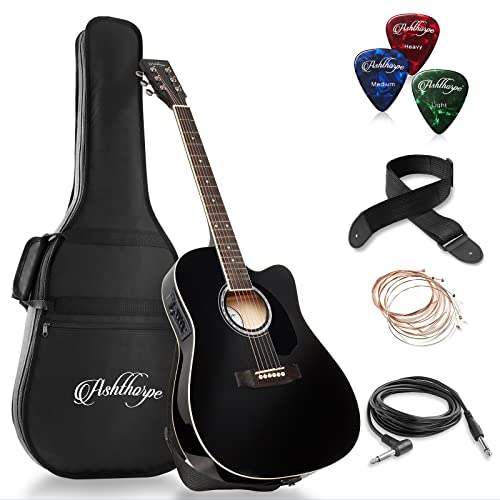


As an Amazon Associate we earn from qualifying purchases at no extra cost to you. Ratings are shown as listed on Amazon.
Quick picks by playing situation
| Home-player situation | Best guitar type | Useful example | Why it fits |
|---|---|---|---|
| First acoustic electric guitar | Dreadnought or concert cutaway | Yamaha FGX800C | Full sound, familiar neck, dependable onboard electronics |
| Small apartment or 10 × 12 ft room | Concert, 000, or grand auditorium | Taylor Academy 12e | Less bulky against the body and easier to control at moderate volume |
| Recording into an audio interface | Balanced auditorium or 000 body | Taylor Academy 10e or 12e | Clear midrange and a comfortable recording posture |
| Casual performances | Cutaway dreadnought or grand auditorium | Fender CD-60SCE | Strong projection with access to higher frets |
| Fingerstyle and lighter touch | 000, concert, or auditorium body | Martin 000-X2E | Responsive balance and less boomy bass than a large dreadnought |
| Plugged-in gigging and rehearsal | Stage-oriented acoustic electric | Takamine GD20CE | Practical controls and a robust performance-focused design |
Body shape: the most noticeable choice at home
Dreadnought
A dreadnought has a broad lower bout, deep body, and strong bass response. It suits strumming, singing, and players who want an acoustic sound that can fill a room without amplification. The trade-off is physical size. A typical dreadnought is roughly 20 inches long, 15.5–16.5 inches wide, and about 4–5 inches deep. Those dimensions can feel crowded in an office chair or on a shallow sofa.
Choose a dreadnought if you mostly strum, want substantial low end, or expect to play with other musicians. For an apartment, remember that a loud guitar can travel through floors and shared walls even when it is not plugged in. A smaller body will not make the instrument silent, but it can encourage a lighter, more controlled playing style.
Concert and 000 bodies
Concert and 000 guitars are narrower through the waist and usually more comfortable when seated. A 000 body is commonly about 15 inches wide and 3.5–4.25 inches deep. It offers enough projection for a living room while keeping the bass tighter than a dreadnought. This is a useful compromise for fingerpicking, folk accompaniment, recording, and long practice sessions.
The Martin 000-X2E represents this general format. It is a good direction for players who want a traditional, balanced response rather than maximum volume.
Grand auditorium
Grand auditorium guitars combine a curvy waist with a relatively full lower bout. They work well for mixed techniques: strumming, fingerstyle, and occasional lead work. Taylor’s Academy 10e and 12e show two variations of this comfortable, home-friendly approach. The 10e has a more traditional dreadnought-like silhouette, while the 12e is smaller and more relaxed in the lap.
Cutaway versus non-cutaway
A cutaway removes part of the upper bout so your hand can reach the higher frets. It is valuable for melodic playing, lessons, and lead parts above the 12th fret. It slightly changes the body’s air volume and may reduce some upper-bout resonance, although the practical difference is usually less important than comfort and access. If you mainly play open chords, a non-cutaway body can provide a simpler, more traditional design.
Pickup systems: what actually changes when you plug in
Most affordable acoustic electrics use an undersaddle piezo pickup. A thin sensor sits beneath the bridge saddle and converts string pressure into an electrical signal. It is resistant to feedback and works well for casual performances, but it can sound bright or “quacky” if the guitar’s preamp or amplifier is poorly adjusted.
Common onboard systems include a tuner, volume control, bass and treble adjustment, and sometimes a midrange control. The Yamaha FGX800C uses Yamaha’s System-53 electronics, while the Taylor Academy 10e and 12e use Taylor’s ES-B electronics. The Fender CD-60SCE includes Fishman electronics. These are practical systems for connecting to an acoustic amplifier, mixer, or audio interface.
Some guitars add an internal microphone or a body-sensing element. These can produce a more natural plugged-in sound, but they are more sensitive to feedback and room noise. For a home player recording quietly, a direct pickup signal can be convenient; for polished recordings, placing a separate microphone 8–16 inches from the 12th fret often captures more of the guitar’s real character than relying on the onboard preamp alone.
Scale length, neck width, and playability
Scale length is the vibrating distance from the nut to the saddle. Longer scales usually create greater string tension at the same tuning and string gauge. They can feel crisp and powerful, but require more stretching. Shorter scales generally feel easier for chord changes and bends, although the difference is subtle and depends on setup.
| Scale-length range | Typical feel | Best suited to |
|---|---|---|
| 24.75–24.9 inches | Slightly softer tension and easier reach | Small hands, relaxed chord playing, frequent bends |
| 25.0–25.4 inches | Balanced tension and familiar acoustic response | General practice, recording, and mixed techniques |
| 25.5 inches | Firm response, strong projection, clearer low end | Hard strumming and players who prefer a taut feel |
Neck width matters just as much. A nut width near 1.69 inches can feel comfortable for general chord work, while a width near 1.75 inches gives fingerstyle players more room between strings. Wider is not automatically better: it can make barred chords and thumb-over playing harder.
Do not judge a guitar by scale length alone. Action height, neck relief, fret condition, string gauge, and saddle shape have a larger immediate effect on comfort. A new acoustic may need a professional setup. Lowering the action too far can create fret buzz, so adjustments should be made gradually.
Materials and construction: where the budget goes
| Construction | Advantages | Trade-offs | Good match for |
|---|---|---|---|
| Solid spruce or solid mahogany top | More complex response and potential to mature with use | More sensitive to humidity and usually more expensive | Regular players and recording |
| Layered or laminated wood top and back | Stable, durable, and often less costly | Usually less dynamic nuance than a comparable solid top | Beginners, travel, and variable home climates |
| Cutaway body | Higher-fret access | May sacrifice a little acoustic air volume | Lead playing and casual performances |
| Built-in tuner and preamp | Fast setup for rehearsal or amplification | Battery replacement and possible electronic failure over time | Players who regularly plug in |
Solid tops are not automatically the right answer for a first home guitar. A well-set-up layered-top instrument can be easier to maintain, especially where indoor heating or air conditioning causes humidity swings. Keep any acoustic guitar away from radiators, exterior doors, and direct sunlight. A room humidifier or case humidifier can help when indoor humidity falls below approximately 40%.
Room fit, furniture, and practice comfort
In a 10 × 12 ft room, allow at least 30 inches of clear space beside your chair so the guitar does not hit a desk, lamp, or side table when you stand up. A chair seat around 17–19 inches high usually places the guitar comfortably on the thigh. A desk 28–30 inches high can work for music reading, but leave roughly 10–12 inches between the guitar’s top edge and the desk underside so your strumming arm is not forced upward.
For back or shoulder discomfort, favor a body no deeper than about 4 inches and use a footstool or adjustable strap while seated. A guitar support or strap can prevent you from leaning forward to keep the instrument in place. Avoid storing the instrument on a sofa where someone may sit on it or where the neck can be knocked against a table.
How much should you spend?
Reliable entry-level acoustic electrics usually cost about $250–$450. The Yamaha FGX800C and Fender CD-60SCE sit in the general value category, depending on finish and current pricing. Better-finished intermediate models commonly run $500–$900, where you may gain a more refined neck, improved electronics, or a solid top. Premium home-recording and performance instruments often cost $1,000–$2,500 or more.
Reserve part of the budget for a padded gig bag, replacement strings, a clip-on tuner, and a setup. A $50–$120 setup can make a moderately priced guitar feel more comfortable than an expensive instrument with high action.
Final choice
Choose a dreadnought such as the Yamaha FGX800C when strong strumming and room-filling acoustic volume matter most. Choose a concert, 000, or smaller grand auditorium model when comfort, recording balance, or limited furniture space matters more. Choose a cutaway when you will actually use the upper frets, and prioritize a proven undersaddle pickup with a built-in tuner if casual amplification is part of your plan.
The best acoustic electric guitar is not the largest or most expensive model. It is the one whose body fits your chair, whose neck lets you practice without tension, and whose pickup system matches the way you will record or perform at home.