Key takeaways
- A rotary cutter is the tool that turns fabric cutting from a chore into a quick, accurate step, but the right one depends on what you cut.
A rotary cutter is the tool that turns fabric cutting from a chore into a quick, accurate step, but the right one depends on what you cut. A 45mm blade handles most quilting strips and apparel pieces, a 60mm blade slices through thicker stacks in fewer passes, and a 28mm blade is for curves and tight corners. Handle style matters as much as blade size, because a cutter that is awkward for your hand turns every cut into a strain on the wrist.
This guide is for quilters, garment sewers and crafters picking a first cutter or upgrading a worn one in 2026. Each option is judged only on what its listing title says, which means blade diameter, handle design, safety features and layer capacity where stated. Always confirm blade compatibility, replacement blade availability and left or right hand suitability on the listing before you order. A rotary cutter is also a safety decision, so think about who shares your sewing space, where the cutter will be stored and whether a blade guard or auto-retract mechanism fits your habits. Nearly every cutting mistake comes from a dull blade, a missing mat or a rushed cut.
Quick Picks
Our top picks




As an Amazon Associate we earn from qualifying purchases at no extra cost to you.
| Product | Best for | Key spec from the title |
|---|---|---|
| Fiskars 45mm Loop | Everyday fabric cutting | 45mm, steel blade, ergonomic loop handle |
| Fiskars 45mm Stick | Traditional grip fans | 45mm, precision-ground blade, multiple layers |
| Fiskars 60mm Loop Titanium | Thicker materials | 60mm, titanium, SoftGrip, loop handle |
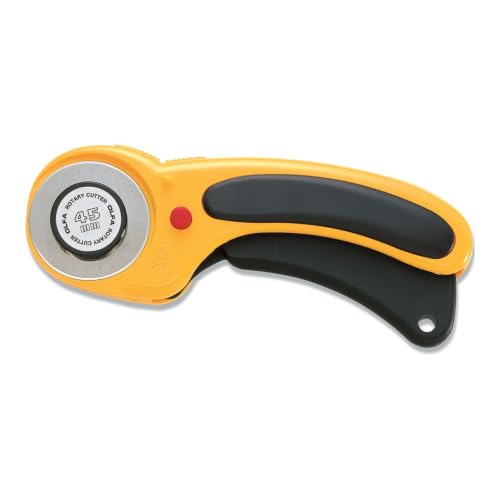
| OLFA 45mm Squeeze-Handle RTY-2/DX | High-volume cutting | Tungsten steel, squeeze trigger, auto-retract |
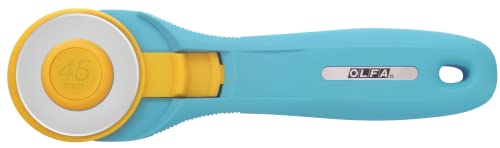
| OLFA 45mm Quick-Change RTY-2/C | Fast blade swaps | 45mm, tungsten blade, finger groove, quick change |
| OLFA 60mm Squeeze-Handle RTY-3/DX | Heavy-duty stacks | 60mm, tungsten steel, 12-layer, auto-retract |
| OLFA 28mm Quick-Change RTY-1/C | Curves and small pieces | 28mm, tungsten steel, finger groove |
How to Choose
Blade size: 28, 45 or 60 millimeters
Forty-five millimeters is the default for a reason: it cuts a handful of fabric layers in one pass and still turns gentle curves. A 60mm blade rolls farther per rotation and cuts thicker stacks, which suits quilters who prepare many layers at once, though it is less nimble on tight arcs. A 28mm blade excels at small pieces, appliqué shapes and tight curves. If you can own only one, start with 45mm. Many quilters eventually keep two sizes at hand, a 45mm for everyday strips and either a 28mm or 60mm for specialty jobs. That second cutter can be chosen after you learn which cuts are slowing you down.
Handle style and hand comfort
Stick handles resemble a traditional grip, loop handles let you wrap your fingers through for control, and squeeze handles release the blade only while you hold the trigger. Pick the one that feels natural when you hold it over a mat. People with joint discomfort often prefer loop or squeeze designs because the force comes from the arm rather than a tight pinch. Check whether the title mentions left and right hand use, which the Fiskars lilac and the pink 45mm models do. Try holding the cutter in a store if you can, or read the listing for handle shape, because a comfortable grip lets you keep a steady pressure along the ruler edge for long sessions.
Blade safety and replacement
Auto-retract and safety lock features, named in the OLFA squeeze models and the pink 45mm cutter, cover the blade when you let go, which protects fingers and your cutting mat when a cutter is left on a table. Replacement blades are a recurring cost, and a dull blade skips threads and drags fabric. Look for blades that are easy to find in 28mm, 45mm and 60mm sizes. Quick-change designs speed up swaps, but check the listing for the process. Keep spare blades in their cases, dispose of dull ones in a sealed container and never toss them loose into a bin where someone could be cut. A cutter that arrives with extra blades, like the pink 45mm model, gives you a head start.
Layers, materials and what to ignore
Layer claims, such as the 12-layer mention on the OLFA 60mm, are manufacturer guidance and depend on the fabric, the mat and the blade condition. Cut on a self-healing mat with a firm ruler, never freehand. Ignore decorative colors unless you like them; they do not change cutting performance. Budget cutters from unfamiliar brands may include extra blades, which is helpful, but quality and fit can vary, so confirm blade size and mounting on the listing. Handle any rotary blade as very sharp even when the cutter is retracted, and keep cutters away from children and pets as general care guidance.
The 7 Best Options
Fiskars 45mm Loop Rotary Cutter
This 45mm cutter has a premium steel blade, an ergonomic loop handle meant to improve control and is aimed at fabric, arts, crafts and sewing. It suits sewers who want steady control on straight and slightly curved cuts. A colored version is also sold in an Explore collection, described as accommodating both right and left hands.
- The loop handle offers good control over the cut line.
- A 45mm size covers most quilting and garment cutting.
- Trade-off: the exposed blade requires careful handling, since the title does not state auto-retract.
Skip it if you want a trigger-style safety release or a blade that retracts automatically. Households with young children may prefer a model with a safety lock or auto-retract for added protection when the cutter is set down.
Fiskars 45mm Stick Rotary Cutter
The stick design pairs a precision-ground steel blade with a straight handle and is described as cutting multiple layers. It fits crafters who like the classic pen-style grip and want a straightforward cutter for fabric, arts and crafts and sewing.
- A simple stick shape feels familiar to many users.
- Designed for cutting multiple layers.
- Trade-off: it gives less wrap-around control than a loop handle.
Skip it if you have wrist or hand fatigue, since a loop or squeeze handle may feel easier. It can also be a fine second cutter for craft projects, kept apart from the one used on fabric so each blade stays sharp for its task.
Fiskars 60mm Loop Titanium SoftGrip Cutter
A larger 60mm blade with a titanium finish, an ergonomic loop handle and a SoftGrip description, intended for thick materials. It suits quilters cutting batting, multiple fabric layers or heavier materials, where a bigger blade means fewer passes.
- The 60mm blade covers more ground per roll.
- The SoftGrip handle is designed for comfort.
- Trade-off: bigger blades are less precise on tight curves.
Skip it if your projects are mostly small pieces and curves. It is also worth checking the weight and hand span on the listing, because large cutters can feel awkward in smaller hands.
OLFA 45mm Ergonomic Squeeze-Handle Cutter (RTY-2/DX)
The OLFA RTY-2/DX uses endurance tungsten steel, a squeeze trigger and auto-retract. It is aimed at high-volume cutting, where repeated safe handling and a consistent feel make long sessions easier.
- Auto-retract covers the blade when released.
- The squeeze trigger gives deliberate control.
- Trade-off: the trigger mechanism needs some practice for new users.
Skip it if you prefer a lighter, simpler tool. The auto-retract feature suits shared sewing rooms, classrooms and anyone who sets a cutter down between cuts.
OLFA 45mm Quick-Change Cutter (RTY-2/C)
A tungsten blade, an integrated finger groove and an easy-slide blade cover for a quick-change experience, offered here in an aqua color. It suits sewers who swap blades often and want a compact, clean design.
- Quick-change helps keep blades fresh.
- The finger groove helps hold the cutter in position.
- Trade-off: the title does not mention auto-retract, so keep the blade cover handy.
Skip it if you want a trigger safety feature. The blade cover helps in storage, but it relies on you remembering to slide it back each time. The lighter body is a plus for people who want less hand fatigue.
OLFA 60mm Ergonomic Squeeze-Handle Cutter (RTY-3/DX)
The 60mm version of the squeeze-handle cutter is listed with tungsten steel, auto-retract and a 12-layer description for heavy-duty fabric work. It is for experienced quilters who need to cut thick stacks safely and repeatedly.
- The bigger blade handles thick stacks.
- The auto-retract feature adds safety.
- Trade-off: it is larger and heavier in the hand than the 45mm model.
Skip it if you mainly cut one or two layers, since the larger blade and handle add weight without adding benefit. Check blade size on the listing before ordering replacements, because 60mm blades are not interchangeable with 45mm ones.
OLFA 28mm Quick-Change Cutter (RTY-1/C)
A small 28mm tungsten steel cutter with an integrated finger groove and a quick-change blade cover. It excels at curves, small pattern pieces and detail work. Combined with a larger cutter, it covers the full range of pattern pieces without forcing a large blade through tight corners.
- The small blade handles tight curves.
- It is compact and light.
- Trade-off: it cuts fewer layers per pass.
Skip it if it will be your only cutter for large quilts, since long straight cuts take more passes with a small blade.
Which One Fits Your Situation
First cutter for general sewing
The Fiskars 45mm Loop is a balanced, easy-to-use choice. Pair it with a self-healing mat and a clear ruler, and keep a spare blade within reach.
Making large quilts
The OLFA 60mm Squeeze-Handle or the Fiskars 60mm Titanium handles thick stacks in fewer passes. Make sure the mat is large enough for the longer blade stroke, and test a few layers before cutting your final fabric.
Cutting small pieces and curves
The OLFA 28mm is the precise option for appliqué and detail work. Pair it with a larger cutter if you also make quilts.
Safety-conscious households
Parents and shared studios often want a blade that covers itself between cuts. The OLFA 45mm Squeeze-Handle with auto-retract suits homes with children. Store all cutters out of reach and replace blades with care.
Common Mistakes
- Cutting without a self-healing mat.
- Using a dull blade and pushing harder.
- Leaving the blade exposed after cutting.
- Choosing 60mm for small, curvy pieces.
- Ignoring how worn the cutting mat is, since deep grooves make the blade wander and shorten its life.
- Buying without checking replacement blade availability.
- Cutting toward your hand instead of keeping fingers behind the ruler edge.
Related guides
- Battery Powered Floodlight Camera With Local Storage
- Cordless Drill Brush Attachment For Bathroom Grout
- Rechargeable Emergency Lantern For Power Outages
Frequently Asked Questions
What size rotary cutter is best?
Forty-five millimeters suits most work. Pick 60mm for thick stacks and 28mm for curves. If you sew often, a 45mm paired with a second size is a common setup.
Are loop handles better than stick handles?
Many people find loop handles more controlled. Stick handles are lighter and familiar, while squeeze handles add a built-in safety step. It comes down to hand comfort, so choose the grip that lets you cut straight with the least strain.
How often should the blade be changed?
Replace it when it skips threads or drags. Heavier use means more frequent swaps, and cutting dense or fuzzy fabric dulls a blade sooner.
Can a rotary cutter cut paper?
Some craft cutters can, but paper dulls blades faster. Many sewers keep a dedicated craft cutter so the fabric blade stays crisp for clean edges. Keep a separate blade for paper, and check the listing to see whether the manufacturer approves of cutting anything other than fabric.
More from Amazon
Programs that pair well with the guide above. Offers and eligibility are set by Amazon and may change.
A free business account with business pricing and bulk-buying tools for work, shop or home office.
Create a business accountFree shipping on eligible items, Prime Video and more. Eligible new members can start with a free trial.
Start a Prime free trialAudiobooks and podcasts to listen to on the go. Eligible new members can start with a free trial.
Try Audible freeAd-free music streaming. Eligible new subscribers can start with a free trial.
Try Music Unlimited freeAs an Amazon Associate we earn from qualifying purchases.