Key takeaways
- Verify the spectrum claim: True full spectrum means near, mid, and far infrared, usually via a hybrid of carbon far-IR panels plus a near-IR emitter. If a listing only cites far infrared plus red light LEDs at 660nm and 850nm, that’s a far-IR cabin with photobiomodulation bolted on — still useful, just not the same thing. Read the panel breakdown, not the headline.
- Match the draw to your circuit: A 1290W cabin on 120V pulls roughly 11 amps and lives happily on a dedicated 15-amp line. Anything approaching 1990W needs a 20-amp circuit with nothing else on it. Check your breaker panel before you check out, and never run one of these off an extension cord or power strip.
- Measure the footprint and the doorway: A 31.5″ wide single-person unit slots into a closet alcove; a 73″ outdoor four-person cabin needs a level pad and clear approach. Crates arrive heavy and oversized, so map your route from the curb to the final spot, including stair turns and door frames.
- Look at panel placement, not panel count: Seven heating panels sounds better than five, but what matters is coverage at your calves, lumbar spine, and shoulders. A dedicated floor or foot warmer makes a bigger difference to comfort than an extra ceiling emitter, because feet are the last thing to heat up.
- Confirm low EMF and check the wood: Reputable makers publish EMF readings at the bench. For the shell, kiln-dried Canadian hemlock is the sweet spot — dimensionally stable, low resin, no odor when hot. Inspect boards for cupping before assembly and reject anything that won’t sit flat.
What's inside
Shopping for a full spectrum infrared sauna feels like walking into a spec sheet arms race. Every listing shouts wattage numbers, wood species, and wavelength figures, but almost none of them tell you what actually matters once the crate lands in your garage: whether the panels are carbon, ceramic, or a hybrid, whether your existing outlet can carry the load, and whether the tongue-and-groove joinery will still be tight after two winters of expansion and contraction. Add the fact that “full spectrum” gets stamped on cabins that only run far infrared, and the whole category turns murky fast.
This guide sorts it out from a builder’s perspective. I’ve assembled these cabins, checked panel placement against where your body actually sits, and paid attention to the unglamorous details — cord gauge, latch alignment, bench support, how the roof panel seats. Below you’ll find the models worth your money in 2026, a checklist for matching a cabin to your space and circuit, and straight answers to the questions that come up during assembly.
As an Amazon Associate we earn from qualifying purchases.



How to Choose a/an Full Spectrum Infrared Sauna (2026)
- Verify the spectrum claim: True full spectrum means near, mid, and far infrared, usually via a hybrid of carbon far-IR panels plus a near-IR emitter. If a listing only cites far infrared plus red light LEDs at 660nm and 850nm, that’s a far-IR cabin with photobiomodulation bolted on — still useful, just not the same thing. Read the panel breakdown, not the headline.
- Match the draw to your circuit: A 1290W cabin on 120V pulls roughly 11 amps and lives happily on a dedicated 15-amp line. Anything approaching 1990W needs a 20-amp circuit with nothing else on it. Check your breaker panel before you check out, and never run one of these off an extension cord or power strip.
- Measure the footprint and the doorway: A 31.5″ wide single-person unit slots into a closet alcove; a 73″ outdoor four-person cabin needs a level pad and clear approach. Crates arrive heavy and oversized, so map your route from the curb to the final spot, including stair turns and door frames.
- Look at panel placement, not panel count: Seven heating panels sounds better than five, but what matters is coverage at your calves, lumbar spine, and shoulders. A dedicated floor or foot warmer makes a bigger difference to comfort than an extra ceiling emitter, because feet are the last thing to heat up.
- Confirm low EMF and check the wood: Reputable makers publish EMF readings at the bench. For the shell, kiln-dried Canadian hemlock is the sweet spot — dimensionally stable, low resin, no odor when hot. Inspect boards for cupping before assembly and reject anything that won’t sit flat.
The Best Full Spectrum Infrared Sauna (2026)s Reviewed
Full Spectrum 1-Person Sauna with Red Light Therapy
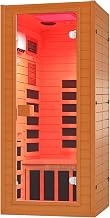
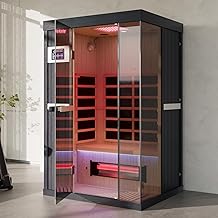
A tidy single-occupant cabin with seven panels, a foot warmer, and 660nm/850nm red light on a 1290W draw that stays within a standard 15-amp circuit. Assembly is genuinely straightforward — buckle clips and a drop-in roof — making it the pick for anyone working solo in a spare room.
springspa Full Spectrum 1-Person Sauna
At 31.5″ wide and 67″ tall, this is one of the few cabins that honestly fits an apartment corner or garage bay without a remodel. Heat-up is quick for the wattage, and the Bluetooth speakers are wired into the frame rather than hanging loose, which is a small detail that says something about the build.
DYNAMIC SAUNAS Cordoba 2-Person
The Cordoba is the most polished cabinetry in this group — clean reveals, well-cut hemlock, and a bench that doesn’t flex under two adults. Worth the step up if you want a unit that reads as furniture in a finished basement or home gym.
LTCCDSS Full Spectrum Outdoor Sauna, 4 Person
Built for outdoor duty with low-EMF heaters, chromotherapy lighting, and enough bench length to actually lie down. Plan for a level, well-drained pad and treat the exterior seams on schedule, and this becomes the backyard centerpiece of the roundup.
2-Person Full Spectrum Sauna, 1990W
The 12″ × 12″ red light array is the largest here, and 1990W means it climbs to temperature noticeably faster than the 1290W cabins. Non-negotiable requirement: a dedicated 20-amp circuit, so budget for an electrician if you don’t have one nearby.
Frequently Asked Questions
Do I need a dedicated electrical circuit?
Yes, for anything above about 1200W. A 1290W unit is fine on its own 15-amp line; 1990W models require a dedicated 20-amp circuit. Sharing with a fridge or a treadmill will trip breakers and stress the wiring.
How long does assembly take?
Two to three hours with a helper for a one- or two-person cabin. Most use interlocking panels with buckle latches, so no framing carpentry is involved. The outdoor four-person builds run half a day and genuinely need two people for the wall panels.
Is red light therapy the same as near infrared?
No. Red light at 660nm is visible and works at the skin surface; 850nm near infrared penetrates deeper. Both are separate from the far infrared that produces the radiant heat you feel, which is why a cabin can offer red light without qualifying as full spectrum.
Can I put an infrared sauna on carpet?
It’ll work, but a rigid, level base is better. Carpet lets the frame settle unevenly, which throws off door alignment over time. A sheet of plywood or a rubber gym mat underneath solves it cheaply.
Final Thoughts
For most home installs, the springspa 1-person cabin is the easiest win — compact enough for a real apartment, and it runs on a circuit you already have. Step up to the DYNAMIC SAUNAS Cordoba if you want two-person space with cabinetry finish worth showing off, or go with the LTCCDSS 4-person outdoor cabin when you have the yard space and want the group-sized build.