Key takeaways
- Wet-rated vs. damp-rated: Wet-rated (or IP65) fans tolerate direct rain and hose spray, which is what you need under an open pergola, a canopy, or a shallow eave. Damp-rated is fine for a fully covered, walled-in porch. Mixing these up is the single most common cause of premature failure.
- Check the box before you buy the fan: The outlet box must be listed for ceiling fan support and fastened to framing — a pancake box screwed into drywall or a plastic lighting box won’t do. If there’s no access from above, an expanding brace bar between joists is the fix. Plug-in caged models sidestep this entirely with a hook and an existing GFCI outlet.
- Span and drop: Match blade span to the space: roughly 20 to 30 inches for a seating nook or gazebo corner, 44 to 52 inches for a typical porch, and 60 inches or more for a deep covered patio or outdoor kitchen. Keep blades at least seven feet off the deck and about 18 inches from walls, and use a downrod on any sloped or vaulted ceiling.
- DC motors are worth the premium outdoors: They draw significantly less power, run noticeably quieter, and give you six or more speeds instead of three, so you can dial in a whisper of air on a still evening rather than choosing between “off” and “wind tunnel.”
- Hardware and finish: Look for stainless or coated fasteners, sealed motor housings, and ABS or all-weather composite blades rather than wood veneer. Near salt air, plan on a rinse and inspection each spring regardless of finish.
What's inside
Anyone who has hung a fan on a covered patio knows the failure pattern: it looks great in June, and by the following spring the blades have curled like potato chips, the motor hums, and there’s a rust streak running down the canopy. Outdoor fans live in a punishing environment of humidity swings, wind-driven rain, pollen, and UV, and most of the units sold as “outdoor” are only rated for damp locations — meaning shelter from direct water. Add the electrical side of it, where a standard ceiling box isn’t rated to carry a swinging 25-pound load, and a weekend project turns into a callback.
This guide approaches outdoor fans the way you’d approach any install you plan to do yourself: what the ratings actually mean, what the ceiling above your head can support, and which fans earn their keep in real conditions. Below are six models spanning plug-in caged units for pergolas and canopies to hardwired 65-inch wet-rated workhorses for tall covered porches, with notes on where each one fits.
As an Amazon Associate we earn from qualifying purchases.


How to Choose an Outdoor Ceiling Fan (2026)
- Wet-rated vs. damp-rated: Wet-rated (or IP65) fans tolerate direct rain and hose spray, which is what you need under an open pergola, a canopy, or a shallow eave. Damp-rated is fine for a fully covered, walled-in porch. Mixing these up is the single most common cause of premature failure.
- Check the box before you buy the fan: The outlet box must be listed for ceiling fan support and fastened to framing — a pancake box screwed into drywall or a plastic lighting box won’t do. If there’s no access from above, an expanding brace bar between joists is the fix. Plug-in caged models sidestep this entirely with a hook and an existing GFCI outlet.
- Span and drop: Match blade span to the space: roughly 20 to 30 inches for a seating nook or gazebo corner, 44 to 52 inches for a typical porch, and 60 inches or more for a deep covered patio or outdoor kitchen. Keep blades at least seven feet off the deck and about 18 inches from walls, and use a downrod on any sloped or vaulted ceiling.
- DC motors are worth the premium outdoors: They draw significantly less power, run noticeably quieter, and give you six or more speeds instead of three, so you can dial in a whisper of air on a still evening rather than choosing between “off” and “wind tunnel.”
- Hardware and finish: Look for stainless or coated fasteners, sealed motor housings, and ABS or all-weather composite blades rather than wood veneer. Near salt air, plan on a rinse and inspection each spring regardless of finish.
The Best Outdoor Ceiling Fans (2026) Reviewed
addlon 20″ Caged Plug-In Patio Fan
The simplest install on this list: hang it on the included hook, plug it in, and you’re moving air in under ten minutes with no wiring at all. IP65 protection, a reversible DC motor with six speeds, remote and timer, plus an integrated light make it a genuinely tidy solution for gazebos, pergolas, and screened corners where running cable isn’t practical.
Minka-Aire Xtreme H2O 65″
This is the one to spec when the space is large and genuinely exposed — a true wet-rated fan with a DC motor, deep 65-inch span, and blade geometry that moves serious air at low RPM. Available in Coal and Oil Rubbed Bronze, both finishes hold up well under UV, and the low-speed setting is quiet enough to sit under while you talk.
Hunter Cassius 44″ Matte Black
A no-nonsense pull-chain fan with three blades, no light kit, and nothing extra to fail, which is exactly what you want over a garage bench or a shaded porch. The 44-inch span suits standard-depth covered areas, and the matte black finish disappears against a dark ceiling.
52″ IP65 Wet-Rated Farmhouse Fan
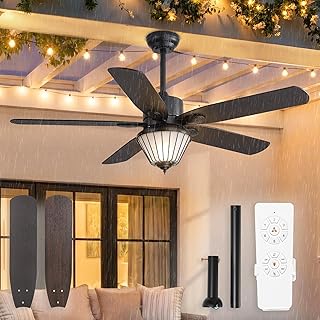
Dual-finish blades give it a warm, farmhouse-leaning look without wood’s tendency to warp, and the IP65 rating plus reversible DC motor means it can handle blowing rain and year-round use. The 52-inch span and integrated light make it a strong single-fan answer for most covered patios.
Orison 24″ Smart Caged Gazebo Fan
The smart option in the caged category: app and remote control, three selectable color temperatures, and dimming, all on a plug-in hook mount. Good pick for a pergola or canopy where you want lighting and fan control from your phone without touching a wire.
Frequently Asked Questions
Can I install an indoor fan on a covered porch?
Not advisably. Indoor fans use unsealed motors and non-treated blades, and humidity alone will cause warping, bearing noise, and corrosion within a season or two. It also voids most warranties.
Do plug-in caged fans need a special outlet?
They need a GFCI-protected outlet, which outdoor receptacles are already required to have. Verify yours trips and resets, and avoid running an indoor extension cord to reach it.
How do I stop an outdoor fan from wobbling?
Confirm the mounting bracket is tight to a solid box, check that all blade screws are seated, then swap two blades to isolate a warped one. A balancing kit corrects the small residual wobble.
Should I use a downrod?
Yes on any ceiling over about nine feet or on a slope. A six- to twelve-inch rod on a standard porch improves airflow and keeps the motor housing off a beadboard ceiling.
Final Thoughts
For a large, exposed patio where the fan will take real weather, the Minka-Aire Xtreme H2O 65″ is the durable choice. The 52″ IP65 wet-rated model covers most standard covered porches with a nicer look and a light, and if you can’t run wire, the addlon 20″ caged fan gets you cooled off with nothing more than a hook and a GFCI outlet.