Key takeaways
- Frame gauge over frame material: Nearly everything in this category is aluminum, so the real question is wall thickness and whether the posts carry internal steel reinforcement. Heavier extrusions resist post twist under wind load and keep the louver track parallel, which is what makes the crank stay smooth long-term.
- Drainage routing: Look for louvers that channel water into the perimeter beam and down through the posts rather than dumping it off the edge. Integrated systems keep your seating area dry and stop the staining that shows up under open-drain designs after one rainy season.
- Louver actuation: Hand-crank mechanisms are simple to service and don’t need a power run, but check whether the linkage is metal or plastic-bushed at the pivot points. Metal-on-metal pivots with grease fittings outlast nylon inserts by a wide margin.
- Anchoring plan before purchase: Concrete, paver, deck, and bare soil each need different hardware, and most kits ship with concrete anchors only. Confirm your footing type and budget for the correct fasteners — a pergola is a sail, and the anchors are the whole safety story.
- Sidewall options: Curtains and bug mesh transform a shade structure into a usable three-season room. If you want them, buying a kit with factory tracks beats retrofitting, since aftermarket rods rarely line up with the beam profile.
What's inside
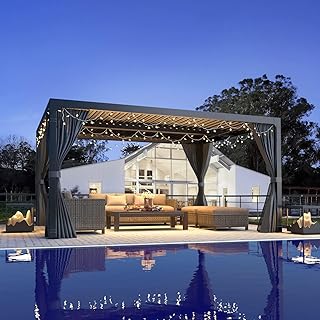
Standing in the middle of a bare patio slab with a tape measure in one hand and a browser full of tabs in the other is where most louvered pergola projects stall. The listings all look the same from ten feet away: powder-coated aluminum, adjustable slats, a crank handle somewhere on the frame. What separates a pergola that still tracks smoothly in its fourth summer from one that binds up after a single freeze-thaw cycle comes down to details buyers rarely see in photos — how the louver blades are pinned, whether the posts are hollow tube or reinforced, and where the water actually goes when it leaves the roof.
I’ve spent enough weekends leveling posts and chasing out-of-square corners to know which specs matter and which are marketing. This guide walks through the current crop of 10×12 and 10×13 louvered pergolas, what to check before you order, and how each of the top models holds up once it’s bolted down and living outdoors full time.
As an Amazon Associate we earn from qualifying purchases.



How to Choose a Louvered Pergola (2026)
- Frame gauge over frame material: Nearly everything in this category is aluminum, so the real question is wall thickness and whether the posts carry internal steel reinforcement. Heavier extrusions resist post twist under wind load and keep the louver track parallel, which is what makes the crank stay smooth long-term.
- Drainage routing: Look for louvers that channel water into the perimeter beam and down through the posts rather than dumping it off the edge. Integrated systems keep your seating area dry and stop the staining that shows up under open-drain designs after one rainy season.
- Louver actuation: Hand-crank mechanisms are simple to service and don’t need a power run, but check whether the linkage is metal or plastic-bushed at the pivot points. Metal-on-metal pivots with grease fittings outlast nylon inserts by a wide margin.
- Anchoring plan before purchase: Concrete, paver, deck, and bare soil each need different hardware, and most kits ship with concrete anchors only. Confirm your footing type and budget for the correct fasteners — a pergola is a sail, and the anchors are the whole safety story.
- Sidewall options: Curtains and bug mesh transform a shade structure into a usable three-season room. If you want them, buying a kit with factory tracks beats retrofitting, since aftermarket rods rarely line up with the beam profile.
The Best Louvered Pergola (2026)s Reviewed
Aoxun Louvered Pergola 10×12
A clean, no-frills build in black-gray that gets the fundamentals right, particularly the internal drainage that runs water down through the posts instead of off the roof edge. Assembly is straightforward for two people over a weekend, and the louver crank has a satisfying, low-effort throw once the frame is properly squared.
MELLCOM 10×12 Louvered Pergola with Curtains & Mesh
The most complete package here — you get the rustproof frame, hidden drainage, waterproof curtains, and bug netting in one box, with tracks already integrated into the beams. It’s the pick if you want a genuine outdoor room rather than just overhead shade, and the curtain hardware is noticeably better than anything you’d bolt on later.
MIRADOR 80S Louvered Pergola 10′ x 12′
Charcoal finish and tighter tolerances give this one the most finished look of the group, closer to a custom install than a flat-pack kit. Installation is genuinely easier than average thanks to well-labeled hardware and pre-drilled beam connections that actually align.
10′ x 13′ Aluminum Louvered Pergola, Deep Grey
The extra foot of depth makes a real difference over a dining table or grill station, and the rainproof hardtop canopy seals up tight when the louvers are fully closed. Worth the slightly longer build time if your patio can take the footprint.
Airwire 10×12 FT Louvered Pergola with Curtains & Netting
A strong value play that includes curtains and netting without a big price jump over bare-bones models. The gray finish is understated and the adjustable roof tracks well, though I’d add a bead of exterior sealant at the post-to-beam joints for extra insurance.
Frequently Asked Questions
Can I install a louvered pergola by myself?
Technically yes, realistically no. The beams are long and awkward, and lifting a roof frame onto four posts solo invites a bent extrusion or worse. Plan on two people and about six to ten hours.
Do these need to be anchored into concrete?
They need to be anchored into something structural. Concrete is easiest, but deck-mount brackets into joists or poured footings both work. Never rely on weight alone.
How do the louvers handle snow?
Open them. Closed louvers hold snow load; open blades let it fall through. Most manufacturers specify opening the roof before any significant snowfall.
Will the crank mechanism need maintenance?
A shot of dry silicone lubricant on the pivots once or twice a year keeps things smooth. Also rinse grit out of the louver channels after dusty stretches.
Final Thoughts
For most patios, the MELLCOM 10×12 is the best overall buy — the included curtains and mesh turn it into a space you’ll actually use in bug season, and the drainage is well executed. If you want the cleanest architectural look with the least assembly frustration, the MIRADOR 80S is worth the premium, while the Aoxun 10×12 remains the sensible choice for anyone who just wants solid adjustable shade without the extras.