Key takeaways
- Footprint plus working room: Measure the cabin’s exterior width, then add roughly 8 inches on the hinge side for door clearance and 3 inches at the back for the vent and cord. A 35-inch cabin genuinely needs about 45 inches of wall.
- Circuit capacity: Anything at 1200W or higher will pull close to 11 amps continuously. That’s fine on a 15-amp circuit with nothing else on it, and a problem on a bedroom circuit shared with a TV and a lamp. Check your panel labels first.
- Heater placement, not just count: Seven small panels arranged around your calves, back, and sides beat two large rear panels every time. Look for photos of the interior — you want emitters below the bench, not only behind your shoulders.
- Joinery and panel thickness: Tongue-and-groove hemlock with steel buckle clips assembles solidly and stays tight. Thin veneered ply held together with corner brackets tends to develop gaps at the roof seam after a few heat cycles.
- Which extras earn their keep: Digital temperature control and a tempered glass door genuinely improve daily use. Bluetooth speakers, color therapy lights, and ionizers are pleasant but shouldn’t decide the purchase.
What's inside
Shopping for an indoor infrared sauna is a strange experience: pull up six listings and you’ll see nearly identical hemlock boxes, the same stock photos of a towel draped over a bench, and spec sheets that shout wattage figures without explaining what any of it means for your house. What the listings almost never tell you is the stuff that actually decides whether you love the thing or resent it — whether the panels clip together square on an uneven floor, whether the door swing clears your baseboard, and whether the outlet you were planning to use is already shared with a space heater.
I put this guide together from a builder’s perspective rather than a wellness one. Below you’ll find current picks across the useful range — true one-person cabins, a fold-flat box for renters, and a couple of hemlock builds worth the extra assembly time — plus the measurements and electrical checks to run before a 150-pound pallet lands in your driveway.
As an Amazon Associate we earn from qualifying purchases.


How to Choose a/an Indoor Infrared Sauna (2026)
- Footprint plus working room: Measure the cabin’s exterior width, then add roughly 8 inches on the hinge side for door clearance and 3 inches at the back for the vent and cord. A 35-inch cabin genuinely needs about 45 inches of wall.
- Circuit capacity: Anything at 1200W or higher will pull close to 11 amps continuously. That’s fine on a 15-amp circuit with nothing else on it, and a problem on a bedroom circuit shared with a TV and a lamp. Check your panel labels first.
- Heater placement, not just count: Seven small panels arranged around your calves, back, and sides beat two large rear panels every time. Look for photos of the interior — you want emitters below the bench, not only behind your shoulders.
- Joinery and panel thickness: Tongue-and-groove hemlock with steel buckle clips assembles solidly and stays tight. Thin veneered ply held together with corner brackets tends to develop gaps at the roof seam after a few heat cycles.
- Which extras earn their keep: Digital temperature control and a tempered glass door genuinely improve daily use. Bluetooth speakers, color therapy lights, and ionizers are pleasant but shouldn’t decide the purchase.
The Best Indoor Infrared Sauna (2026)s Reviewed
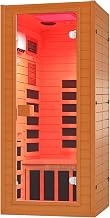
1-Person Far Infrared Home Sauna, 7 Low-EMF Carbon Heaters
The seven-heater layout is the standout here — coverage reaches your lower legs and flanks instead of just your back, which is what makes a single-person cabin feel genuinely warm rather than merely hot in patches. Assembly is straightforward clip-and-drop work, and the compact profile suits a spare room or wide closet alcove.
35.2″ Single Person Sauna Room, 1200W Hemlock
A well-proportioned hemlock cabin with a real 25–60°C adjustable range, which matters if you prefer longer sessions at lower temperatures. At 1200W it heats quickly, so give it a circuit of its own and confirm your 35-inch wall opening before ordering.
Far Infrared Sauna Box with Red Light Therapy
The pragmatic pick for renters and small apartments: a full-size 5.9 x 2.9 ft carbon-crystal box with nine heat levels that collapses and stores against a wall. You trade the enclosed cabin feel and bench comfort for zero assembly and zero permanent footprint.
Canadian Hemlock 800W Sauna with Tempered Glass Door
At 800W this is the gentlest on your wiring, and the tempered glass door plus circulation vents make it the most livable of the group for anyone who dislikes tight spaces. Reading lights and a proper control panel round out a genuinely easy build — expect about an hour with a second set of hands.
Canadian Hemlock Cabin with Digital Temperature Control
Purpose-built for apartments, small bedrooms, and offices, this one plugs into a standard outlet and keeps the feature list disciplined. Solid choice if you want hemlock construction and precise temperature control without paying for speakers and light shows.
Frequently Asked Questions
Do I need an electrician?
Usually no. Most of these units run on standard 110V household power. But if the cabin draws 1200W or more, run it on a circuit with nothing else drawing load, and skip extension cords and power strips entirely — plug directly into the wall.
How long does assembly actually take?
Plan on 45 to 90 minutes for a clip-together hemlock cabin with two people, and closer to two hours solo. Unbox in the room where it will live; carrying assembled panels through doorways is the part people underestimate.
Can I set one on carpet or upstairs?
Carpet is fine, though a thin plywood or rubber mat underneath keeps the base level and protects the fibers. Upstairs is generally fine too — a loaded one-person cabin sits in the same weight range as a filled bookshelf.
Is red light therapy worth seeking out?
It’s a separate function from infrared heat, not an upgrade to it. Units like the 1350W five-plate cabin with a red light panel bundle both, which is convenient, but choose your sauna on heat coverage and build first.
Final Thoughts
For most homes, the 7-heater 1-person cabin gives you the best warmth distribution for the space it occupies, while the 800W Canadian hemlock model with the tempered glass door is the easiest build and the friendliest to older wiring. If you’re renting or short on floor space, the collapsible infrared sauna box with red light therapy is the sensible compromise — no assembly, no permanent footprint, and it tucks away between sessions.