Key takeaways
- Weight rating and base material: Treat the stated capacity as a ceiling, not a target. Look for a five-star nylon or steel base with wide-set casters, and check that the gas cylinder is Class 3 or 4 — that’s the single most common failure point on heavy-duty chairs, and the cheapest one to upgrade later.
- Massage type — vibration vs. kneading: Six-point vibration is broad, gentle, and good for keeping circulation moving during long sessions. 3D kneading nodes work deeper into the lumbar tissue and feel closer to a real massage, but they’re mechanically more complex and add cost. Pick based on whether you want maintenance or relief.
- Seat width and foam depth: Measure your current chair between the armrests before shopping. Anything under 20 inches gets tight fast for larger frames; 22 inches gives you room to shift. Thicker high-density foam resists the pancake effect that ruins cheap seats within months.
- Recline mechanism and footrest integration: A locking recline that holds at multiple angles beats a free-rocking tilt for actual napping or reading. If there’s a retractable footrest, check how it stows — the flimsy ones sag and rattle once the plastic guides wear.
- Upholstery and heat compatibility: Bonded and PU leather clean up easily and handle heating elements without discoloring, but they breathe poorly in warm rooms. If your office runs hot, plan on a breathable cover, or accept that you’ll use the heat function seasonally.
What's inside
Anyone who has spent a Saturday rebuilding a chair base or shimming a wobbly caster knows the truth about office seating: most of it is built to a price, not to a body. You sit down at 8 a.m. feeling fine, and by mid-afternoon your lower back is doing that dull, pulsing complaint that no amount of stretching quite fixes. Massage office chairs promise relief, but the category is a minefield — vibration motors that buzz like a cheap phone, heat pads that quit after a season, and “big and tall” claims that fall apart the moment a 300-pound frame leans back.
I’ve taken enough chairs apart to know where the money actually goes: the gas lift class, the thickness of the seat foam before it compresses, the gauge of the steel in the base, and whether the massage nodes sit under a properly padded panel or press straight into your spine. This guide covers the models worth your bench time in 2026, what to inspect before you commit, and how to get the most out of the features you’re paying for.
As an Amazon Associate we earn from qualifying purchases.




How to Choose a Massage Office Chair (2026)
- Weight rating and base material: Treat the stated capacity as a ceiling, not a target. Look for a five-star nylon or steel base with wide-set casters, and check that the gas cylinder is Class 3 or 4 — that’s the single most common failure point on heavy-duty chairs, and the cheapest one to upgrade later.
- Massage type — vibration vs. kneading: Six-point vibration is broad, gentle, and good for keeping circulation moving during long sessions. 3D kneading nodes work deeper into the lumbar tissue and feel closer to a real massage, but they’re mechanically more complex and add cost. Pick based on whether you want maintenance or relief.
- Seat width and foam depth: Measure your current chair between the armrests before shopping. Anything under 20 inches gets tight fast for larger frames; 22 inches gives you room to shift. Thicker high-density foam resists the pancake effect that ruins cheap seats within months.
- Recline mechanism and footrest integration: A locking recline that holds at multiple angles beats a free-rocking tilt for actual napping or reading. If there’s a retractable footrest, check how it stows — the flimsy ones sag and rattle once the plastic guides wear.
- Upholstery and heat compatibility: Bonded and PU leather clean up easily and handle heating elements without discoloring, but they breathe poorly in warm rooms. If your office runs hot, plan on a breathable cover, or accept that you’ll use the heat function seasonally.
The Best Massage Office Chairs (2026) Reviewed
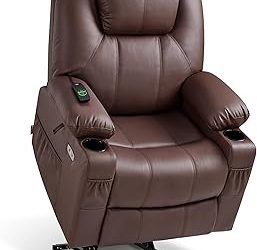
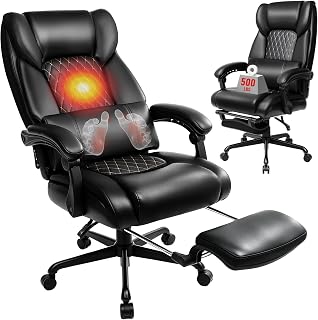
Massage Office Chair with Foot Rest, 6-Point Vibration & Heat, 500 lbs
This is the one I’d hand to someone who needs genuine heavy-duty capacity without overthinking it — the 500-pound rating comes with a frame and base that actually justify it. The dual-use pillow is smarter than it sounds, working as either lumbar support or a headrest depending on how you’ve set the recline.
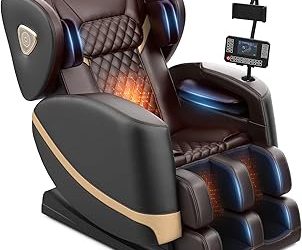
3D Kneading Massage Office Chair with Heat, 500 lbs
The step up from vibration to real kneading nodes changes the experience entirely; this feels like a massage rather than a buzz. The trade-off is a bulkier backrest and more moving parts, so give it clearance behind the chair and keep the mechanism free of debris.
Sharper Image S600 Active Lumbar Executive Massage Chair
The active lumbar system here is the standout — it works with your posture instead of just pressing against it, which makes a real difference over an eight-hour stretch. Bonded leather in white/gray keeps it looking like office furniture rather than gaming gear, though it needs more regular wiping than darker upholstery.
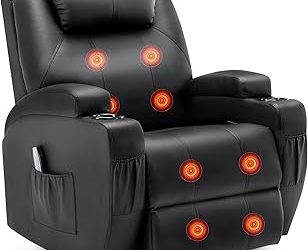
500 lbs Reclining 6-Point Massage Desk Chair, Wider Seat
The widened, thicker seat cushion is the reason to pick this one; it distributes weight better than the standard pan and holds its shape far longer. PU leather over that foam is a durable combination, and the assembly is straightforward enough for one person with a hex key.
22.05″ Wide Massage Office Chair with Foot Rest
That extra seat width is genuinely usable space, not marketing math, and it makes shifting position through the day much easier for broader builds. Six-point vibration and heat cover the basics reliably without the complexity of a kneading mechanism.
Frequently Asked Questions
Do massage office chairs actually help back pain?
They help with stiffness and circulation, which is where most desk-related discomfort starts. They won’t correct an underlying structural issue — for that, see a professional. Think of the massage function as a supplement to good posture and regular movement, not a replacement.
How long do the massage motors typically last?
Vibration motors in this price bracket generally give two to four years of regular use. Running them in shorter bursts of 15 to 20 minutes rather than continuously extends that meaningfully, since heat buildup is what kills them.
Is assembly something I can handle alone?
Yes, on most models — expect 30 to 60 minutes with the included tools. The one step worth a second pair of hands is mating the backrest to the seat, since heavy-duty backrests are awkward to hold square while you thread bolts.
Can I replace the gas cylinder if it fails?
Usually, yes. Standard Class 3 and 4 cylinders are widely available and swap out with a pipe wrench and some patience. Measure your existing stroke length and taper before ordering a replacement.
Final Thoughts
For most buyers, the 500 lbs 6-Point Vibration & Heat chair with the dual-use pillow is the practical pick — solid capacity, versatile support, no fragile extras. If you want massage that genuinely works the muscle rather than just vibrating against it, spend up for the 3D Kneading model. And if the chair needs to look at home in a professional space, the Sharper Image S600 and its active lumbar system is the one I’d choose.