Key takeaways
- Real temperature control vs. heat levels: An LCD panel that lets you set 135°F and hold it beats a nine-position dial every time. Level-based controllers on tents and boxes are fine, but you’ll be guessing — bring a probe thermometer and map the levels yourself during the first few sessions.
- Preheat time: Wooden cabins with ceramic or carbon panels typically need 15 to 25 minutes to reach 130°F. Fabric tents hit temperature in under ten because there’s almost no thermal mass to warm. If you’re squeezing sessions into a morning routine, that difference matters more than peak temp.
- EMF ratings and panel placement: Low-EMF heaters keep field exposure down where your back actually contacts the wall. Check that panels sit behind the calves and lower back, not just at shoulder height — leg coverage is what makes a lower temperature feel effective.
- Wiring reality: A 1200W unit on 110V pulls around 11 amps. That’s a dedicated circuit in practice, not a shared bedroom outlet with a space heater on the same run. Verify before you buy, not after the breaker trips mid-session.
- Red light wavelengths: If a unit advertises red light therapy, look for 660nm and 850nm specifically. Generic “red LEDs” are mood lighting. The dual-wavelength setups deliver something measurable alongside the heat.
What's inside
Ask five sauna owners what temperature they run and you’ll get five different answers, most of them wrong for the wrong reasons. Infrared saunas don’t work like the Finnish rock stoves people picture — they heat your body directly instead of roasting the air around you, which means the number on the panel means something completely different. Crank a far-infrared cabin to 190°F and you’ll mostly get a sweaty scalp and a burnt-out heater, because the panels never had a chance to warm your core before the thermostat cut out. The sweet spot for most bodies sits between 120°F and 150°F, held for 25 to 45 minutes, and that gap between what buyers expect and what the technology actually delivers is where most disappointment lives.
This guide comes from someone who has assembled hemlock panel kits on a garage floor, rewired a tent controller after a shipping crush, and logged core temps with a cheap probe thermometer just to see what these units really do. Below you’ll find the units worth your money in 2026, sorted by how they handle heat — how fast they climb, how steady they hold, and whether the controller lets you dial in a temperature or just a vague “level.” Then a breakdown of what to look for, honest notes on each pick, and answers to the questions that come up after the box is open.
As an Amazon Associate we earn from qualifying purchases.


How to Choose a Temp For Infrared Sauna (2026)
- Real temperature control vs. heat levels: An LCD panel that lets you set 135°F and hold it beats a nine-position dial every time. Level-based controllers on tents and boxes are fine, but you’ll be guessing — bring a probe thermometer and map the levels yourself during the first few sessions.
- Preheat time: Wooden cabins with ceramic or carbon panels typically need 15 to 25 minutes to reach 130°F. Fabric tents hit temperature in under ten because there’s almost no thermal mass to warm. If you’re squeezing sessions into a morning routine, that difference matters more than peak temp.
- EMF ratings and panel placement: Low-EMF heaters keep field exposure down where your back actually contacts the wall. Check that panels sit behind the calves and lower back, not just at shoulder height — leg coverage is what makes a lower temperature feel effective.
- Wiring reality: A 1200W unit on 110V pulls around 11 amps. That’s a dedicated circuit in practice, not a shared bedroom outlet with a space heater on the same run. Verify before you buy, not after the breaker trips mid-session.
- Red light wavelengths: If a unit advertises red light therapy, look for 660nm and 850nm specifically. Generic “red LEDs” are mood lighting. The dual-wavelength setups deliver something measurable alongside the heat.
The Best Temp For Infrared Sauna (2026)s Reviewed
Homsido 1-Person Hemlock Indoor Sauna
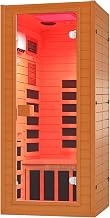
The LCD control panel with time and temp presets is the reason this one earns a spot — you can lock in 140°F and trust it, which most cabins in this price bracket won’t do. Ten-minute prewarm on 1200W low-EMF panels means it’s genuinely usable on a weekday, and the hemlock joints on my unit lined up without any shim work.
2-3 Person Ceramic Corner Sauna
Ceramic heaters run hotter at the surface than carbon, so this corner unit climbs fast and holds 150°F comfortably even with two people inside pulling heat away. The corner footprint is smart use of a spare room, and the Bluetooth speakers are better than the spec sheet suggests.
1-2 Person Infrared Sauna with 7-Color Therapy
At 40″ x 36″ x 73″ this is the honest compromise: enough bench for one adult to stretch out or two to sit upright, with red light therapy and radio built in. Temperature holds steady in the 125–140°F range, which is exactly where most people should be sitting anyway.
Infrared Sauna Tent with 3L Steamer
Nine heat levels plus a 99-minute timer and remote, wrapped in five-layer insulated fabric that actually retains heat instead of bleeding it into the room. The folding chair is functional rather than luxurious, but for renters or anyone short on floor space this is the most flexible heat you can buy.
Infrared Sauna Box with 660nm & 850nm Red Light
The dual-wavelength lamp is the differentiator here — genuine therapeutic wavelengths rather than decorative glow, paired with a 1200W steamer that pushes the box past dry-heat-only limits. Fold-down storage is a real advantage if the sauna has to live in a closet between uses.
Frequently Asked Questions
What temperature should I actually set?
Start at 120°F for your first week, then work up to 130–150°F as you acclimate. Session length matters more than peak temperature — 35 minutes at 130°F does more than 15 minutes at 160°F, and it’s far easier on your cardiovascular system.
Why does my sauna never reach its advertised maximum?
Ambient room temperature, ceiling height, and door seal all pull against the heaters. A cabin in a 60°F basement may top out 15 degrees below its rating. Preheat with the door closed and a towel over any gap at the base.
Do heat levels on tents correspond to real temperatures?
Not consistently between brands. Buy a $12 probe thermometer, hang it at chest height, and log what each level actually delivers. Ten minutes of testing gives you numbers you can rely on for years.
Can I run one on a standard bedroom outlet?
A 1200W unit needs roughly 11 amps, which fits a 15-amp circuit only if nothing else significant shares it. Check what else is on that breaker before your first session.
Final Thoughts
For precise, repeatable heat control, the Homsido hemlock cabin is the pick — presets and an LCD panel beat guesswork every time. If you need room for company, the ceramic corner sauna holds temperature under load better than anything comparable, and the sauna tent with 3L steamer remains the smartest option for anyone who can’t dedicate permanent floor space.