Key takeaways
- Fiber: Solution-dyed polypropylene is the workhorse. The color runs through the filament rather than sitting on the surface, so UV exposure fades it slowly and evenly. Skip anything labeled simply “synthetic blend” without a fiber name.
- Backing: Three options, three tradeoffs. Open flatweave breathes and dries fast but slides. Rubber-particle backing grips hard surfaces without a separate pad. Full latex coating grips best but traps moisture — a mildew risk on wood.
- Edge construction: Look for stitched or serged borders. Run your thumb along the binding: if you feel a stiff glued seam, plan on a needle and UV-stable thread within two seasons.
- Pile height and texture: Low, tight, and flat sheds debris. Deep textured weaves look richer in photos but hold pine needles and sand in the valleys, which means shop-vac duty instead of a quick sweep.
- Drainage and drying: Before buying, decide how you will dry it. Open-weave rugs can hang over a railing and drip clear in an hour. Coated-back rugs need to be flipped and propped, so leave yourself room to do that.
What's inside
Anyone who has hosed down a patio rug only to find it still smelling like a wet dog three days later knows the real problem: most “indoor/outdoor” rugs are sold on looks and tested by nobody. The failure points are predictable once you have dragged a few of these things around a deck. Backings delaminate after one freeze-thaw cycle. Dyes go chalky on the south-facing half while the shaded half stays saturated. Edges curl into tripping hazards because the binding tape was heat-pressed instead of stitched. And the fiber that felt pleasantly nubby in the photos turns into a grit magnet that no broom will clear.
This guide is written from the perspective of someone who has cut, bound, taped, and re-staked outdoor floor coverings across concrete, composite decking, and uneven flagstone. Below are six polypropylene and flatweave rugs that survive real conditions, plus the specs that actually predict longevity — pile construction, backing type, and how the rug behaves when you need to lift it, dry it, and put it back. Sizes range from 4×6 up to 8×10, so there is something for a balcony nook and something for a full dining-table footprint.
As an Amazon Associate we earn from qualifying purchases.


How to Choose an Indoor/Outdoor Rug (2026)
- Fiber: Solution-dyed polypropylene is the workhorse. The color runs through the filament rather than sitting on the surface, so UV exposure fades it slowly and evenly. Skip anything labeled simply “synthetic blend” without a fiber name.
- Backing: Three options, three tradeoffs. Open flatweave breathes and dries fast but slides. Rubber-particle backing grips hard surfaces without a separate pad. Full latex coating grips best but traps moisture — a mildew risk on wood.
- Edge construction: Look for stitched or serged borders. Run your thumb along the binding: if you feel a stiff glued seam, plan on a needle and UV-stable thread within two seasons.
- Pile height and texture: Low, tight, and flat sheds debris. Deep textured weaves look richer in photos but hold pine needles and sand in the valleys, which means shop-vac duty instead of a quick sweep.
- Drainage and drying: Before buying, decide how you will dry it. Open-weave rugs can hang over a railing and drip clear in an hour. Coated-back rugs need to be flipped and propped, so leave yourself room to do that.
The Best Indoor/Outdoor Rugs (2026) Reviewed
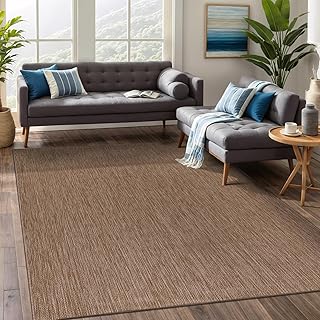
Beverly Rug Indoor Outdoor Rug 8×10, Jute Beige
This one nails the hardest trick in the category: reading as natural jute while being fully water resistant and washable, which means you get the warm neutral look without the rot risk of actual plant fiber. At 8×10 it comfortably clears a six-seat dining set, and the flat profile means chair legs slide instead of catching.
JONATHAN Y Ourika Moroccan Geometric 8×10
The natural-and-black geometry hides everything a busy entry throws at it, and the textured Ourika weave is dense enough that it does not go floppy when you drag it into position. Non-shedding and genuinely pet-friendly — claws catch on the surface without pulling loops loose, which is the specific failure I look for first.
nuLOOM Asha Bordered 4×6
The right call for a balcony, a landing, or under a small bistro table where an 8×10 would swallow the space. The bordered light-brown design gives the area definition, and at 4×6 it is light enough to shake out one-handed and flip over a railing to dry.
Nourison Home Aloha 5’3″ x 7’5″
Nourison’s outdoor construction is consistently well finished, and the blue multi-color pattern is the pick if you want the rug to be the color anchor rather than a neutral base. The mid-size footprint suits a two-chair conversation setup on a deck.
MontVoo Patio Rug 6×9
A vintage medallion in neutral brown, executed in polypropylene with a textured weave that holds up under real traffic and resists fading. This is the size-to-value sweet spot for a standard rectangular patio, and the pattern is busy enough to camouflage dust between cleanings.
Frequently Asked Questions
Can I leave an outdoor rug down all winter?
You can, but you will shorten its life. Trapped moisture under a rug freezes, expands, and stresses both the backing and the surface underneath. Roll it up, store it dry, and put it back in spring.
Do I need a rug pad outdoors?
Only if the rug lacks grip of its own. Rubber-particle-backed options, like the flatweave 6×9 above, are designed to skip the pad. On slick composite decking, a thin open-weave pad also improves airflow.
How do I actually clean one?
Sweep or vacuum first, then mild dish soap, a soft brush, and a hose rinse. Pressure washers on a wide fan setting work on polypropylene but will fuzz the surface if you get close.
Will these stain from potted plants?
Terracotta and fertilizer runoff are the usual culprits. Set planters on risers so water drains through instead of pooling, and rinse spills before they dry.
Final Thoughts
For most patios, the Beverly Rug 8×10 in jute beige is the best balance of size, washability, and a natural look that does not fight the rest of your furniture. If your space sees heavy traffic or pets, the JONATHAN Y Ourika earns its keep with a dense non-shedding weave, and the MontVoo 6×9 is the smart middle-ground pick when you want pattern and durability without the 8×10 price step.