Key takeaways
- Lay geometry: Gathered-end hammocks curl you into a shallow V, which side sleepers tolerate poorly. Flat-lay models use spreader bars or asymmetrical cuts to hold a level sleeping surface. If you toss and turn at home, pay the weight penalty for flat-lay.
- Suspension hardware: Look for tree straps with multiple sewn loops rather than rope, plus forged or cast carabiners over stamped steel. Straps at least 0.75 inches wide protect bark and satisfy Leave No Trace rules at most managed sites.
- Rainfly coverage and ridgeline: A fly that only shades the middle third is useless in wind-driven rain. Measure it against the hammock’s total length and confirm the ridgeline is a separate line you can tension independently, not stitched flat to the fly.
- Netting attachment: Netting sewn to a dedicated ridgeline stays lifted off your face. Netting that relies solely on the hammock’s own tension will droop. Check the zipper too, since a single-slider zip means unzipping the full length just to reach your boots.
- Rated capacity with honest math: Add your body weight, pack, water, and any gear you sling inside, then leave 30 percent headroom for dynamic load when you drop in. A 500 lb rating gives real margin; 330 lb is fine for lighter solo hikers packing minimal gear.
What's inside
Anyone who has spent a night rigged between two pines knows the failure points before the marketing does. Ridgeline sags into a banana shape, the bug netting collapses onto your face by 2 a.m., and the tarp you tied off in the dark starts funneling water down the suspension straps and straight onto your sleeping bag. Hammock tents promise to solve all three with one purchase, and some genuinely do. Plenty just bundle a cheap gathered-end hammock with an undersized fly and call it a system.
I have hung, tensioned, seam-checked, and re-rigged enough of these to know which specs actually matter on the trail versus which ones read well in a bullet list. This guide breaks down the current crop of all-in-one hammock tents, covering the flat-lay designs worth the extra weight, the budget setups that hold up fine for backyard and campground use, and the details worth inspecting the moment the box arrives.
As an Amazon Associate we earn from qualifying purchases.




How to Choose a Hammock Tent Best (2026)
- Lay geometry: Gathered-end hammocks curl you into a shallow V, which side sleepers tolerate poorly. Flat-lay models use spreader bars or asymmetrical cuts to hold a level sleeping surface. If you toss and turn at home, pay the weight penalty for flat-lay.
- Suspension hardware: Look for tree straps with multiple sewn loops rather than rope, plus forged or cast carabiners over stamped steel. Straps at least 0.75 inches wide protect bark and satisfy Leave No Trace rules at most managed sites.
- Rainfly coverage and ridgeline: A fly that only shades the middle third is useless in wind-driven rain. Measure it against the hammock’s total length and confirm the ridgeline is a separate line you can tension independently, not stitched flat to the fly.
- Netting attachment: Netting sewn to a dedicated ridgeline stays lifted off your face. Netting that relies solely on the hammock’s own tension will droop. Check the zipper too, since a single-slider zip means unzipping the full length just to reach your boots.
- Rated capacity with honest math: Add your body weight, pack, water, and any gear you sling inside, then leave 30 percent headroom for dynamic load when you drop in. A 500 lb rating gives real margin; 330 lb is fine for lighter solo hikers packing minimal gear.
The Best Hammock Tent Best (2026)s Reviewed
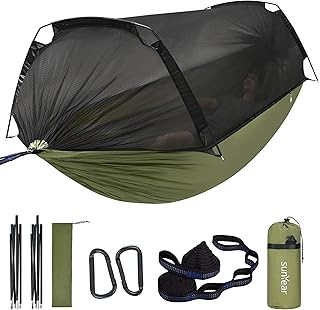
Sunyear Camping Hammock Tent
The anti-rollover cut and 500 lb rating make this the most forgiving option for anyone still learning to dial in sag angle, and the double-size version leaves room to stash a pack at your feet. Two included tree straps mean you can hang it out of the box without a hardware store run.
Night Cat Flat Lay Hammock Tent
The spreader-bar architecture delivers a genuinely level surface at 87 by 28 inches, which is what side sleepers should be looking for. The 330 lb rating and single-person footprint keep it in solo ultralight territory, so plan your load accordingly.
Flat Lay 3-in-1 Camping Hammock Tent
A solid middle path: flat-lay geometry with the netting and rainfly integrated into one packable system, plus tree straps included. Tension the ridgeline first, then the fly, and the whole thing sets up in under five minutes once you have the sequence down.
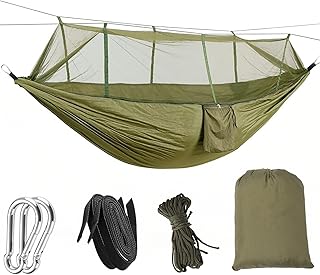
3-in-1 Camping Hammock Tent (Dark Green)
This is the classic gathered-end configuration done competently, with waterproof fly coverage that extends past the hammock ends. Best suited to back sleepers and shoulder-season trips where packed weight matters more than a perfectly flat lay.
2-in-1 Camping Hammock with Mosquito Net (Black & Grey)
The convertible double-to-single layout and 500 lb capacity give it real versatility for car camping, beach days, and porch duty. Netting is removable, which means it doubles as a plain lounging hammock in bug-free months.
Frequently Asked Questions
What hang angle should I aim for?
Roughly 30 degrees from horizontal at each attachment point. Too tight and you get a taut, rib-squeezing surface with enormous force on the anchors. Too loose and you fold into a cocoon.
Do I need an underquilt?
Below about 65°F, yes. A sleeping bag compresses beneath you and loses nearly all its insulating loft, so heat escapes straight through the fabric. An underquilt or closed-cell foam pad handles that.
Can I set one up without trees?
Only with a portable hammock stand rated for your combined load, or by staking the tarp as a ground bivy in a pinch. Neither is ideal, so scout your site for two healthy trunks 12 to 15 feet apart.
How do I keep condensation down?
Pitch the rainfly in a porch configuration with one side raised, and avoid sealing yourself in unless the weather demands it. Airflow beats waterproofing for staying dry overnight.
Final Thoughts
For most buyers the Sunyear Camping Hammock Tent hits the best balance of capacity, roll resistance, and included hardware. Dedicated side sleepers should go with the Night Cat Flat Lay for its true level surface, while the 2-in-1 Black & Grey model is the smartest pick if you want one hammock that works equally well on the trail and on the back patio.