Key takeaways
- Published wind rating: Look for a specific MPH figure rather than vague “heavy duty” language. A stated 60 or 70 MPH rating means the manufacturer ran the numbers on the frame and fasteners as a system, and it gives you something concrete to compare against your local design wind speed.
- Post and beam dimensions: Wall thickness and cross-section do the heavy lifting. Beams in the 5-inch range with genuinely thick extruded aluminum resist twisting far better than lightweight box tube, and you’ll feel the difference the first time you lean on a finished corner.
- Anchoring provisions: Check the base plates before you buy. You want wide flanges, four bolt holes per post minimum, and enough clearance to swing a socket wrench. Wedge anchors into cured concrete or through-bolts into deck framing beat the surface screws included in most kits.
- Roof behavior under load: Louvered roofs let you open the blades and dump wind pressure instead of catching it, which is a real structural advantage in gusty conditions. Fixed hardtop panels shed rain better but need firmer anchoring to compensate.
- Pre-drilled fit and hardware quality: Factory-drilled holes mean parts align without persuasion, which matters because forced joints never seat fully and become the loose ones later. Stainless or hot-dipped galvanized fasteners are worth the upgrade if the kit ships with plated steel.
What's inside
Anyone who has bolted a pergola down in a windy yard knows the failure points aren’t where the catalog photos look weakest. It’s rarely the roof slats. It’s the four spots where post meets slab, the hardware that came in the little baggie, and the moment a gust turns a flat roof into a wing and tries to peel the whole frame off its anchors. If you live on a ridge, near open water, or anywhere the afternoon breeze routinely knocks over patio chairs, a standard shade structure is a liability you’ll be re-tightening every spring.
I’ve assembled enough of these kits to know which ones make the job easy and which ones fight you at every lag bolt. This guide focuses on pergolas with published wind ratings, beam sections thick enough to matter, and anchor plates that give you room to work with real concrete hardware. Below you’ll find the picks, a checklist of what actually determines whether a structure stays put, and honest notes on where each kit shines.
As an Amazon Associate we earn from qualifying purchases.


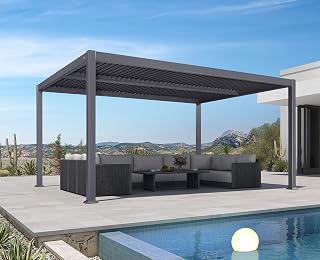


How to Choose a/an “Pergola” For High Winds (2026)
- Published wind rating: Look for a specific MPH figure rather than vague “heavy duty” language. A stated 60 or 70 MPH rating means the manufacturer ran the numbers on the frame and fasteners as a system, and it gives you something concrete to compare against your local design wind speed.
- Post and beam dimensions: Wall thickness and cross-section do the heavy lifting. Beams in the 5-inch range with genuinely thick extruded aluminum resist twisting far better than lightweight box tube, and you’ll feel the difference the first time you lean on a finished corner.
- Anchoring provisions: Check the base plates before you buy. You want wide flanges, four bolt holes per post minimum, and enough clearance to swing a socket wrench. Wedge anchors into cured concrete or through-bolts into deck framing beat the surface screws included in most kits.
- Roof behavior under load: Louvered roofs let you open the blades and dump wind pressure instead of catching it, which is a real structural advantage in gusty conditions. Fixed hardtop panels shed rain better but need firmer anchoring to compensate.
- Pre-drilled fit and hardware quality: Factory-drilled holes mean parts align without persuasion, which matters because forced joints never seat fully and become the loose ones later. Stainless or hot-dipped galvanized fasteners are worth the upgrade if the kit ships with plated steel.
The Best “Pergola” For High Winds (2026)s Reviewed
Backyard Discovery Beaumont 12′ x 10′ Cedar Pergola
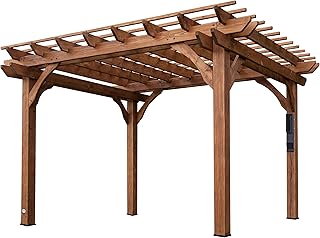
Cedar with a high-wind rating is an unusual combination, and Beaumont pulls it off through substantial post sections and a bracing scheme that keeps the frame square under lateral load. The built-in PowerPort is a genuinely practical touch, since running weatherproof power to a finished pergola after the fact is a miserable job.
Backyard Discovery Sarasota 12′ x 10′ Louvered Steel Pergola
The galvanized steel frame gives this one serious mass, and the adjustable louvers let you flatten the roof profile when weather rolls in. The integrated gutter system is the detail I appreciate most; it moves runoff away from your post bases instead of letting water pool where your anchors live.
PURPLE LEAF 11′ x 15′ Louvered Pergola, Bronze
Those 5.12-inch beams are the headline, and they earn it. The all-aluminum build rated to 60 MPH assembles cleanly thanks to accurate pre-drilling, and the footprint is generous enough to hold a full dining set and a lounge seating area without feeling cramped.
PURPLE LEAF 10′ x 16′ Aluminum Pergola with Independent Roof
The 70 MPH rating puts this at the top of the group for exposed sites, achieved through notably thick aluminum posts. The independent roof structure means the covering isn’t relying on adjacent walls or fencing for support, so you can site it wherever the shade actually falls.
AECOJOY 10′ x 14′ Adjustable Lean-To Pergola
Wall-mounted designs borrow strength from your house, which is a legitimate strategy in high wind if the ledger attachment hits solid framing. The 6.5 to 9.8 foot height adjustment lets you dial in a proper slope for drainage, and the hardtop roof handles driving rain well.
Frequently Asked Questions
Do I need to anchor a pergola into concrete?
For any windy site, yes. Concrete footings or a properly cured slab with wedge anchors give you the pullout resistance the wind rating assumes. Freestanding on pavers or bare ground, even a well-built frame becomes a sail.
Are louvered roofs better than fixed panels in wind?
Generally yes, because opening the blades relieves uplift pressure rather than resisting it. Just remember to open them before a storm arrives, not during.
Can one person assemble these kits?
Most are technically possible solo with ratchet straps and a couple of props, but beam lifts genuinely want a second pair of hands. Budget half a day with a helper.
Should I upgrade the included hardware?
If you’re near salt air or dealing with frequent wetting, swapping to stainless fasteners at the connection points is cheap insurance against the corrosion that quietly weakens joints.
Final Thoughts
For the most exposed sites, the PURPLE LEAF 10′ x 16′ with its 70 MPH rating and thick aluminum posts is the strongest choice here. The Backyard Discovery Sarasota is my pick if you want steel mass plus proper drainage management, while the Beaumont cedar kit delivers real wind resistance for anyone who wants the warmth of wood over metal.