Key takeaways
- Add-on net or integrated system: A separate sleeve net slides over the hammock you already own and costs less, which is ideal if your current hammock is comfortable and you just want bug protection. An integrated hammock has the net sewn directly to the ridgeline, so there’s nothing to align at dusk — but you’re locked into that hammock body.
- Mesh fineness: Mosquitoes need roughly 600-hole-per-square-inch mesh to be stopped. No-see-ums and biting midges need closer to 1,200. If you camp near marshes, coastal dunes, or Southeast river bottoms, look specifically for “no-see-um” mesh rather than generic mosquito netting.
- Zipper layout: Dual-sided zippers let you exit from whichever side the ground is friendlier on, and a diagonal run means the opening falls near your hip instead of your ankles. Single-sided nets work fine but commit you to one entry point for the whole trip.
- Ridgeline support: Netting needs internal tension to stay off your face. A dedicated ridgeline — whether built in or a cord you rig through the net’s apex — is what keeps the mesh lifted. Nets that rely purely on shock cord sag onto your nose within an hour.
- Packed dimensions and weight: Standalone nets typically run 10 to 16 ounces. If you’re carrying weight on your back rather than driving to the site, that difference matters more than the price gap.
What's inside
The first time you get eaten alive in a hammock, you learn something the gear reviews rarely mention: mosquitoes bite through the fabric from underneath. Your back and shoulders are pressed flat against a single layer of nylon, and every no-see-um in the county knows it. Slapping at your own spine at 2 a.m. is a rite of passage, but it’s one you only need once. The fix is a bug net that fully encloses the hammock — top, bottom, and both ends — rather than draping over you like a bedsheet and calling it protection.
I’ve hung, patched, and re-hemmed enough netting to know where the failure points live: cheap coil zippers that jam on the third night, mesh with holes wide enough to admit sand flies, and shock cord that stretches out permanently by mid-season. This guide sorts the standalone add-on nets from the all-in-one hammock-and-net systems, explains which one makes sense for your setup, and points out the small details — ridgeline compatibility, mesh count, zipper geometry — that separate a good night’s sleep from a long one.
As an Amazon Associate we earn from qualifying purchases.


How to Choose a/an Hammock Bug Nets (2026)
- Add-on net or integrated system: A separate sleeve net slides over the hammock you already own and costs less, which is ideal if your current hammock is comfortable and you just want bug protection. An integrated hammock has the net sewn directly to the ridgeline, so there’s nothing to align at dusk — but you’re locked into that hammock body.
- Mesh fineness: Mosquitoes need roughly 600-hole-per-square-inch mesh to be stopped. No-see-ums and biting midges need closer to 1,200. If you camp near marshes, coastal dunes, or Southeast river bottoms, look specifically for “no-see-um” mesh rather than generic mosquito netting.
- Zipper layout: Dual-sided zippers let you exit from whichever side the ground is friendlier on, and a diagonal run means the opening falls near your hip instead of your ankles. Single-sided nets work fine but commit you to one entry point for the whole trip.
- Ridgeline support: Netting needs internal tension to stay off your face. A dedicated ridgeline — whether built in or a cord you rig through the net’s apex — is what keeps the mesh lifted. Nets that rely purely on shock cord sag onto your nose within an hour.
- Packed dimensions and weight: Standalone nets typically run 10 to 16 ounces. If you’re carrying weight on your back rather than driving to the site, that difference matters more than the price gap.
The Best Hammock Bug Nets (2026)s Reviewed
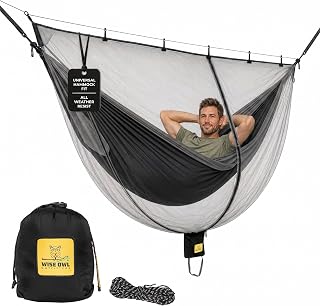
Wise Owl Outfitters Hammock Bug Net
This is the sensible first purchase for anyone who already owns a hammock they like — it sleeves on in under a minute and doesn’t fight the suspension you’re already using. The netting is fine enough for standard mosquito season and the whole thing stuffs down small enough to live permanently in a pack lid.
Hammock Bug Mosquito Net XL, 11 x 4.6 ft
The dual-sided diagonal zipper is the standout here; being able to swing out either direction is genuinely useful on uneven ground, and the diagonal run puts the opening where your hands naturally reach. At 11 feet it clears full-length gathered-end hammocks without the mesh pressing down at your feet.
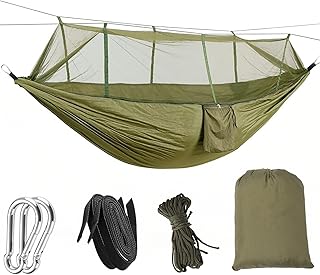
Camping Hammock with Mosquito Net and Rain Fly
Buying the net, hammock, and tarp as one kit removes the guesswork about whether components will play nicely together — a real advantage if this is your first hammock setup. Expect a heavier package than piecing it together yourself, which is a fair trade for car camping and weekend trips.
Onewind 11 ft Ultralight Hammock with Mosquito Net
The 40D ripstop body, integrated no-see-um bugnet, and included ridgeline put this in a different category from the entry-level options — it’s built for people counting ounces and sleeping in genuinely buggy terrain. The single-wide 64-inch panel gives you enough room for a flat diagonal lay without the fabric bunching.
Camping Hammock with Mosquito Net, 500 lb Capacity
The 500-pound rating and 2-in-1 double/single layout make this the most forgiving pick for larger campers or anyone sharing space with a kid or a dog. Tree straps are included, which saves the usual scramble for separate suspension hardware.
Frequently Asked Questions
Can I use a bug net with any hammock?
Most sleeve-style nets fit standard gathered-end hammocks up to about 11 feet. Bridge hammocks and spreader-bar models often won’t work, since their geometry doesn’t collapse into a tube the net can slide over.
Do I need a ridgeline for the net to work?
Functionally, yes. Without something holding the mesh apex up, the netting drapes onto your face and pins itself against your skin — which defeats the purpose, since mosquitoes bite right through contact points.
Will a bug net make the hammock hotter?
Slightly, but less than you’d expect. Fine mesh does cut airflow a bit; the practical fix is orienting your hang to catch cross-breeze rather than skipping the net.
How do I repair a tear in the mesh?
Mesh patch tape works for small punctures, and a needle with fine polyester thread handles seam separations. Carry a few inches of tape wrapped around a trekking pole — a one-inch hole is an all-night invitation.
Final Thoughts
If you already own a hammock, start with the Wise Owl Outfitters Bug Net or the XL Dual-Zipper Net — both solve the problem for less than replacing your whole setup. If you’re building from scratch and heading somewhere genuinely infested, the Onewind 11 ft Ultralight is the one I’d carry, with an integrated ridgeline and no-see-um mesh that earns its price over a long season.