Key takeaways
- Rough opening vs. faceplate: Manufacturers list overall dimensions and rough opening separately, and the gap between them is your trim margin. Build your framed cavity to the rough opening spec plus about 1/8 inch of wiggle, and let the bezel overlap hide the drywall cut. Never size your hole to the outside measurement.
- Depth against your wall assembly: A standard 2×4 wall gives you roughly 3.5 inches between drywall planes. Ultra-thin inserts around 3 to 4 inches deep drop in clean; anything deeper means furring out the wall, using 2×6 framing, or building a shallow bump-out box.
- Power draw and circuit math: At 1500W you’re pulling about 12.5 amps, which eats most of a 15-amp branch circuit. Plan a dedicated receptacle inside the cavity, positioned where the cord reaches without kinking, and avoid extension cords entirely.
- Heat exhaust direction: Front-venting units push warm air out below the glass and tolerate tight framing. Top-venting designs need clear space above, which matters if you’re stacking a TV or a floating mantel shelf directly overhead.
- Control access after install: Once the bezel is trimmed in, touch panels behind the glass edge become hard to reach. Confirm the remote covers every function you care about, or that a smart app handles it, before you close up the wall.
What's inside
Framing a 36-inch electric fireplace looks simple until you actually open the wall. Suddenly you’re dealing with a stud that sits an inch off center, a unit that needs 3.5 inches of depth when your 2×4 wall gives you 3.25, and a manual that assumes an outlet magically exists inside the cavity. Most buyer frustration with these inserts has nothing to do with flame quality and everything to do with rough opening dimensions, trim clearances, and whether the thing can run on a shared 15-amp circuit without tripping every time the microwave kicks on.
This guide approaches the category the way a builder would: depth requirements first, glass and bezel geometry second, flame aesthetics third. I’ve pulled together the six 36-inch inserts that hold up best in real installs — recessed into framed walls, dropped into media cabinets, or surface-mounted where cutting isn’t an option — and flagged the quirks each one brings to the jobsite.
As an Amazon Associate we earn from qualifying purchases.



🛒 Best Price Today on Amazon
Prime members get fast, free shipping on everything above, plus member-only deals. New members get a 30-day free trial — cancel anytime.
How to Choose a/an 36 Inch Electric Fireplace Insert (2026)
- Rough opening vs. faceplate: Manufacturers list overall dimensions and rough opening separately, and the gap between them is your trim margin. Build your framed cavity to the rough opening spec plus about 1/8 inch of wiggle, and let the bezel overlap hide the drywall cut. Never size your hole to the outside measurement.
- Depth against your wall assembly: A standard 2×4 wall gives you roughly 3.5 inches between drywall planes. Ultra-thin inserts around 3 to 4 inches deep drop in clean; anything deeper means furring out the wall, using 2×6 framing, or building a shallow bump-out box.
- Power draw and circuit math: At 1500W you’re pulling about 12.5 amps, which eats most of a 15-amp branch circuit. Plan a dedicated receptacle inside the cavity, positioned where the cord reaches without kinking, and avoid extension cords entirely.
- Heat exhaust direction: Front-venting units push warm air out below the glass and tolerate tight framing. Top-venting designs need clear space above, which matters if you’re stacking a TV or a floating mantel shelf directly overhead.
- Control access after install: Once the bezel is trimmed in, touch panels behind the glass edge become hard to reach. Confirm the remote covers every function you care about, or that a smart app handles it, before you close up the wall.
The Best 36 Inch Electric Fireplace Insert (2026)s Reviewed
Electactic 36″ Ultra-Thin Recessed Insert
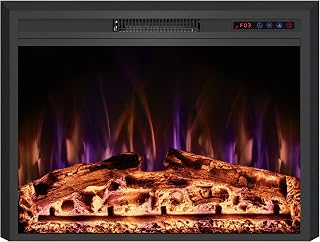
The slim profile is the headline here — it clears a standard 2×4 stud bay without furring strips, which saves a whole afternoon of framing work. Thermostat control plus a timer means it behaves like a real supplemental heater rather than a light show, and the touch screen is genuinely usable during setup before you trim it out.
Touchstone Sideline 36″
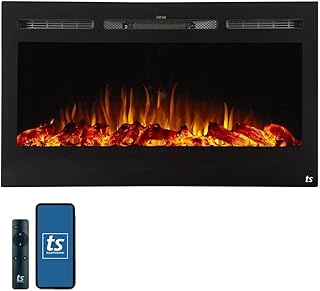
This is the one I’d spec for a permanent feature wall. Build quality on the housing and glass is a clear step up, the 30 ember and flame combinations let you dial in something that doesn’t read as artificial, and WiFi with Alexa support means you never hunt for a remote. Swapping between log and crystal media is a two-minute job.
Valuxhome 36″ Fireplace Insert
The crackling audio is the differentiator, and it’s more convincing than you’d expect once the unit is recessed and the sound reflects off the cavity. Overheating protection adds a layer of confidence for installs inside cabinetry or millwork surrounds where airflow is tighter than ideal.
R.W.FLAME 36″ Recessed Insert
A solid middle-of-the-road pick with five flame colors, five brightness levels, and an 8-hour timer — enough range without a menu system you need to relearn every winter. The 36 by 27 inch face gives you a taller opening than most, so verify your header height before cutting.
Realsmart 36″ Wall Mounted Insert
Twelve flame colors and notably quiet operation make this a good fit for bedrooms and offices where fan whine would be a dealbreaker. The slim black bezel disappears against dark paint or stone veneer, which is handy if you’d rather the flame read as the only feature.
Frequently Asked Questions
Can I frame the opening myself?
Yes, and it’s straightforward carpentry: locate your studs, cut and cripple as needed, and build a box to the manufacturer’s rough opening dimensions. Add blocking at the top and bottom so the insert has something solid to screw into.
Does it need a dedicated circuit?
Not strictly required by most manuals, but strongly advised. A 1500W unit on a shared circuit with other loads will nuisance-trip. Running a new 15- or 20-amp line to the cavity is the cleaner long-term answer.
Will 36 inches heat a whole room?
Expect supplemental warmth for roughly 400 square feet in a reasonably insulated space. Treat it as zone heating that takes the chill off, not a furnace replacement.
Can a TV go above it?
Generally yes with front-venting models, provided you respect the clearance in the manual — usually a few inches minimum. With top-venting units, mount the TV higher or plan a deflecting shelf.
Final Thoughts
For a feature wall you’ll live with for a decade, the Touchstone Sideline 36″ earns its premium through housing quality and smart control. If your framing is tight and you want to avoid furring out the wall, the Electactic ultra-thin insert is the pragmatic choice, while the Valuxhome delivers the most convincing ambient experience for the money thanks to its crackling audio.