Key takeaways
- Choose a full-size automatic dispenser if you prepare many bottles, have counter space, and can confirm exact formula compatibility. It can reduce repetitive measuring, but adds calibration checks and cleaning.
- Choose a compact automatic dispenser if you want the same general one-touch approach in a smaller kitchen. Compare reservoir capacity, feed-volume limits, and access for cleaning—not just the exterior size.
- Choose a warm-water dispenser if faster water access is helpful but you prefer to measure and mix powder yourself. This still requires careful adherence to preparation instructions.
- Skip the machine if you use ready-to-feed formula, make bottles infrequently, or do not want another appliance to clean and maintain. Manual preparation may be simpler for your household.
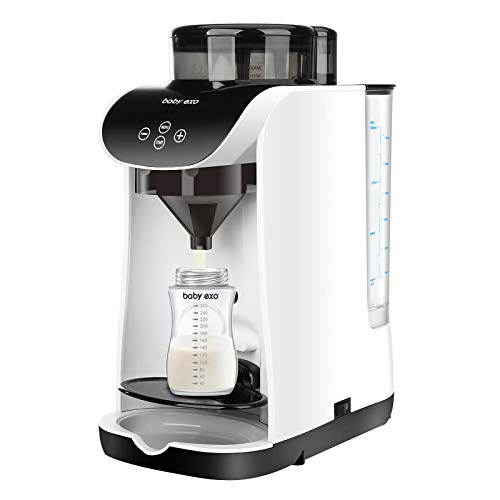
The best baby formula dispenser machines for accurate, quick feeds are the Baby Brezza Formula Pro Advanced for one-touch convenience, the Baby Brezza Formula Pro Mini for tight counters, and the Baby Brezza Instant Warmer for parents who prefer to measure and mix powder themselves. Choose based on how much control you want: automatic machines reduce measuring steps, while a warm-water dispenser leaves formula portions in your hands.
Our top picks



As an Amazon Associate we earn from qualifying purchases at no extra cost to you. Ratings are shown as listed on Amazon.
Best baby formula dispenser machines by situation
| Situation | Best fit | Why it fits | Check before buying |
|---|---|---|---|
| Frequent feeds; want one-touch mixing | Baby Brezza Formula Pro Advanced | Dispenses measured water and formula powder into a bottle | Brand and formula-powder compatibility; bottle clearance |
| Limited counter space | Baby Brezza Formula Pro Mini | Smaller footprint than a full-size automatic dispenser | Reservoir capacity and the space needed to remove parts for cleaning |
| Want to control the powder measurement | Baby Brezza Instant Warmer | Keeps water warm for faster manual preparation | You still need to measure, mix, and check the prepared bottle |
| Prefer formula prepared without a machine | Manual preparation with a clean bottle and safe water | No machine calibration, powder funnel, or reservoir to maintain | Follow the formula label and local guidance on water preparation |
Product features and supported settings can vary by model generation and market. Before purchasing, verify the current manual for the exact machine, the specific formula powder, and any accessories you plan to use.
What matters more than the number of settings
Formula accuracy
An automatic dispenser is only useful if it delivers the right powder-to-water ratio for your formula. Powder density and dispensing behavior can differ between brands and product types, so do not assume that a setting for one formula works for another—even if both use the same scoop instructions. Check the manufacturer’s compatibility information and set the machine exactly as directed. If your formula is not listed, ask the machine maker and your child’s clinician before relying on an automatic setting.
Keep the powder compartment dry and clean, and refill it according to the manual. Damp powder, residue, or a poorly seated funnel can interfere with dispensing. If a bottle looks unusually thin or thick, do not compensate by adding powder or water to the next one; prepare a fresh bottle using the formula label’s instructions and investigate the machine setup.
Water temperature and safe preparation
“Warm” is a convenience setting, not a substitute for safe preparation. Some infants need additional precautions, and recommendations for mixing powdered formula with water can depend on age and health. Follow the formula label and guidance from your pediatrician or public-health authority—especially for premature or medically vulnerable babies. A warmer or dispenser cannot make contaminated water safe or sterilize powder.
Check what temperatures the machine actually offers and whether it dispenses water only, mixes powder, or does both. For a water warmer, confirm that the selected setting suits your intended preparation method. For an automatic mixer, make sure the machine’s temperature and preparation instructions are compatible with the formula’s directions. Test the bottle temperature before feeding; never judge it by the machine display alone.
Bottle fit and size range
Compatibility involves more than whether a bottle fits under the spout. Check the bottle’s height and width, the machine’s maximum dispensing volume, and whether it can center narrow-neck, wide-neck, or angled bottles. Some setups allow a bottle to sit directly beneath the outlet; others may require positioning adjustments. A bottle that touches the housing or sits off-center can make filling messy.
Think about the size you use now and the likely next size. A machine that handles small newborn feeds may be less convenient if your child’s usual feed later exceeds its single-dispense limit. For larger feeds, check whether the unit can dispense in one cycle or requires multiple steps, and follow its instructions rather than topping up by guesswork.
Counter fit, clearance, and cleaning
Measure the actual space before ordering. As a planning allowance—not a manufacturer specification—reserve roughly 12–16 inches of counter width and 16–20 inches of depth for a full-size automatic unit, plus several inches above it if the lid opens upward. Compact models may need less room, but still require space to lift out the water tank, powder container, and funnel. Measure the machine in the manual or current product listing, then add the access space your kitchen needs.
Also check the outlet location and cord reach. Keep the machine on a stable, dry counter, away from the sink edge, stove heat, and places where splashes or curious children can reach it. A dispenser used overnight should be close enough for convenient bottle handling without blocking a walkway or making you carry hot water across the room.
| Planning check | Useful measurement or routine | Why it matters |
|---|---|---|
| Counter footprint allowance | About 12–16 in wide × 16–20 in deep for planning | Leaves room for the unit and nearby bottle handling; confirm actual dimensions |
| Top clearance | Allow several inches beyond the closed height | The lid or removable parts may need vertical room to open and lift out |
| Feed volume | Compare the machine’s stated range with your bottle size in ounces or milliliters | A feed outside the supported range may require a different preparation method |
| Cleaning access | Leave enough space to remove every part named in the manual | Parts that are awkward to reach are more likely to be skipped |
Cleaning is a core ownership task, not an occasional refresh. Powder-contact parts and the dispensing funnel can collect residue, while a water reservoir needs regular washing and drying. Follow the model’s schedule and cleaning method; do not assume a part is dishwasher-safe unless the manual says so. If the funnel must be removed and cleaned frequently, consider whether you can comfortably fit that task into your daily routine.
Noise, speed, and nighttime use
Automatic machines make mechanical sounds while mixing or dispensing. The sound and cycle length vary by model, and manufacturers do not always provide comparable noise measurements, so a published decibel figure is uncommon. If the machine will run near a sleeping child or in a small apartment, look for a current demonstration from the manufacturer or an authorized product video, and check whether the cycle can be started without bright lights or repeated button tones.
A warm-water dispenser can be quieter during the feed itself, but it does not measure or mix the powder. That trade-off may suit a household that values a simple, low-step nighttime routine but wants to retain direct control of each portion.
Which type should you choose?
- Choose a full-size automatic dispenser if you prepare many bottles, have counter space, and can confirm exact formula compatibility. It can reduce repetitive measuring, but adds calibration checks and cleaning.
- Choose a compact automatic dispenser if you want the same general one-touch approach in a smaller kitchen. Compare reservoir capacity, feed-volume limits, and access for cleaning—not just the exterior size.
- Choose a warm-water dispenser if faster water access is helpful but you prefer to measure and mix powder yourself. This still requires careful adherence to preparation instructions.
- Skip the machine if you use ready-to-feed formula, make bottles infrequently, or do not want another appliance to clean and maintain. Manual preparation may be simpler for your household.
Before the first bottle
- Read the machine manual and formula label together; confirm the exact formula and preparation method are supported.
- Wash and dry the parts as instructed, then assemble them securely. Use only the water type and reservoir-filling method specified for the appliance.
- Set the formula and volume precisely. Do not change the powder setting to make a bottle thicker, thinner, or more filling.
- Dispense a bottle and check its volume and temperature as directed by the machine and formula instructions.
- Keep up with scheduled cleaning and any calibration or replacement-part guidance. If the machine dispenses inconsistently, stop using it for feeds until you have checked the manual or contacted the manufacturer.
The right machine is the one that matches your formula, bottle sizes, counter space, and willingness to clean it—not simply the one with the most buttons. If accuracy, safe preparation, or your baby’s specific feeding needs are uncertain, use the formula’s preparation directions and ask your pediatrician rather than relying on an appliance setting.