Key takeaways
- Read the capacity number honestly: A 3,000 or 3,500 lb rating is a static distributed load, not a guarantee for a single point. That’s still an enormous margin over a 600 lb dynamic load, which is exactly the buffer you want. Anything under 1,000 lb should be skipped outright.
- Count the center legs: Steel rails are only as good as their support underneath. Look for a center support beam with its own legs running to the floor, not just perimeter contact. This single detail separates foundations that last a decade from ones that sag in eighteen months.
- Match your profile height: Measure from the floor to the top of your bed frame’s mattress ledge. A 9 or 10 inch foundation on a tall frame gives you a bed you’ll be climbing. A 2 inch bunkie board is the right call when your frame already sits high or you’re just replacing broken slats.
- Slat gap matters more than slat count: Memory foam and hybrid mattresses need gaps under 3 inches to avoid bulging between supports. Wide-gap foundations create pressure ridges that show up as uneven wear across the mattress surface.
- Check the joinery method: Bolt-together steel with lock washers stays tight. Tool-free interlocking designs are faster to assemble but worth inspecting after the first month. Either beats stapled wood, which loosens every time you shift weight.
What's inside
If you’ve ever hauled a sagging box spring out to the curb and found the internal frame snapped clean at a weld, you already know the failure point. Most factory foundations are built to a price, not a load. The wood is thin, the staples are few, and the center of the frame has nothing meaningful holding it up. Put 500 pounds of combined sleeper weight plus a modern 100-pound hybrid mattress on top of that, and the middle starts to dish within a year. Your mattress follows the shape of whatever it sits on, so a tired foundation quietly ruins a good mattress and voids the warranty while it’s at it.
The fix is a foundation engineered around steel and load distribution rather than a decorative fabric wrap. This guide breaks down what actually carries weight in a box spring, which specs are worth reading and which are marketing filler, and six foundations that hold up under real-world heavy use. I’ve included profile heights from 2 inches up to 10 inches so you can match your existing frame instead of ending up with a bed you need a step stool to climb into.
As an Amazon Associate we earn from qualifying purchases.




🛒 Best Price Today on Amazon
Prime members get fast, free shipping on everything above, plus member-only deals. New members get a 30-day free trial — cancel anytime.
How to Choose a Box Spring For Heavy People (2026)
- Read the capacity number honestly: A 3,000 or 3,500 lb rating is a static distributed load, not a guarantee for a single point. That’s still an enormous margin over a 600 lb dynamic load, which is exactly the buffer you want. Anything under 1,000 lb should be skipped outright.
- Count the center legs: Steel rails are only as good as their support underneath. Look for a center support beam with its own legs running to the floor, not just perimeter contact. This single detail separates foundations that last a decade from ones that sag in eighteen months.
- Match your profile height: Measure from the floor to the top of your bed frame’s mattress ledge. A 9 or 10 inch foundation on a tall frame gives you a bed you’ll be climbing. A 2 inch bunkie board is the right call when your frame already sits high or you’re just replacing broken slats.
- Slat gap matters more than slat count: Memory foam and hybrid mattresses need gaps under 3 inches to avoid bulging between supports. Wide-gap foundations create pressure ridges that show up as uneven wear across the mattress surface.
- Check the joinery method: Bolt-together steel with lock washers stays tight. Tool-free interlocking designs are faster to assemble but worth inspecting after the first month. Either beats stapled wood, which loosens every time you shift weight.
The Best Box Spring For Heavy People (2026)s Reviewed
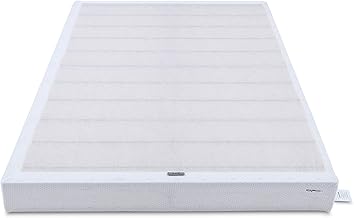
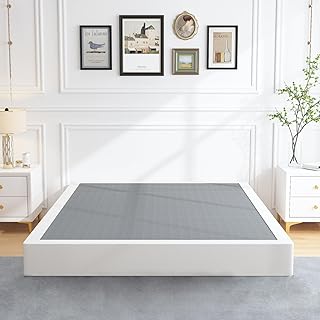
ROIL 10 Inch King Box Spring
At 3,500 lb capacity with a full heavy-gauge steel skeleton, this is the one I’d put under a king-size hybrid without a second thought. The rounded corners are a genuinely thoughtful touch if you’ve ever barked a shin on a square steel edge in the dark, and the fabric cover comes off for washing rather than being stapled on permanently.
Snaye Queen 9 Inch Box Spring
The tool-free assembly here is the real story: the rails interlock and lock down without a wrench, and the whole thing goes together in under twenty minutes solo. At 3,000 lb capacity in a standard 9 inch profile, it’s a direct drop-in replacement for a conventional queen box spring with none of the wood-frame weak points.
MAF 2 Inch Queen Bunkie Board
This is the pick when your frame height is already where you want it and you just need proper support. Wood slats over a steel perimeter, 3,500 lb rated, and only 2 inches tall, so it slides into a platform bed or replaces failed slats without changing your bed height by more than an inch.
ALDRICH 7 Inch Queen Foundation
The mid-height option, and the non-slip surface treatment is worth calling out because heavy mattresses genuinely do creep on smooth steel. Easy-clean cover, 3,000 lb capacity, and a 7 inch profile that splits the difference nicely for anyone with a standard metal frame.
Greaton 8 Inch Amish-Made Wood Foundation
If you prefer solid wood over steel, this is how wood should be done: Amish-built in the USA, fully assembled, and shipped in two halves so it actually fits up a stairwell. The joinery is real carpentry rather than staples, which is why it stays silent under load where cheap wood foundations start creaking.
Frequently Asked Questions
Do I need a box spring with a modern hybrid mattress?
You need a supportive base, though it doesn’t have to be a traditional coil box spring. Steel foundations like these serve the same structural purpose with far better load distribution. Some options, like the 10 inch metal bed frame with fabric cover, do both jobs and eliminate the separate foundation entirely.
Will a heavy-duty foundation make my bed too tall?
It can. Add the foundation height to your frame’s ledge height plus mattress thickness. If the total pushes past 30 inches, drop to a 7 inch or 2 inch profile instead of the 9 or 10 inch versions.
How do I stop the squeaking?
Squeaks almost always come from metal-on-metal contact at joints or feet. Retighten all bolts after the first two weeks, then add felt pads under the legs. Foundations with fabric covers over the steel also help by isolating the frame from the mattress base.
Can two people over 250 pounds each use these safely?
Comfortably. A 500 lb combined load against a 3,000 lb rating leaves a six-fold margin. The bigger risk is your bed frame, not the foundation, so check the frame’s rating too.
Final Thoughts
For most heavy sleepers, the ROIL 10 Inch is the strongest all-around choice thanks to its 3,500 lb steel build and washable cover. If you want the same durability with a faster setup, the Snaye 9 Inch tool-free foundation is hard to beat, and anyone working with limited height clearance should go straight to the MAF 2 Inch bunkie board.