Key takeaways
- Profile height: Measure from your floor to the top of your existing bed frame rails, then work backward. A 4-inch low profile keeps a thick hybrid mattress from turning your bed into a climbing wall; an 8- or 9-inch high profile restores that classic tall silhouette when you’re pairing it with a slim mattress or skipping a frame entirely.
- Load rating and slat spacing: Anything advertised at 3,000 lbs is engineered with real margin. Just as important, check that support members sit no more than 3 inches apart — wide gaps are what void foam mattress warranties and create sag lines you can feel with your palm.
- Assembly reality check: Steel quick-lock designs typically snap together in 15 minutes with zero tools. Fully assembled wood units skip the build entirely but need a clear path through doorways and stairwells, so measure your tightest turn before ordering.
- Noise control: Squeaks come from metal-on-metal contact and unsecured joints. Look for felt or rubber pads at contact points, or plan on adding your own — a few adhesive felt discs at the rail junctions solve most complaints for under five dollars.
- Split versus single unit: Multi-piece king foundations are far easier to carry upstairs and around corners. Two halves of a king sit side by side under one mattress with no gap you’ll ever notice, and they’re the smarter call in older homes.
What's inside
A king mattress is roughly 6,000 square inches of surface area, and every inch of it has to be held up by something. That’s where most bedroom builds go wrong. Buyers spend weeks agonizing over coil counts and foam densities, then drop the finished mattress onto a wobbly 20-year-old foundation, a frame with slats spaced five inches apart, or nothing at all. Six months later there’s a valley down the middle, the warranty claim gets denied for “inadequate support,” and nobody can figure out why.
The good news: a box spring is one of the few bedroom components you can genuinely evaluate on the spec sheet, and one of the easiest things to assemble yourself if you know what you’re looking at. This guide breaks down what actually matters — profile height, load rating, slat spacing, joint design, and how the thing arrives at your door — then walks through the foundations worth your money in 2026, from 4-inch low-profile wood platforms to 9-inch steel frames rated well past what any mattress will ever demand.
As an Amazon Associate we earn from qualifying purchases.


🛒 Best Price Today on Amazon
Prime members get fast, free shipping on everything above, plus member-only deals. New members get a 30-day free trial — cancel anytime.
How to Choose a Box Spring For King Bed (2026)
- Profile height: Measure from your floor to the top of your existing bed frame rails, then work backward. A 4-inch low profile keeps a thick hybrid mattress from turning your bed into a climbing wall; an 8- or 9-inch high profile restores that classic tall silhouette when you’re pairing it with a slim mattress or skipping a frame entirely.
- Load rating and slat spacing: Anything advertised at 3,000 lbs is engineered with real margin. Just as important, check that support members sit no more than 3 inches apart — wide gaps are what void foam mattress warranties and create sag lines you can feel with your palm.
- Assembly reality check: Steel quick-lock designs typically snap together in 15 minutes with zero tools. Fully assembled wood units skip the build entirely but need a clear path through doorways and stairwells, so measure your tightest turn before ordering.
- Noise control: Squeaks come from metal-on-metal contact and unsecured joints. Look for felt or rubber pads at contact points, or plan on adding your own — a few adhesive felt discs at the rail junctions solve most complaints for under five dollars.
- Split versus single unit: Multi-piece king foundations are far easier to carry upstairs and around corners. Two halves of a king sit side by side under one mattress with no gap you’ll ever notice, and they’re the smarter call in older homes.
The Best Box Springs For King Beds (2026) Reviewed
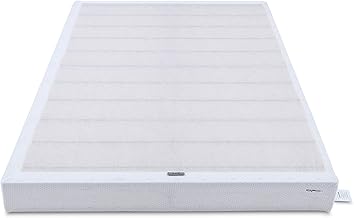
Amazon Basics Smart Box Spring, 5-Inch
Tool-free assembly, a genuinely useful 5-inch height that splits the difference between low and standard profile, and a clean white cover that disappears under any bedding. This is the default recommendation for anyone replacing a worn foundation without changing their bed’s overall height much.
Greaton 4-Inch Wood Foundation, Fully Assembled
Amish-built solid wood, four pieces, arrives ready to slide into place — no hardware, no instructions, no swearing. The low profile is ideal under thick modern mattresses, and wood construction sidesteps the metal-on-metal squeak problem entirely.
Zinus Victor 4-Inch Quick Lock
The steel structure folds and locks into shape faster than you can unbox it, and the fabric cover means it reads as furniture rather than hardware. Best pick for a low-profile setup where you want steel strength without wood’s weight.
Greaton 8-Inch Solid Wood Box Spring
A traditional-height wood foundation that ships flat-packed, so it clears tight stairwells that a pre-assembled unit never would. Choose this when you want the classic tall bed look and prefer timber over tube steel.
9-Inch Heavy Duty Metal Foundation, 3000 lbs
High profile, serious steel, and a load rating with enormous headroom for heavier mattresses or couples. The fabric cover and non-slip contact points keep it quiet, and at this height you can genuinely skip a separate bed frame.
Frequently Asked Questions
Does a memory foam mattress need a box spring?
It needs continuous, evenly spaced support — which a modern box spring with closely set slats provides. Avoid vintage coil-style box springs, which flex under foam and cause premature body impressions.
Will a king box spring fit up my stairs?
A single-piece 76 x 80 inch unit often won’t. Split or flat-packed designs like the Greaton and Zinus options solve this, which is why they dominate this category.
Can I use a box spring without a bed frame?
Yes, and high-profile 8- and 9-inch models are designed for it. Place it on a clean, level floor and expect slightly less airflow underneath than a frame provides.
How do I stop a new box spring from squeaking?
Fully tighten every fastener, then add adhesive felt pads where metal contacts metal or where the foundation touches the frame rails. That handles the overwhelming majority of noise complaints.
Final Thoughts
For most king setups, the Amazon Basics 5-Inch Smart Box Spring hits the best balance of height, price, and painless assembly. If you want zero build time and quiet solid-wood support, the fully assembled Greaton 4-Inch is the one to get, and the 9-Inch heavy duty metal foundation is the pick for maximum strength and a tall, frame-free bed.