Key takeaways
- Mesh count: Look for netting rated against no-see-ums, not just mosquitoes. A 1000-hole-per-square-inch mesh blocks biting midges that walk straight through standard 500-count netting. The tradeoff is slightly reduced airflow, which you’ll notice on humid nights.
- Zipper layout: Dual-sided or diagonal zippers let you get in and out without contorting. Single-side zippers are cheaper but force you to always enter from one direction, which is annoying when your tree spacing dictates otherwise.
- Length and sizing: Measure your hammock body, not the total length including suspension. An 11-foot net on a 10-foot hammock gives you slack to keep mesh off your face; too short and the netting presses against you all night, which defeats the purpose.
- Ridgeline hardware: The included cord and shock loops are usually the weakest link. Budget for a length of 2mm Dyneema and a couple of prusik knots if you want a taut, sag-free peak that holds through a windy night.
- Standalone vs. integrated: A separate net works with any hammock you already own and can be left home on cold trips. Integrated hammock-and-net systems are lighter overall and faster to pitch, but you’re locked into one setup.
What's inside
Anyone who has strung up a hammock at dusk knows the exact moment the evening turns. One minute you’re watching the light drop through the trees, the next you’re swatting at your ankles and doing that frantic tuck-your-arms-under-your-back maneuver that never works. Mosquitoes and no-see-ums find the underside of a hammock almost immediately, because a stretched nylon shell is thin, warm, and full of pressure points where your skin sits flush against the fabric. No amount of repellent fixes geometry.
A dedicated bug net solves it by putting a sealed mesh shell around the whole rig, ridgeline and all. I’ve rigged, patched, and re-hung enough of these to know the differences that matter once you’re out there in the dark: mesh density, zipper placement, how the net gathers at the ends, and whether the included ridgeline cord is worth keeping or worth swapping for something better. Below are six options worth your money in 2026, plus the buying criteria I’d hand a friend before they order.
As an Amazon Associate we earn from qualifying purchases.


How to Choose a Bug Net For Hammock (2026)
- Mesh count: Look for netting rated against no-see-ums, not just mosquitoes. A 1000-hole-per-square-inch mesh blocks biting midges that walk straight through standard 500-count netting. The tradeoff is slightly reduced airflow, which you’ll notice on humid nights.
- Zipper layout: Dual-sided or diagonal zippers let you get in and out without contorting. Single-side zippers are cheaper but force you to always enter from one direction, which is annoying when your tree spacing dictates otherwise.
- Length and sizing: Measure your hammock body, not the total length including suspension. An 11-foot net on a 10-foot hammock gives you slack to keep mesh off your face; too short and the netting presses against you all night, which defeats the purpose.
- Ridgeline hardware: The included cord and shock loops are usually the weakest link. Budget for a length of 2mm Dyneema and a couple of prusik knots if you want a taut, sag-free peak that holds through a windy night.
- Standalone vs. integrated: A separate net works with any hammock you already own and can be left home on cold trips. Integrated hammock-and-net systems are lighter overall and faster to pitch, but you’re locked into one setup.
The Best Bug Nets For Hammocks (2026) Reviewed
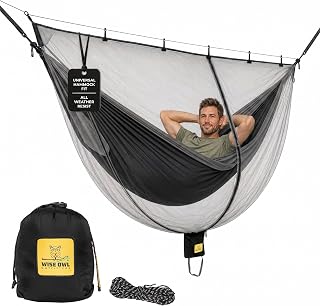
Wise Owl Outfitters Hammock Bug Net
A dependable, no-fuss net that slides over most single and double hammocks and packs down small enough to forget about in a side pocket. The stitching holds up to repeated stuffing, and the pass-through ends cinch tight without needing extra cordage.
Hammock Bug Mosquito Net XL 11×4.6FT
The generous 11-foot cut is the standout here, giving you enough interior volume to sit up and read without mesh on your nose. Genuine no-see-um polyester and dual diagonal zippers make this my pick for buggy Southeast summers.
Camping Hammock with Mosquito Net and Rain Fly
A complete kit for anyone who wants one purchase and no compatibility guesswork, bundling hammock, integrated netting, and a tarp. The fly is modest in size, so pitch it low and add a longer ridgeline if you expect driven rain.
G4Free Large Camping Hammock with Mosquito Net
Built around a 440-pound capacity and roomy enough for two, this is the choice for car campers and anyone who values interior space over ounces. Tree straps and tarp are included, which saves you assembling a suspension kit separately.
AYAMAYA Hammock Bug Net, 11ft
Fast to deploy thanks to sensible shock-cord ends and a genuinely smooth double-sided zipper that doesn’t snag the mesh. At 11 feet with 360-degree coverage, it fits nearly any hammock in circulation and sets up in under a minute once you’ve done it twice.
Frequently Asked Questions
Do I need a ridgeline for a hammock bug net?
Yes, practically speaking. Without a ridgeline the mesh drapes onto your face and biting insects reach through the contact points. A simple length of cord tied between your suspension points, with the net’s apex clipped to it, is all it takes.
Will a bug net make my hammock hotter?
Slightly. Fine mesh cuts breeze, and no-see-um netting more than standard mosquito mesh. Pitching the net high and keeping the sides off your body restores most of the airflow.
Can I use a bug net with an underquilt?
You can, but sleeve-style nets that slide over the hammock will fight your underquilt suspension. If you run an underquilt regularly, choose a net with a full-length zipper that opens wide enough to work around the shock cord.
How do I patch a torn net in the field?
A few inches of Tenacious Tape on each side of the tear seals it permanently and weighs nothing. Keep a strip wrapped around a trekking pole or lighter so it’s always in your pack.
Final Thoughts
For most people the Hammock Bug Mosquito Net XL 11×4.6FT delivers the best combination of no-see-um-grade mesh and usable interior room, while the AYAMAYA 11ft net is the one I’d grab for quick overnights thanks to its painless setup. If you’d rather buy one integrated system and skip the fitment math entirely, the G4Free hammock with bug net and tarp covers everything in a single box.