Key takeaways
- Moisture rating: Wet-rated (IP65 or UL Wet) is the safe default for any porch with blowing rain, screened openings, or a shallow overhang. Damp-rated fans are fine only under a deep, fully covered roof where the housing never sees direct water.
- Motor type: DC and BLDC motors pull far less power, hum less, and typically offer six speeds instead of three — a real advantage on a porch where you want a barely-there breeze in the evening. AC motors are simpler and cheaper to replace if you’re wiring a workshop-adjacent space.
- Blade span vs. porch size: Measure wall to wall before ordering. A 52″ fan wants roughly 12 feet of clearance and moves serious air; anything under 100 square feet is better served by a 20–24″ caged fan you can aim where people actually sit.
- Mounting and clearance: Check that your ceiling box is fan-rated (it should say so, stamped inside) and plan for 7 feet of floor-to-blade clearance. Sloped porch ceilings need a downrod plus a canopy that accommodates the pitch — verify the angle limit in the spec sheet, not the listing photo.
- Controls and light: Remote and app control saves you from fishing a pull chain in the dark, but remotes get lost outdoors. If your porch already has sconces, a no-light fan keeps the wiring simple and the bug attraction low.
What's inside
Standing on a ladder with a fan box balanced on your shoulder, you learn fast that porch fans are their own category. The junction box up there was probably installed for a lightweight flush-mount fixture, the ceiling might slope more than you remembered, and the fan you liked at the store turns out to be dry-rated — meaning it’ll rust into a squeaky mess by the second August. Add wind gusts that make an underpowered fan feel decorative and it’s easy to spend a weekend and still be swatting mosquitoes in still air.
This guide is written from the ladder’s point of view. We looked at moisture ratings that actually match covered and semi-exposed porches, motor types that hold up to humidity and hard use, blade spans that suit real porch footprints, and mounting realities — from downrods on sloped ceilings to plug-in caged fans that hang from a single hook. Below are six fans worth your Saturday, plus the specs that matter before you cut power at the breaker.
As an Amazon Associate we earn from qualifying purchases.


🛒 Best Price Today on Amazon
Prime members get fast, free shipping on everything above, plus member-only deals. New members get a 30-day free trial — cancel anytime.
How to Choose a Ceiling Fan For Porch (2026)
- Moisture rating: Wet-rated (IP65 or UL Wet) is the safe default for any porch with blowing rain, screened openings, or a shallow overhang. Damp-rated fans are fine only under a deep, fully covered roof where the housing never sees direct water.
- Motor type: DC and BLDC motors pull far less power, hum less, and typically offer six speeds instead of three — a real advantage on a porch where you want a barely-there breeze in the evening. AC motors are simpler and cheaper to replace if you’re wiring a workshop-adjacent space.
- Blade span vs. porch size: Measure wall to wall before ordering. A 52″ fan wants roughly 12 feet of clearance and moves serious air; anything under 100 square feet is better served by a 20–24″ caged fan you can aim where people actually sit.
- Mounting and clearance: Check that your ceiling box is fan-rated (it should say so, stamped inside) and plan for 7 feet of floor-to-blade clearance. Sloped porch ceilings need a downrod plus a canopy that accommodates the pitch — verify the angle limit in the spec sheet, not the listing photo.
- Controls and light: Remote and app control saves you from fishing a pull chain in the dark, but remotes get lost outdoors. If your porch already has sconces, a no-light fan keeps the wiring simple and the bug attraction low.
The Best Ceiling Fan For Porch (2026)s Reviewed
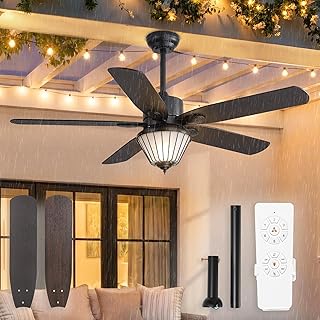
52″ IP65 Waterproof Outdoor Ceiling Fan with Lights, Black
This is the one I’d hang on an exposed or screened porch without second thoughts — IP65 sealing plus a reversible DC motor and six speeds covers both summer downdraft and winter air mixing. The five dual-finish blades give you a farmhouse look that reads intentional rather than utilitarian, and the integrated light means one circuit does double duty.
52″ Solid Wood Outdoor Fan, No Light, Dark Walnut
Three wide propeller blades on a quiet BLDC motor move a lot of air at low RPM, which is exactly what you want when the porch is also where you take phone calls. It’s damp rated, so reserve it for genuinely covered ceilings, but the real wood grain looks far better in person than any faux-finish composite blade.
ABZ 52″ Solid Wood Ceiling Fan, Walnut
A straightforward, handsome three-blade fan for the builder who wants the fixture to disappear into the architecture. Water resistant rather than fully wet rated, so it belongs under a solid overhang — but the walnut finish transitions cleanly if you ever move it indoors to a bedroom or den.
Hunter Cassius 44″ Matte Black
The pragmatist’s pick: pull chain, standard mount, no electronics to fail, and Hunter’s reputation for bearings that stay quiet. At 44 inches it fits narrower porches and garage bays where a 52″ blade span would be crowding the walls.
Orison 24″ Caged Plug-In Gazebo Fan
Renters and pergola owners, this is your workaround — it hangs from a hook, plugs into a GFCI outlet, and skips the junction box entirely. Remote plus app control and 3CCT dimmable lighting make it surprisingly capable for something you can install in ten minutes.
Frequently Asked Questions
Do I really need a wet-rated fan on a covered porch?
If wind can drive rain onto the ceiling, yes. Damp-rated housings tolerate humidity but not standing water in the motor cavity, and a failed outdoor fan is both a warranty denial and a shock hazard.
Can I hang a fan from an existing light fixture box?
Only if it’s a fan-rated box — standard boxes aren’t built for the dynamic load of spinning blades. Retrofitting a brace-style fan box through the existing hole takes about twenty minutes and no drywall repair.
What size fan fits a typical porch?
Under 100 sq ft, go 20–29 inches or use a directional caged fan. From 100 to 200 sq ft, 42–48 inches works well. Above that, a 52-inch span is the sweet spot for airflow without excessive noise.
Are plug-in caged fans as effective as hardwired models?
Over a small seating area, absolutely — they concentrate airflow instead of spreading it thin. They won’t cool a large porch, and you’ll need a weather-rated GFCI outlet within cord reach.
Final Thoughts
For most covered porches, the 52″ IP65 Waterproof Outdoor Ceiling Fan is the confident choice — wet rated, DC quiet, and finished well enough to be part of the design. If your ceiling stays bone dry and you want warmth in the material, the 52″ Solid Wood BLDC fan in Dark Walnut is hard to beat, and renters or pergola builders should go straight to the addlon 20″ caged plug-in fan for airflow without a single wire nut.