Key takeaways
- Check the maximum slope rating first: Every fan lists a degree limit for its canopy, usually somewhere between 15 and 30 degrees. Measure your actual pitch with a digital angle finder held flat against the ceiling before you buy anything, because an undersized canopy will bind and let the fan hang crooked no matter how carefully you shim it.
- Size the downrod to land blades 8 to 9 feet off the floor: Measure from the floor to your mounting box, then subtract 9 feet and the fan body height to get your rod length. Cathedral rooms routinely need 24 to 48 inches, and the stubby 4-inch rod in the box is almost never enough.
- Go bigger on blade span than you think: Vaulted rooms hold far more cubic volume than their square footage suggests, so a 52-inch fan that would be perfect in a flat-ceiling bedroom underperforms badly under a peak. For open great rooms, 65 to 72 inches moves the air you actually need.
- Prioritize a DC motor for quiet high-CFM operation: DC motors draw roughly a third of the power of AC units at comparable airflow and run noticeably quieter, which matters when a hard-surfaced vaulted room reflects every hum straight back at you. Six-speed control also lets you find that low setting that circulates without creating a draft.
- Confirm damp rating and remote reliability: Covered patios and screened porches with vaulted framing need at least a damp-rated fan. Since a pull chain is useless at that height, verify the remote has a memory function so a power blip doesn’t reset your settings and force you back onto the ladder.
What's inside
Vaulted ceilings look incredible and move air terribly. The peak traps every bit of warm air fifteen feet above your head while you sit in a room that never quite feels comfortable, and the standard fan you bolted up there is spinning in a pocket of air it can’t reach. I’ve mounted fans in cathedral rooms, A-frame cabins, and one nightmare of a 22-degree slope over a stairwell, and the pattern is always the same: the fan itself is rarely the problem. The mount height, blade span, and whether the canopy can actually articulate to your pitch decide whether the install works or whether you’re up the ladder again next weekend.
This guide covers the fans I’d actually put on a sloped ceiling in 2026, with an emphasis on the specs that matter when you’re working with a downrod and an angled canopy. I’ve broken down how to size your blade span to the room, how to calculate downrod length so the blades land in the occupied zone instead of the dead air at the peak, and what to check on the mounting hardware before you commit to a purchase. The picks below skew toward large-diameter DC motor fans, because on a vaulted install you need the sweep and you don’t want a noisy motor amplified by all that open volume above you.
As an Amazon Associate we earn from qualifying purchases.



🛒 Best Price Today on Amazon
Prime members get fast, free shipping on everything above, plus member-only deals. New members get a 30-day free trial — cancel anytime.
How to Choose a Ceiling Fan For Vaulted Ceilings (2026)
- Check the maximum slope rating first: Every fan lists a degree limit for its canopy, usually somewhere between 15 and 30 degrees. Measure your actual pitch with a digital angle finder held flat against the ceiling before you buy anything, because an undersized canopy will bind and let the fan hang crooked no matter how carefully you shim it.
- Size the downrod to land blades 8 to 9 feet off the floor: Measure from the floor to your mounting box, then subtract 9 feet and the fan body height to get your rod length. Cathedral rooms routinely need 24 to 48 inches, and the stubby 4-inch rod in the box is almost never enough.
- Go bigger on blade span than you think: Vaulted rooms hold far more cubic volume than their square footage suggests, so a 52-inch fan that would be perfect in a flat-ceiling bedroom underperforms badly under a peak. For open great rooms, 65 to 72 inches moves the air you actually need.
- Prioritize a DC motor for quiet high-CFM operation: DC motors draw roughly a third of the power of AC units at comparable airflow and run noticeably quieter, which matters when a hard-surfaced vaulted room reflects every hum straight back at you. Six-speed control also lets you find that low setting that circulates without creating a draft.
- Confirm damp rating and remote reliability: Covered patios and screened porches with vaulted framing need at least a damp-rated fan. Since a pull chain is useless at that height, verify the remote has a memory function so a power blip doesn’t reset your settings and force you back onto the ladder.
The Best Ceiling Fan For Vaulted Ceilings (2026)s Reviewed
ZMISHIBO 72″ Ceiling Fan with Lights
This is the one I reach for when a great room needs serious sweep without a motor you can hear from the couch. The dual-finish blades and 24W 3-CCT LED give you real flexibility on warm-versus-cool light temperature, and the damp rating means it works under a covered vaulted porch as well as indoors.
Fanbulous 72 Inch Ceiling Fan with APP Control
The standout here is that it’s explicitly built for both flat and sloped ceilings, so the canopy won’t fight you during the install. App control is genuinely practical at cathedral height, and the reversible dual-sided blades let you flip the look without buying a second fan.
52 Inch Ceiling Fan, Sloped Compatible to 15°
The right call for a smaller vaulted bedroom or a slope under 15 degrees where a 72-inch span would overwhelm the space. Downrod mount comes standard and the quiet reversible DC motor handles winter reversal cleanly, which matters more in a vaulted room than anywhere else in the house.
Amico 72 Inch Ceiling Fan with Remote
Six speeds and a timer make this one of the more livable large fans on the list, especially if you want low-and-slow circulation overnight. The black finish and dimmable 3-CCT LED suit a modern cathedral living room, and it’s rated for indoor or covered outdoor use.
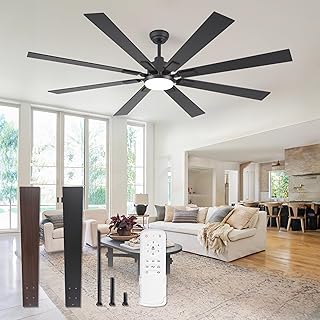
Modern 72 Inch 8 Blade Outdoor Ceiling Fan
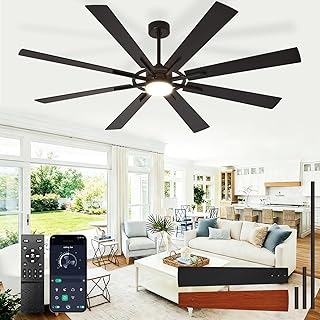
The eight-blade layout moves air more smoothly at low speed than a comparable five-blade fan, which is useful when you’re pushing air down a long vertical distance. App and remote control together mean you’ll never need to reach the switch loop again.
Frequently Asked Questions
How do I know what downrod length I need?
Measure floor to ceiling at the mounting box, then subtract 9 feet for ideal blade height and subtract the fan’s body height from the spec sheet. Round up to the nearest available rod length, since blades slightly lower is far better than blades stranded near the peak.
Will a standard fan work on my sloped ceiling?
Only if its canopy is rated for your pitch. Many fans handle up to 15 or 20 degrees out of the box, but steeper cathedral slopes need either a fan rated higher or an aftermarket sloped ceiling adapter kit matched to the manufacturer’s rod diameter.
Do I need a bigger fan for a vaulted room?
Generally yes. Because the air column is taller, you want more sweep to actually reach floor level, which is why 65 and 72 inch models dominate this category for open great rooms.
Is a support brace required for a large fan?
Your outlet box must be listed as fan-rated and fastened to framing or a rated brace bar. Standard lightweight boxes are not adequate for a 72-inch fan on a long downrod, and this is worth verifying in the attic before you hang anything.
Final Thoughts
For most vaulted great rooms, the Fanbulous 72 Inch is my first recommendation because it’s designed around sloped installs from the start and the app control earns its keep at that height. The ZMISHIBO 72″ is the pick if airflow and finish flexibility matter most, and the 52 Inch sloped-compatible model handles smaller angled rooms where a big fan would simply be too much.