Key takeaways
- Rib count and material: Eight ribs is the practical minimum on a 10ft span. Look at where the rib meets the stretcher — riveted steel joints outlast plastic sockets, and the tips should have caps so the canopy fabric is not abrading on raw metal every time it flexes.
- Crank gearbox: A good lift crank raises the canopy with steady resistance and no gritty spots. Cheap gear sets skip under load, which you will feel as a sudden drop. Test it before the base is weighted so you can return it easily if it binds.
- Tilt mechanism: Push-button and collar tilts are simple and repairable; auto-tilt (built into the crank) is more convenient but has more to go wrong. Either way, check that the tilt holds position with the canopy fully open rather than creeping back to vertical.
- Solar hardware: The panel should sit in a sealed housing at the top hub with strain-relieved wiring routed inside or along the ribs, not draped loose. LEDs mounted in the rib channel survive weather better than surface-taped strips, and a replaceable battery is a genuine advantage.
- Base weight: Plan on 50 lbs minimum for a freestanding 10ft umbrella, or 35 to 40 lbs if the pole passes through a patio table. Match the base opening to the pole diameter — most of these use a 1.5in pole and need the included shim ring for a snug fit.
What's inside
Anyone who has wrestled a market umbrella out of its box on a hot driveway knows the drill: eight ribs to seat, a crank housing that may or may not line up, a canopy that needs coaxing over the tips, and a solar panel with wiring you hope is already terminated. Then comes the real test — the first gust. A 10ft canopy catches wind like a sail, and a three-tier vent stack is the design answer, letting pressure bleed off through the layers instead of levering the pole out of its base. Add solar LEDs and you are also buying a small electrical system that lives outdoors year-round, which means the panel housing, the battery, and the rib-mounted strips all matter as much as the fabric.
This guide looks at the Best Choice Products 10ft 3-tier solar umbrella alongside the closest alternatives from the same brand and two competitors, judged the way a hands-on builder would: how the hardware actually goes together, how the crank and tilt feel under load, how the LED wiring is routed and protected, and what base weight you need to keep the whole thing upright. Everything below is grounded in build quality and serviceability rather than marketing spec sheets.
As an Amazon Associate we earn from qualifying purchases.


🛒 Best Price Today on Amazon
Prime members get fast, free shipping on everything above, plus member-only deals. New members get a 30-day free trial — cancel anytime.
How to Choose a/an Choice Products 10ft 3 Tier Solar Patio Umbrella (2026)
- Rib count and material: Eight ribs is the practical minimum on a 10ft span. Look at where the rib meets the stretcher — riveted steel joints outlast plastic sockets, and the tips should have caps so the canopy fabric is not abrading on raw metal every time it flexes.
- Crank gearbox: A good lift crank raises the canopy with steady resistance and no gritty spots. Cheap gear sets skip under load, which you will feel as a sudden drop. Test it before the base is weighted so you can return it easily if it binds.
- Tilt mechanism: Push-button and collar tilts are simple and repairable; auto-tilt (built into the crank) is more convenient but has more to go wrong. Either way, check that the tilt holds position with the canopy fully open rather than creeping back to vertical.
- Solar hardware: The panel should sit in a sealed housing at the top hub with strain-relieved wiring routed inside or along the ribs, not draped loose. LEDs mounted in the rib channel survive weather better than surface-taped strips, and a replaceable battery is a genuine advantage.
- Base weight: Plan on 50 lbs minimum for a freestanding 10ft umbrella, or 35 to 40 lbs if the pole passes through a patio table. Match the base opening to the pole diameter — most of these use a 1.5in pole and need the included shim ring for a snug fit.
The Best Choice Products 10ft 3 Tier Solar Patio Umbrella (2026)s Reviewed
Best Choice Products 10ft 3-Tier Solar Umbrella, Sand
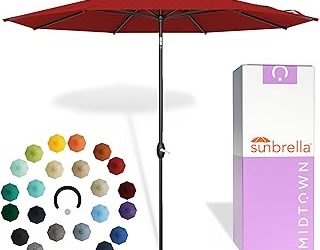
This is the reference build in the category: three vented tiers, eight ribs, a crank lift, and 24 LEDs fed by a top-mounted panel. Assembly is genuinely straightforward, and the sand canopy hides pollen and dust far better than dark fabrics, which matters if your patio sits under trees.
PHI VILLA 10ft 3 Tier Solar Umbrella, Blue & Cyan
The auto-tilt integrated into the crank is the standout here, letting you chase afternoon sun without reaching up to a button collar. The 1.5in pole and eight-rib frame feel appropriately stout, though the two-tone canopy is a stronger visual statement than most patios need.
Kingdura 10ft 3-Tier Solar Umbrella, Grey
Thirty-two LEDs give this one the brightest spread of the group, useful if the umbrella is your only light source over a dining table. The crank and tilt operate cleanly, and the neutral grey canopy reads as a deliberate design choice rather than a compromise.
Best Choice Products 10ft Solar LED Umbrella, Navy Blue
A single-canopy option with UV-resistant polyester and the same tilt-and-crank setup, priced below the tiered models. Without the vent stack it needs to be closed more diligently in wind, so treat it as a value pick for sheltered decks.
Best Choice Products 10ft 3-Tier Market Umbrella, Navy Blue
Mechanically identical to the solar version minus the lighting, which makes it the smart buy if you already run string lights or a pergola fixture overhead. Fewer electrical parts means fewer things to fail in year three.
Frequently Asked Questions
How long do the solar LEDs run on a full charge?
Expect roughly four to six hours after a full day of direct sun. Output tapers as the internal battery ages, and shaded panels charge poorly, so park the closed umbrella somewhere sunny if you want reliable evening light.
Can I replace the solar battery myself?
Often yes. Most panel housings open with a few small screws and hold a standard rechargeable cell. Photograph the wiring before disconnecting anything and reseal the gasket carefully on reassembly.
What base weight do I actually need?
Fifty pounds or more for freestanding use, less if a table shares the load. Undersized bases are the single most common cause of a snapped pole after a storm.
Should I leave it up through winter?
No. Fabric UV coatings degrade, and repeated freeze-thaw cycles work moisture into the crank gearbox. Close it, dry it fully, and store it horizontally in a cover.
Final Thoughts
For most patios the Best Choice Products 10ft 3-Tier Solar Umbrella in sand is the balanced choice, pairing a properly vented canopy with straightforward, serviceable hardware. Step up to the Kingdura 10ft 3-Tier if you need real usable light over a dining table, or the PHI VILLA 10ft 3 Tier if auto-tilt convenience is worth the extra mechanism.