Key takeaways
- Measure the usable desk width, not just the tabletop’s advertised width.
- Add at least 10 inches beside the keyboard for a comfortable mouse area; low-sensitivity players may want 16–20 inches.
- Allow 3–4 inches behind the keyboard for a cable, receiver lead, or charging cable.
- Check that a wrist rest will not overhang the front edge of a shallow desk.
- For a 60% keyboard, confirm that your games and work apps support function-layer shortcuts.
- For wireless models, decide where the receiver will sit and whether Bluetooth switching is useful in your room.
The best Corsair gaming keyboards for most setups are the K65 Plus Wireless for a compact wireless desk, the K70 Max for adjustable magnetic switches, the K70 RGB Pro for a full-size wired board, and the K65 RGB Mini for the smallest footprint.
Corsair’s lineup differs less by lighting than by the space each keyboard occupies, the feel of its switches, and how much control you want over actuation. Before choosing a model, decide whether you need a number pad, wireless freedom, quiet typing, rapid-trigger-style adjustment, or simply the largest amount of desk space for a mouse.
Our top picks


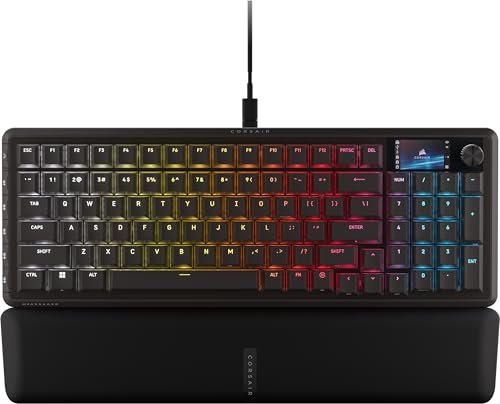
As an Amazon Associate we earn from qualifying purchases at no extra cost to you. Ratings are shown as listed on Amazon.
Quick comparison of the best Corsair gaming keyboards
| Keyboard | Layout | Connection | Switch approach | Approximate footprint | Typical market range |
|---|---|---|---|---|---|
| Corsair K65 Plus Wireless | 75% | 2.4 GHz, Bluetooth, USB | Pre-lubricated MLX Red linear | 12.9 × 5.5 in | Usually $150–$200 |
| Corsair K70 Max | Full-size | Wired USB | Adjustable MGX magnetic linear | 17.4 × 6.5 in | Usually $180–$230 |
| Corsair K70 RGB Pro | Full-size | Wired USB | Cherry MX or OPX, depending on version | 17.4 × 6.5 in | Usually $130–$190 |
| Corsair K65 RGB Mini | 60% | Wired USB | Cherry MX or OPX, depending on version | 11.6 × 4.1 in | Usually $70–$120 |
| Corsair K100 RGB | Full-size | Wired USB | OPX optical-mechanical or Cherry MX Speed | 18.5 × 6.5 in | Usually $180–$250 |
Dimensions are useful planning estimates rather than a substitute for checking the exact product page, since wrist rests and regional versions can change the total depth. Leave at least 3–4 inches behind the keyboard for a cable bend or receiver cable, and preserve roughly 10–12 inches of clear space beside it for comfortable mouse movement.
Best Corsair gaming keyboards by situation
| Your situation | Best fit | Why | Compromise |
|---|---|---|---|
| Small apartment or shallow desk | K65 Plus Wireless | 75% controls in a compact body, with wireless modes | No dedicated number pad |
| Competitive games and adjustable actuation | K70 Max | Magnetic switches allow software adjustment of actuation | Large, wired, and more expensive |
| Work and gaming with spreadsheets | K70 RGB Pro | Full-size layout and dedicated navigation controls | Uses more desk width |
| Maximum mouse room | K65 RGB Mini | 60% footprint leaves substantial lateral space | Function row, arrows, and navigation keys use layers |
| Macro-heavy games and media controls | K100 RGB | Extra controls, wheel, display keys, and full-size layout | Largest footprint and highest cost |
| Shared room or late-night typing | K65 Plus Wireless | Its pre-lubricated linear switches are smoother and less clicky than click switches | Linear does not automatically mean silent |
Switch types: choose feel before RGB
Magnetic switches: K70 Max
The K70 Max uses Corsair MGX magnetic switches, which detect key travel electronically rather than relying on a conventional mechanical contact. Corsair’s software can set actuation points across a range, making a key respond with a lighter press for gaming or require more travel to reduce accidental presses while typing. Dual-actuation-style settings can also assign different actions to different points in a key’s travel.
This is the most flexible choice for players who want to tune movement keys, but it is not automatically the best value for ordinary typing. Magnetic adjustment is most useful when you will actually configure profiles and experiment with actuation.
Optical-mechanical switches: K100 RGB and selected K70 versions
OPX optical-mechanical switches are linear and use light-based actuation. They are designed for a fast, smooth press and suit games where repeated inputs matter. The trade-off is that linear switches provide little tactile information before bottoming out, so they can feel less deliberate for people who prefer a bump or click.
Conventional mechanical switches: K70 RGB Pro and K65 RGB Mini versions
Cherry MX Red and Speed variants are familiar linear options. Speed switches actuate earlier than standard linear switches, while Red switches offer a more conventional travel profile. Some Corsair models are sold in different switch versions, so confirm the exact switch name rather than assuming every K70 or K65 feels identical.
Pre-lubricated linear switches: K65 Plus Wireless
The K65 Plus Wireless uses Corsair MLX Red switches and is aimed at a smoother, less hollow typing experience than a basic entry-level board. Its gasket-style construction and included keycap and switch features make it attractive to people who care about sound and feel as well as gaming speed. It remains a mechanical keyboard, however: expect key noise in a shared room even without a click mechanism.
Layout and desk-footprint trade-offs
A full-size board such as the K70 RGB Pro, K70 Max, or K100 RGB is about 17–18.5 inches wide before you account for mouse clearance. On a 48-inch desk, that can leave only about 30 inches for the mouse, monitor stand, speakers, and other items. A 75% K65 Plus Wireless is closer to 13 inches wide, while the 60% K65 RGB Mini is roughly 12 inches wide.
The 75% layout is the practical middle ground: it keeps the function row, arrow keys, and several navigation keys while removing the number pad. A 60% board removes even more dedicated keys. You can still use arrows and function commands through layered shortcuts, but this takes adaptation and is less convenient for spreadsheet work.
Choose a full-size layout if you regularly enter numbers, use navigation keys for work, or need dedicated controls without memorizing layers. Choose 75% if desk space matters but you still want familiar everyday controls. Choose 60% when mouse room and portability matter more than instant access to secondary keys.
Wired versus wireless connectivity
Wired models have the simplest setup and avoid battery management. They are usually the sensible choice for a fixed desktop, tournament-style play, or a computer positioned close to the keyboard. A detachable USB cable also makes storage easier, but it does not remove the cable from the desk during use.
The K65 Plus Wireless offers 2.4 GHz wireless for low-latency desktop use, Bluetooth for laptops and tablets, and USB operation when charging or using a permanent connection. This makes it the better choice for a multi-device workspace or a desk that must be cleared frequently. Wireless introduces a receiver, charging routine, and possible interference considerations, although 2.4 GHz gaming connections are generally intended to feel close to wired operation.
Keycaps, lighting, and software controls
Most of these keyboards use double-shot PBT keycaps or PBT-focused keycap sets, which generally resist the shiny, greasy feel that develops faster on thin ABS caps. PBT can feel slightly rougher and more textured; ABS often feels smoother and can produce a brighter, sharper sound. Keycap material is only part of the result because plate construction, foam, switch lubrication, and stabilizers also affect noise.
Corsair’s iCUE software controls per-key RGB lighting, macros, remaps, profiles, media functions, and—on compatible models—advanced switch settings. The K70 Max gains the most from these controls because actuation can be tuned. The K100 RGB is more useful for elaborate macro and media setups, while smaller keyboards rely more heavily on layers and software remaps.
RGB is individually addressable on the gaming-focused models, allowing effects or static colors by key. If you prefer a clean workspace, lighting can be disabled without changing the keyboard’s core function. Check operating-system and onboard-memory behavior if you switch between computers, since complex profiles may depend on iCUE being installed.
Which keyboard should you buy?
Choose the K65 Plus Wireless if you want one keyboard for a compact desk
It is the strongest all-around choice for a small office, bedroom desk, or laptop setup. The 75% layout preserves useful keys, the tri-mode connection is versatile, and the linear switches suit both gaming and ordinary typing. It is less suitable if you need a number pad or insist on clicky tactile feedback.
Choose the K70 Max if adjustable actuation matters
This is the specialist pick for players who want magnetic-switch customization. It is also a substantial full-size board, so measure before buying. On a desk narrower than about 48 inches, its width can force the mouse too close to the edge or leave little room for a large desk mat.
Choose the K70 RGB Pro for a traditional full-size gaming keyboard
The K70 RGB Pro is a good fit when you want dedicated keys, a sturdy metal-topped construction, fast conventional switches, and a straightforward wired connection. It is easier to understand than a magnetic board and often costs less than the newest premium options.
Choose the K65 RGB Mini for maximum mouse space
A 60% keyboard is ideal for a narrow desk or low-sensitivity mouse aiming, provided you accept function layers. It is also easier to pack and move. For a first compact keyboard, the K65 Plus Wireless is usually less disruptive because it retains more dedicated controls.
Choose the K100 RGB for controls and customization
The K100 RGB is the feature-heavy option, with a full-size layout, extra controls, media functions, and premium lighting integration. Its size makes it a poor choice for cramped furniture, but it works well at a deep workstation where macro access is more valuable than mouse clearance.
Before ordering: measure the whole workstation
- Measure the usable desk width, not just the tabletop’s advertised width.
- Add at least 10 inches beside the keyboard for a comfortable mouse area; low-sensitivity players may want 16–20 inches.
- Allow 3–4 inches behind the keyboard for a cable, receiver lead, or charging cable.
- Check that a wrist rest will not overhang the front edge of a shallow desk.
- For a 60% keyboard, confirm that your games and work apps support function-layer shortcuts.
- For wireless models, decide where the receiver will sit and whether Bluetooth switching is useful in your room.
For most buyers, the K65 Plus Wireless is the balanced recommendation; the K70 Max is the best choice for adjustable magnetic input, the K70 RGB Pro for a conventional full-size setup, and the K65 RGB Mini for the smallest practical gaming footprint.