Key takeaways
- You backpack, kayak, or moto-camp and count ounces: Choose an ultralight tension table under 2.5 lbs. You sacrifice height and surface area but gain a packable side table for meals and gear. Pair it with a low chair (seat height 11-13 inches) for ergonomic fit.
- You are a solo or duo car camper cooking real meals: Choose a compact aluminum roll-top at 27-28 inches tall. Standard dining height matches most camp chairs (seat height 17-19 inches) and lets you chop and use a two-burner stove without bending. Usually $70-$150.
- You camp with kids, pets, or on soft sand/gravel: Choose a low bamboo roll-top (16-18 inches). Lower height lowers the center of gravity and four independent legs with wide feet resist sinking. Less tipping when kids lean.
- You host group base camps, tailgates, or extended stays: Choose a 4-foot adjustable HDPE bi-fold. At 36-inch counter height you can prep food standing, and at 22-24 inches it becomes a kids’ table. Fits 4 adults with 12 inches of elbow room per person. Usually $60-$120.
- You need one table for everything in a small apartment or van: Choose the small adjustable aluminum 4-in-1 style. The two height settings let it work as a coffee table indoors (21 inches) and dining table outdoors (27 inches), and it stores in a closet 3.5 inches thick.
What's inside
- How to Choose a Folding Camping Table: 4 Decision Criteria
- Best Folding Tables for Camping Compared: Specs That Matter
- Material and Construction Trade-Offs
- Which Table Should You Buy? Decision Matrix by Situation
- Setup, Moving and Durability Realities
- Tips for Stability on Uneven Ground
- Frequently Asked Questions
The best folding table for camping in 2026 is the Helinox Table One Hard Top for ultralight backpacking and the Lifetime 4-Foot Adjustable Folding Table for car camping, because they cover the two opposite priorities campers actually choose between: minimum packed size and weight versus maximum stability and usable surface on uneven ground.
- How to Choose a Folding Camping Table: 4 Decision Criteria
- Best Folding Tables for Camping Compared: Specs That Matter
- Material and Construction Trade-Offs
- Which Table Should You Buy? Decision Matrix by Situation
- Setup, Moving and Durability Realities
- Tips for Stability on Uneven Ground
- Frequently Asked Questions
Most folding camping tables fail not in your backyard but on soft dirt, gravel, and sloped campsites. Weight, packed dimensions, setup mechanism, and leg design determine whether you get a steady cooking or dining surface or a wobbling liability. This guide compares lightweight and compact picks by how they perform where it matters.
As an Amazon Associate we earn from qualifying purchases at no extra cost to you.


How to Choose a Folding Camping Table: 4 Decision Criteria
Forget marketing weight limits alone. Focus on these four specs that predict real-world usability:
1. Packed Size vs. Usable Surface
A table that packs to 11 inches long is easy to strap to a backpack, but typically offers only 400-500 sq inches of top. A full-size 4-foot car camping table gives you over 1,100 sq inches but packs to 50+ inches. Measure your vehicle cargo space and how you carry it from car to site. If you hike more than 200 yards to a site, packed length under 20 inches and weight under 3.5 lbs should be your ceiling.
2. Weight and Frame Material
Aluminum frames (like Helinox DAC poles and Coleman aluminum) weigh 40-60% less than steel but flex more under load and cost more. Steel frames (Lifetime, GCI Outdoor) support 100-300 lbs but add 7-15 lbs to carry weight. For backcountry use, aluminum is non-negotiable. For base camps and family car camping, steel’s stability is worth the weight.
3. Setup Time and Mechanism
There are three systems: tensioned fabric with collapsible poles (fastest ultralight), accordion-style roll-tops with bungee cord slats, and bi-fold blow-molded tops with locking legs. Tension designs set up in 60-90 seconds but require practice. Roll-tops take 2-3 minutes. Bi-fold tables take 30 seconds but are bulkier.
4. Stability on Uneven Ground
Four independent legs wobble less than a single pedestal or X-frame on rocks and roots. Look for adjustable leg length, wide foot caps, and lower center of gravity. Tables under 16 inches tall are inherently more stable on slopes than 27-inch dining-height tables, but less comfortable for cooking while standing.
Best Folding Tables for Camping Compared: Specs That Matter
This comparison uses manufacturer specs and standardized independent measurements for packed dimensions, weight, height, and surface area to show trade-offs you won’t see in a product listing.
| Table Type / Example Model | Packed Size (L x W x H) | Weight | Table Height | Top Size (Surface Area) | Stated Weight Capacity | Best For |
|---|---|---|---|---|---|---|
| Ultralight Tension Table (e.g., Helinox Table One Hard Top) | 16 x 4.5 x 4.5 in | 2.1 lbs (962g) | 15 in | 23.5 x 15.5 in (364 sq in) | 110 lbs | Backpacking, solo campers, motorcycle camping |
| Compact Roll-Top Aluminum (e.g., ALPS Mountaineering Eclipse) | 24 x 6 x 6 in | 7.5 lbs | 28 in | 28 x 20 in (560 sq in) | 50 lbs | 2-person car camping, camp kitchen |
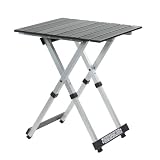
| Small Adjustable Aluminum (e.g., Coleman Pack-Away 4-in-1) | 27 x 15 x 3.5 in | 8.8 lbs | 21 / 27 in adjustable | 34 x 17 in (578 sq in) | 50 lbs | Versatile height for cooking or kids |
| Mid-Size Roll-Top Wood/Aluminum (e.g., REI Co-op Camp Roll Table) | 26 x 10 x 5 in | 12.3 lbs | 18 in | 40 x 20 in (800 sq in) | 100 lbs | Family of 3-4, low stable dining |
| Full-Size Bi-Fold Blow-Molded (e.g., Lifetime 4-Foot Adjustable) | 24 x 24 x 3.5 in (folded in half) | 17.5 lbs | 22 / 24 / 36 in adjustable | 48 x 24 in (1,152 sq in) | 300 lbs | Group base camp, food prep for 4-6 |
Clearance and fit notes: For two camp chairs, allow at least 24 inches of clearance on each side of the table for elbows and getting up. A 28 x 20 inch roll-top fits inside a typical 4-person tent vestibule (usually 40 x 30 inches) for vestibule cooking in rain, while a 48 x 24 inch bi-fold requires a 10 x 10 ft canopy or open area. In a standard car trunk (approx. 36-42 inches wide), only ultralight and small roll-top models pack lengthwise without folding seats.
Material and Construction Trade-Offs
The top and frame material determines durability, cleaning, and how it handles heat, water, and sun.
| Material | Pros | Cons | Durability Reality |
|---|---|---|---|
| Hard Top Tension Fabric + Aluminum Frame | Lightest, packs smallest, rust-proof | Fabric stains, lower heat resistance, flexes with heavy pots | Frame lasts 5+ years; fabric sags after 2-3 seasons of UV exposure |
| Aluminum Roll-Top Slats | Heat resistant, easy to wipe, rolls compact | Slats can pinch, small gaps let crumbs through, bungee wears | Bungee cord is first failure point (usually 2-4 years); slats dent if stepped on |
| Bamboo / Wood Roll-Top | Very stable, premium feel, better wind resistance | Heavier, needs oiling, not fully waterproof | Requires drying after rain to prevent warping; heavier to carry over 100 yards |
| Blow-Molded High-Density Polyethylene (HDPE) + Steel | Highest weight capacity, waterproof, cheap to replace | Heaviest, bulkiest packed, steel rusts if paint chips | Top is nearly indestructible; leg locking rings and hinges loosen first |
For camp cooking, avoid bare fabric tops directly under stoves. Aluminum and HDPE handle a hot pan briefly, but use a 6-inch clearance or a small heat trivet. Bamboo scorches above 400F.
Which Table Should You Buy? Decision Matrix by Situation
Choose by how you camp, not by which table is “best” overall.
- You backpack, kayak, or moto-camp and count ounces: Choose an ultralight tension table under 2.5 lbs. You sacrifice height and surface area but gain a packable side table for meals and gear. Pair it with a low chair (seat height 11-13 inches) for ergonomic fit.
- You are a solo or duo car camper cooking real meals: Choose a compact aluminum roll-top at 27-28 inches tall. Standard dining height matches most camp chairs (seat height 17-19 inches) and lets you chop and use a two-burner stove without bending. Usually $70-$150.
- You camp with kids, pets, or on soft sand/gravel: Choose a low bamboo roll-top (16-18 inches). Lower height lowers the center of gravity and four independent legs with wide feet resist sinking. Less tipping when kids lean.
- You host group base camps, tailgates, or extended stays: Choose a 4-foot adjustable HDPE bi-fold. At 36-inch counter height you can prep food standing, and at 22-24 inches it becomes a kids’ table. Fits 4 adults with 12 inches of elbow room per person. Usually $60-$120.
- You need one table for everything in a small apartment or van: Choose the small adjustable aluminum 4-in-1 style. The two height settings let it work as a coffee table indoors (21 inches) and dining table outdoors (27 inches), and it stores in a closet 3.5 inches thick.
Setup, Moving and Durability Realities
What listings don’t show is how these tables live with you.
Box weight and doorway fit: Ultralight models ship in boxes under 3 lbs and fit any doorway. A 4-foot HDPE table ships at 18-22 lbs boxed and needs a 25-inch doorway clearance when folded – tight for some apartment doors and van side doors.
Setup time learning curve: Tension tables take 2 minutes the first time as you learn pole hubs, then under 90 seconds. Roll-tops are intuitive but aligning slats in wind takes patience. Bi-folds are instant but pinch fingers at the center hinge if you rush.
What wears first: On aluminum roll-tops, the bungee cord loses tension and side locks loosen. On fabric tops, the mesh pocket and corner seams fray. On HDPE/steel, the leg brace locks develop play and wobble after frequent folding. Store all types dry and avoid leaving them in direct sun for weeks – UV degrades both plastic tops and bungees.
Weight limits vs. real use: A 50-lb rating is enough for a stove, pot, and food, but not for sitting or leaning hard with your full weight. Only HDPE tables with steel frames are rated for 200+ lbs and can double as a bench. For uneven ground, load capacity drops 20-30% if weight is on one corner.
Tips for Stability on Uneven Ground
- Set the table perpendicular to the slope, not parallel, so two legs share the same contour line.
- Dig small 1-inch depressions for downhill legs instead of stacking rocks under uphill legs – rocks slip.
- For sand, place 4-inch squares of plywood or plastic lids under feet to prevent sinking; most aftermarket foot caps are only 1.5 inches wide.
- Keep heavy items (water jug, Dutch oven) centered and low, not on edges. A 10-lb pot on the edge creates 2-3x more leverage than in the middle.
Frequently Asked Questions
What height folding table is best for camping chairs?
Match table height to chair seat height. For standard camp chairs (seat 17-19 inches), a 27-28 inch table allows comfortable eating with 8-10 inches of clearance between seat and tabletop. For low-profile chairs (seat 11-13 inches), a 15-18 inch table prevents hunching. Adjustable 21/27 inch models cover both.
Can I use a camp stove on a folding camping table?
Yes, if the top is aluminum or HDPE and rated for at least 50 lbs. Keep stove feet fully on the surface, leave 6 inches from the edge, and avoid bamboo or fabric tops directly under high heat without a trivet. Never exceed the table’s stated capacity with a full water pot and stove combined.
Are roll-top tables waterproof?
Aluminum slats are waterproof and wipe clean, but water drains through the gaps between slats. Bamboo is water-resistant but can warp if left wet. HDPE is fully waterproof. Fabric tension tops are water-resistant but will pool water and sag.