Key takeaways
- Wire routing and density: Lay the pad flat and run your palm across it before first use. You should feel wire runs spaced roughly 2 to 3 inches apart across the sleeping surface. Wide gaps mean cold stripes, and no amount of dial-turning fixes that. Pay special attention to the foot region — budget pads often skimp there.
- True dual zones, not just dual dials: Two controllers are standard now, but confirm the pad is split down the centerline with fully independent circuits. Some cheaper builds share a heating grid, so one side bleeds into the other and neither person gets what they asked for.
- Pocket depth versus your actual mattress: Pull out a tape measure and check your mattress from seam to seam, then add any topper. Pillow-top and hybrid builds routinely hit 15 to 17 inches, and a pad rated for 12 will pop a corner every third night.
- ETL or UL listing plus auto shut-off: This is non-negotiable on anything you plug in and then fall asleep on. The listing mark means the unit was tested by a third-party lab for overheat protection and wiring integrity. A 1-to-12-hour programmable timer is the second layer.
- Washability and cord serviceability: Look for detachable controllers with keyed connectors. The controller module is almost always the first thing to fail, and a plug-in design means you replace a part instead of the whole pad. Machine-washable shells with reinforced connector points last considerably longer.
What's inside
Anyone who has ever crawled into a king bed in January knows the math doesn’t work in your favor. A king is 6,240 square inches of fabric acting like a heat sink, and your body only warms the small patch it occupies. Add a partner who runs hot while you run cold, and you get the classic standoff: one person kicking off blankets while the other lies there rigid, waiting for the sheets to give up and cooperate. Cranking the thermostat is the brute-force fix, and it’s an expensive one — you’re paying to heat an entire house so one mattress feels less like a slab of granite.
A heated mattress pad solves it from underneath, which is the smarter direction. Heat rises into you instead of escaping into the room, and with dual controllers each side of the bed gets its own setting. But not all pads are built alike, and the differences are mechanical: how densely the heating wire is routed, how the skirt anchors to a thick mattress, how the seams hold up after a dozen wash cycles. Below, I’ve laid out what actually matters when you’re inspecting one of these, plus honest notes on the models worth your money this year.
As an Amazon Associate we earn from qualifying purchases.


🛒 Best Price Today on Amazon
Prime members get fast, free shipping on everything above, plus member-only deals. New members get a 30-day free trial — cancel anytime.
How to Choose a King Heated Mattress Pad (2026)
- Wire routing and density: Lay the pad flat and run your palm across it before first use. You should feel wire runs spaced roughly 2 to 3 inches apart across the sleeping surface. Wide gaps mean cold stripes, and no amount of dial-turning fixes that. Pay special attention to the foot region — budget pads often skimp there.
- True dual zones, not just dual dials: Two controllers are standard now, but confirm the pad is split down the centerline with fully independent circuits. Some cheaper builds share a heating grid, so one side bleeds into the other and neither person gets what they asked for.
- Pocket depth versus your actual mattress: Pull out a tape measure and check your mattress from seam to seam, then add any topper. Pillow-top and hybrid builds routinely hit 15 to 17 inches, and a pad rated for 12 will pop a corner every third night.
- ETL or UL listing plus auto shut-off: This is non-negotiable on anything you plug in and then fall asleep on. The listing mark means the unit was tested by a third-party lab for overheat protection and wiring integrity. A 1-to-12-hour programmable timer is the second layer.
- Washability and cord serviceability: Look for detachable controllers with keyed connectors. The controller module is almost always the first thing to fail, and a plug-in design means you replace a part instead of the whole pad. Machine-washable shells with reinforced connector points last considerably longer.
The Best King Heated Mattress Pads (2026) Reviewed
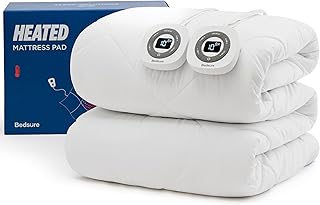
Bedsure Heated Mattress Pad King
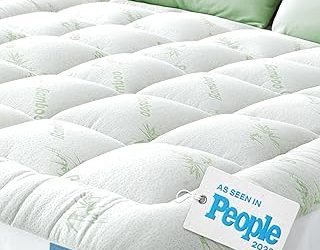
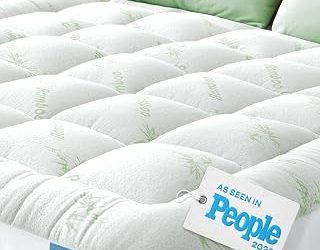
The quilted shell here is noticeably denser than typical budget pads, which spreads warmth more evenly instead of concentrating it in hot lines you can feel through a thin sheet. Ten settings plus a memory function that recalls your last configuration means you stop fiddling with the controller every night, and the deep-pocket skirt handles thick mattresses without a fight.
Bwarm Multi-Zone Electric Heated Mattress Pad
The standout feature is separate body and feet control on each side — four independent zones total — which is genuinely useful if your feet run cold but your torso doesn’t. Nine settings with a 1-to-12-hour timer gives fine control, and the zone split means you’re not overheating your whole side just to fix one region.
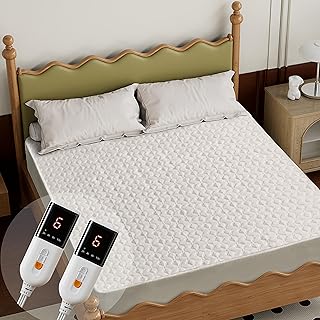
12-Setting Pad with Lighted Controls
Twelve steps across the heat range is the finest granularity in this group, and the illuminated buttons are a small detail that pays off at 2 a.m. when you don’t want to turn on a lamp to find the down arrow. Preheat plus memory, dual control, and ETL and FCC listing round out a well-specified package.
Serta Heated Mattress Pad, Deep Pocket
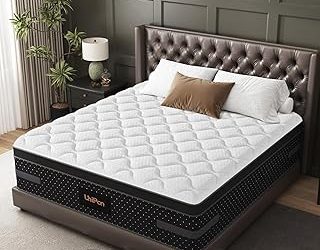
Serta’s version is the one I’d pick for genuinely tall mattresses — it’s rated to 17 inches, and the skirt has enough stretch and depth to grip a pillow-top without corner blowouts. The surface fabric is softer than most, so it disappears under a fitted sheet rather than adding a crinkly layer.
Sunbeam Quilted Heated Mattress Pad
Sunbeam has been building these longer than almost anyone, and the quilting and wire anchoring reflect it — the elements stay put through repeated washing instead of migrating into bunches. Twelve heat levels and a deep-pocket fit make it a dependable, no-drama choice.
Frequently Asked Questions
Can I use one on a memory foam mattress?
Yes, and it helps — foam stiffens when cold and softens as it warms. Place the pad on top of the foam, never underneath, since foam is an insulator and trapping heat below it can cause the pad to cycle its overheat protection.
How do I wash it without wrecking the wiring?
Unplug and detach both controllers first, then wash on a gentle cold cycle with a mild detergent. Tumble on low for ten minutes and finish by air drying flat. Never dry-clean, never wring or twist it, and never iron it — all three crack the wire insulation.
Do they cost much to run?
Not much. A king pad on a medium setting typically pulls somewhere in the 100 to 200 watt range, which is pennies per night compared to raising your whole-house thermostat several degrees.
Over or under the fitted sheet?
Under. The pad sits directly on the mattress, fitted sheet goes over it. That protects the wiring from spills and body oils while keeping the heat close to you.
Final Thoughts
For most king beds, the Bedsure hits the best balance of even heat distribution, sensible controls, and durable quilting. If you and your partner have genuinely different needs — cold feet, warm torso, or opposite schedules — the Bwarm multi-zone pad gives you control nothing else here matches. And for deep pillow-top mattresses where fit is the real problem, the Serta’s 17-inch pocket is the one that will actually stay on.