Key takeaways
- Frame material and joinery: Look for kiln-dried hardwood or engineered plywood rails with visible corner bracing. Skip anything that lists only “solid wood” with no species or thickness noted, and treat plastic corner brackets as a wear item you’ll eventually replace with metal L-plates.
- Pull-out mechanism type: Pop-up platform designs (the seat slides forward, the back drops flat) have fewer moving parts than a true trifold innerspring mechanism, which means less to break and no metal bar under your spine. Trifolds sleep better but cost more of your budget.
- Deployed footprint, not just sofa length: Measure the bed depth with the mechanism fully extended, then add 24 inches of walking clearance. A 77-inch sectional can eat five feet of floor once it’s open, which matters more in an apartment than the sofa’s closed dimensions.
- Upholstery you can actually service: Removable, machine-washable covers are worth real money over a five-year span. Chenille hides pet hair poorly but resists pilling; corduroy conceals seams and wear but traps dust in the wales, so plan on a brush attachment.
- Hardware count and quality: Fewer fasteners generally means faster assembly but more reliance on interlocking brackets. Whatever you buy, check the bolts on arms and chaise connections after two weeks of use and again seasonally, since seat flex loosens them predictably.
What's inside
Anyone who has ever flipped a sofa on its back to check the underside knows the truth: most convertible couches hide their compromises where buyers never look. Staple guns instead of corner blocks, cardboard dust covers, a fold-out mechanism built from stamped steel thinner than a paint can lid. Under $1,000 that pressure gets worse, because the sleeper mechanism alone eats a big chunk of the budget before a single yard of upholstery goes on. The result is a category full of couches that look sharp in photos and sag by month four.
This guide takes the maker’s approach. Instead of ranking by looks, I judged these six sleepers the way you’d assess a piece of shop furniture: how the frame carries load, how the hardware is fastened, whether the pull-out geometry actually clears the seat cushions, and how much of the build you can repair yourself with a socket set and a bag of replacement bolts. Everything below is available for under $1,000, ships flat, and can be assembled without a second pair of hands in most cases.
As an Amazon Associate we earn from qualifying purchases.



🛒 Best Price Today on Amazon
Prime members get fast, free shipping on everything above, plus member-only deals. New members get a 30-day free trial — cancel anytime.
How to Choose a Sleeper Sofa Under 1000 (2026)
- Frame material and joinery: Look for kiln-dried hardwood or engineered plywood rails with visible corner bracing. Skip anything that lists only “solid wood” with no species or thickness noted, and treat plastic corner brackets as a wear item you’ll eventually replace with metal L-plates.
- Pull-out mechanism type: Pop-up platform designs (the seat slides forward, the back drops flat) have fewer moving parts than a true trifold innerspring mechanism, which means less to break and no metal bar under your spine. Trifolds sleep better but cost more of your budget.
- Deployed footprint, not just sofa length: Measure the bed depth with the mechanism fully extended, then add 24 inches of walking clearance. A 77-inch sectional can eat five feet of floor once it’s open, which matters more in an apartment than the sofa’s closed dimensions.
- Upholstery you can actually service: Removable, machine-washable covers are worth real money over a five-year span. Chenille hides pet hair poorly but resists pilling; corduroy conceals seams and wear but traps dust in the wales, so plan on a brush attachment.
- Hardware count and quality: Fewer fasteners generally means faster assembly but more reliance on interlocking brackets. Whatever you buy, check the bolts on arms and chaise connections after two weeks of use and again seasonally, since seat flex loosens them predictably.
The Best Sleeper Sofas Under $1000 (2026) Reviewed
99″ L-Shaped Convertible Sleeper with Storage Chaise
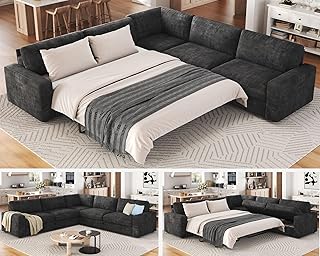
This is the pick if you want maximum function per dollar: a storage chaise, USB-A and Type-C ports wired into the arm, and chenille covers that zip off for the washer. The pull-out platform is straightforward and serviceable, though I’d add felt pads under the feet before sliding it into position on hardwood.
Txtin’s 112″ U-Shaped Sleeper Sofa
At 112 inches with a U-shaped layout, this is a genuine great-room piece, and the modular sections make it far easier to carry upstairs than the dimensions suggest. The warm white chenille reads bright and clean, but budget for a fabric protector spray if kids or pets share the space.
2-in-1 Dark Grey Sectional Sleeper with Double Storage
Two storage compartments under the chaise plus a side pocket make this the most organized option here, which is genuinely useful when the sleeper doubles as a guest room. Assembly is bracket-based and quick, and the dark grey weave forgives scuffs better than lighter fabrics.
Aiho 78″ Sectional Sleeper with Adjustable Backrest
The adjustable backrest and separate ottoman give you three or four usable configurations from one 78-inch footprint, which is the smartest space math in this roundup. It’s the one I’d recommend for a home office that occasionally hosts overnight guests.
77″ Corduroy L-Shaped Sleeper with Storage Chaise
Corduroy is an underrated choice for households with pets, since the ribbed pile hides claw marks that would show plainly on flat weave. Three-seat capacity, a storage chaise, and tool-light assembly make this a strong small-apartment pick.
Frequently Asked Questions
Can I sleep on one of these every night?
Pop-up platform sleepers are built for occasional use. For nightly sleeping, add a two- to three-inch foam topper to bridge the seam between cushions and distribute load more evenly.
How hard is assembly, honestly?
Most of these ship in two to four boxes and go together in 30 to 60 minutes with the included hex key. The 76-inch boneless convertible needs essentially no assembly beyond unboxing.
Will a sectional fit through a standard doorway?
Yes, because they ship disassembled in sections. That’s the main advantage of flat-pack over a traditional pre-built sleeper, which frequently will not clear a 30-inch door.
Are the storage compartments actually usable?
They hold bedding, pillows, and off-season throws well. Avoid storing anything heavy or hard-edged, since the compartment floors are typically thinner panels than the load-bearing frame.
Final Thoughts
For most buyers, the 99″ L-shaped convertible with USB-C charging delivers the widest feature set for the money, while the Aiho 78″ sectional wins on adaptability in tight rooms. If you’re furnishing a large open living area and want the sofa to anchor it, Txtin’s 112″ U-shaped sleeper is the one worth stretching the budget for.