Key takeaways
- No cord to snag on the workpiece, drag through sparks, or limit you to within 25 feet of an outlet.
- Safer footing on ladders, roofs, and under vehicles because there is nothing to trip over.
- Battery platforms are shared: if you already own 20V drills, a bare-tool grinder costs $60 to $120 and uses the packs you have.
- Brushless models manage current electronically, so they hold speed under moderate load better than cheap brushed corded tools.
- Electric brake and paddle switches are common on cordless models, stopping the disc in about 2 seconds instead of coasting for 10.
- Mini 3-inch kits under $40 fit where a full-size grinder simply cannot, such as inside an engine bay or a cabinet.
- Kits ship with everything needed to start cutting within minutes of unboxing.
The Short Answer
Yes, a cordless angle grinder is worth it for metal cutting if your cuts are short and intermittent: trimming a bolt, cutting rebar to length, slicing through a rusted exhaust clamp, or notching angle iron for a shelf bracket. It is not worth it as your only grinder if you regularly cut material thicker than 1/4 inch or make cuts longer than a couple of feet at a time, because a 4-1/2 inch cordless tool on a 4.0Ah battery gives you roughly 10 to 25 minutes of actual cutting before you are swapping packs, and the motor will heat-soak long before a corded model would.
What You Actually Get
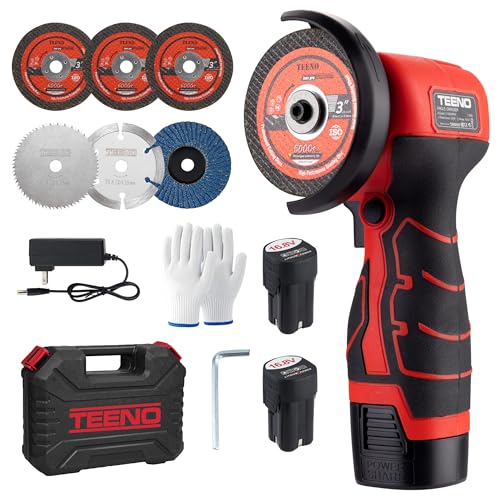
A typical 4-1/2 inch cordless grinder weighs 4 to 6 pounds with the battery, spins a cutting disc at 8,000 to 10,000 rpm, and runs on an 18V to 21V lithium pack. Kits in the $70 to $130 range, such as the AOBEN 21V brushless kit with two 4.0Ah batteries at about $79.99, include a charger, a side handle, a guard, and often a handful of cut-off wheels. The smaller 3-inch class, like the TEENO 16.8V mini kit at about $35.99 with 19,500 rpm and six discs, is a different animal: it weighs under 2 pounds and is built for sheet metal, small bolts, and tight spaces rather than structural steel.
Our top picks

As an Amazon Associate we earn from qualifying purchases at no extra cost to you.
What you do not get is the sustained power of a corded grinder. A 7 to 11 amp corded 4-1/2 inch model delivers 750 to 1,300 watts continuously. A cordless tool can match that peak output for a few seconds, but the battery’s discharge limit and the motor’s thermal protection cut in on long cuts. Expect a 4.0Ah pack to be drained in 12 to 20 minutes of actual trigger time when cutting 1/4 inch steel, or 25 to 40 minutes on thin tubing and sheet.
The thin 0.045 inch cut-off wheels these tools use cut fast and waste little material, but they wear quickly. Budget one wheel per 15 to 30 cuts through 1/8 inch stock.
Pros
- No cord to snag on the workpiece, drag through sparks, or limit you to within 25 feet of an outlet.
- Safer footing on ladders, roofs, and under vehicles because there is nothing to trip over.
- Battery platforms are shared: if you already own 20V drills, a bare-tool grinder costs $60 to $120 and uses the packs you have.
- Brushless models manage current electronically, so they hold speed under moderate load better than cheap brushed corded tools.
- Electric brake and paddle switches are common on cordless models, stopping the disc in about 2 seconds instead of coasting for 10.
- Mini 3-inch kits under $40 fit where a full-size grinder simply cannot, such as inside an engine bay or a cabinet.
- Kits ship with everything needed to start cutting within minutes of unboxing.
Cons
- Runtime is the hard limit. A long cut through 3/8 inch plate can eat a full battery, and a second cut has to wait for the charger.
- Heat builds faster in a compact housing; many cordless grinders will shut down for a cooldown after 5 to 10 minutes of continuous grinding.
- Weight sits at the back with the battery, which makes the tool feel unbalanced compared with a corded grinder of the same size.
- Replacement batteries cost $40 to $90 each, sometimes more than the bare tool.
- Peak wattage lags corded models, so grinding and heavy stock removal go noticeably slower.
- Off-brand batteries and chargers often lack the cell quality of major platforms and fade faster.
- The 3-inch class uses smaller, harder-to-find discs and lacks the reach to cut anything thicker than roughly 1/8 inch cleanly.
Who Should Buy It
Homeowners doing occasional metalwork: cutting off a seized bolt, trimming a fence post cap, shortening threaded rod for a closet system, or breaking down old shelving for recycling. If each session involves fewer than 20 cuts and you already own batteries on the same platform, cordless is the obvious buy. It also suits anyone working away from power, such as on a fence line or a boat trailer, and people who value the safety of no cord near their feet when sparks are flying. A single kit in the $70 to $130 range covers years of this kind of use.
Who Should Skip It
Anyone welding regularly, fabricating gates or trailers, or cutting a lot of 1/4 inch and thicker steel should start with a corded 4-1/2 inch grinder in the $40 to $90 range and consider cordless as a second tool later. The same goes for demolition work involving cast iron pipe or steel tubs, where a cut can take a full minute of continuous trigger time. If you do not own any batteries yet and would only ever buy this one cordless tool, the battery and charger add cost that a corded model avoids entirely.
Cheaper Alternatives
| Option | Cost | Trade-off |
|---|---|---|
| Corded 4-1/2 inch angle grinder | $40-$90 | Unlimited runtime and more power, but you are tethered to an outlet and managing a cord near sparks |
| Mini 3-inch cordless grinder kit | $30-$50 | Very light and compact, ideal for sheet metal and bolts, but too small for anything over about 1/8 inch |
| Reciprocating saw with metal blades | $50-$150 (or bare tool on your platform) | Slower and rougher cuts, but far safer for pipe and tubing and no abrasive dust |
| Hacksaw with bi-metal blade | $12-$30 | Silent, no sparks, works anywhere, but tiring past 1/8 inch stock and slow on hardened steel |
| Bolt cutters | $25-$60 | Instant cuts on rod, chain, and bolts up to about 3/8 inch, but useless on flat stock or tubing |
| Rotary tool with cut-off wheels | $40-$100 | Precise for tiny jobs like screw heads and thin sheet; wheels are fragile and cuts are very slow |
FAQ
How thick can a cordless angle grinder cut?
A 4-1/2 inch disc has a maximum cutting depth of about 1-1/8 inches once the guard and arbor are accounted for, but practical cordless cutting tops out around 1/4 to 3/8 inch for steel plate. Thicker material is possible in multiple passes; it just drains the battery quickly.
Do brushless cordless grinders cut better than brushed ones?
They run cooler and hold speed under load more consistently, and the same battery delivers 20 to 40 percent more cutting time. For metal cutting, where the disc is under constant load, brushless is worth the small premium.
What battery size should I use for metal cutting?
Use at least 4.0Ah. A 2.0Ah pack works but may last only 5 to 8 minutes of hard cutting and can trigger low-voltage shutoffs under heavy load. Larger 5.0Ah and 6.0Ah packs add weight but noticeably extend sessions.
Are cordless grinders safe for cutting metal indoors?
The tool is no more or less dangerous than a corded one, but sparks travel 6 to 10 feet and abrasive dust lingers. Clear flammables, wear a face shield and hearing protection, and, if you are equipping a shop in 2026, budget for a fire extinguisher within reach before you budget for a second battery.