Key takeaways
- The 80-pound hopper reduces refill frequency across longer residential routes.
- Adjustable front and side baffles help avoid adjacent planted borders.
- Ten-inch pneumatic tires handle irregular driveway edges better than tiny wheels.
A staircase and a two-car driveway call for different deicing tools; the wrong machine can waste granules or jam. Choose an ice melt spreader first by permitted materials, then by the pavement you maintain. Some homeowner carts accept fine pelletized deicers but expressly reject coarse rock salt, whereas commercial models may handle both. These six products cover targeted spots, residential paths, and larger maintenance routes.
Quick Verdict: The Chapin 88000A is our Best Overall choice for homeowners using approved granular ice melt on longer paved runs: its 80-pound hopper, 10-inch pneumatic tires, and adjustable baffles make repeated passes easier to control. For steps and short entrances, choose the compact Chapin 8705A instead; for bulk rock salt, consider the SaltDogg WB155BG. These are editorial picks based on manufacturer documentation and US listings as of October 2026, not firsthand testing. Check current price and your deicer’s particle size before ordering.
As an Amazon Associate we earn from qualifying purchases.
By DIY Ideas 4 Home Editorial Team
6 Ice Melt Spreaders Reviewed
We selected six model-specific tools from Chapin, EarthWay, Scotts, and Buyers Products by comparing published material compatibility, dispensing controls, capacity, wheel or hand-carry geometry, and available US prices. In the October 2026 listings reviewed, prices range from $24.99 for a small hand crank to $375 for a commercial salt cart. That range reflects different workloads, not simply quality: an 80-pound hopper is inconvenient on porch steps, while a hand shaker is slow across a commercial lot. Manufacturer capacity and spread-distance statements are specifications, not a promise of uniform application in wet or clumped conditions.
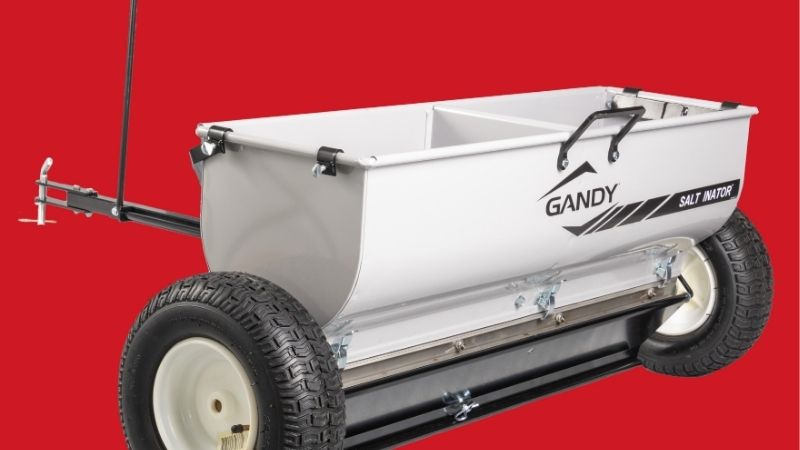
| Product | Best For | Key Spec | Listed Price (October 2026) | Watch Out For |
|---|---|---|---|---|
| Chapin 88000A | Best Overall: long residential runs | 80 lb poly hopper; 10 in pneumatic tires; 15 gate settings | $179.99 | Manufacturer excludes coarse rock salt and sand mixtures |
| Chapin 8705A | Steps and entrances | 3 L manual crank; thumb-controlled gate; 7.2 in listed height | $24.99 | Not approved for rock salt or sand |
| EarthWay 17001 | Small targeted patches | 4 lb EarthShaker container; adjustable outlet dial | $27.99 | Shake operation gives less reach than rotary broadcast |
| Scotts Wizz 71131 | One-hand powered broadcasting | 4 AA batteries; 23 settings; maker states 5 ft broadcast | $34.99 | Clumps can impede the small powered outlet |
| EarthWay 2030P-PLUS | Multi-season driveway maintenance | 65 lb hopper; 9 in air tires; side-spread control | $165.99 | Confirm granule compatibility with your chosen deicer |
| Buyers SaltDogg WB155BG | Bulk salt and large paved areas | 100 lb hopper; 13 in air tires; up to 24 ft broadcast | $375.00 | Heavy cart; retailer may require special ordering |
Chapin 88000A: Best Overall
Best For: Households treating a substantial driveway and several walkways with compatible pelletized deicer throughout winter.
Chapin’s residential SaltPro is easier to recommend for recurring winter work than a general lawn cart because the hopper, auger, and included cover were designed around salt and ice-melt use. Adjustable side and front baffles also help direct material away from planted edges while maintaining a useful walking pace. Its considerable capacity reduces refill trips, but do not confuse large capacity with a license to pour in any material: Chapin specifically excludes coarse rock salt, sand, and sand blends for this model.
Chapin’s product page for model 88000A specifies an 80-pound poly hopper, 10-inch pneumatic tires, adjustable baffles, a spiked plastic auger, and 15 gate positions. Chapin markets it for suitable small ice-melt particulates, while its current safety instructions warn against rock salt and sand. A Home Depot listing for the exact 88000A showed $179.99 in October 2026, which is a more meaningful cost reference than assuming that every Chapin 80-pound spreader is identical. The manufacturer’s documentation gives a two-year limited warranty.
Northern Tool’s model-specific listing measures this assembled cart at 31.5 by 23.5 by 34.5 inches and about 23 pounds before filling. A wet winter mix can still bridge over a gate, so load only dry, approved granules and stop if the auger binds rather than dragging the wheels backward against resistance. The flip-up handle saves a little storage depth without converting it into a compact handheld. Its powder-coated steel frame needs thorough cleaning and drying after salty jobs despite the poly hopper.
Pros:
- The 80-pound hopper reduces refill frequency across longer residential routes.
- Adjustable front and side baffles help avoid adjacent planted borders.
- Ten-inch pneumatic tires handle irregular driveway edges better than tiny wheels.
Cons:
- Coarse rock salt is explicitly outside the approved material list.
- A 23-pound empty cart is excessive for a short doorstep.
Who Should Buy It: Choose this cart for repeat driveway treatments using approved granules; use the Buyers SaltDogg WB155BG when bulk rock salt is nonnegotiable.
Chapin 8705A: Best for Steps
Best For: Residents who want a gloved-hand tool for icy stairs, small porches, or vehicle-side touchups.
The value of the 8705A is that you can scoop directly from an ice-melt bucket, walk around parked cars, and crank material toward a limited target without hauling a wheeled cart. The toothed scoop edge helps break into a bag of compacted product before spreading, while thumb control lets you shut delivery off at a doorway. Compared with the EarthWay 17001’s gravity-fed shaking motion, the Chapin’s rotating impeller offers a different way to distribute approved small granules.
Chapin’s SaltPro 8705A product page specifies a 3-liter, approximately 0.8-gallon, poly scoop with a thumb-controlled trigger gate, enclosed gears, and a hand crank designed to be usable with gloves. Walmart’s listing of the specific 8705A carried a $24.99 price when checked in October 2026. The maker calls it a tool for steps, paths, and confined spots and states explicitly that rock salt, sand, and sand mixes are not recommended. Chapin lists a one-year limited warranty rather than the longer coverage stated for the 88000A cart.
HD Supply lists assembled dimensions of 7.2 inches high, 7.2 inches wide, and 7.2 inches deep for the 8705A; its small physical presence makes a shelf or garage bucket a plausible home between storms. That portability has a cost: frequent refills and repetitive cranking are unavoidable on long pavement. Keep the trigger closed while moving near metal threshold strips, and empty the hopper before storage so crystallized residue does not obstruct its moving parts when temperatures fall again.
Pros:
- The 3-liter scoop works in narrow spaces where carts cannot turn.
- Enclosed gearing limits direct exposure of the crank mechanism to debris.
- Glove-friendly handle and thumb gate reduce winter hand manipulation.
Cons:
- Repeated manual cranking becomes tedious for a two-car driveway.
- The manufacturer prohibits the coarse material sold as rock salt.
Who Should Buy It: Use the 8705A for porch and stair touchups; choose the EarthWay 2030P-PLUS when the job becomes a lengthy driveway loop.
EarthWay 17001: Best for Spot Treatment
Best For: People treating a few icy patches who prioritize a closable, refillable container over broad throwing distance.
The EarthShaker 17001 favors aim and storage over throughput. Its adjustable dial drops granules from the container rather than using the crank of the Chapin 8705A or the powered throw of the Scotts Wizz. That difference is useful when an isolated icy patch sits next to flower beds or between cars. You spend a little more time walking the surface, but you do not have a broad spray pattern to manage on every pass.
EarthWay’s 2025 product guide identifies the single-unit SKU 17001 and describes it as an EarthShaker hand spreader for salt, ice melt, fertilizer, and seed, with capacity up to 4 pounds. The 17001-specific EarthWay listing showed a $27.99 purchase price in October 2026. Its screw-top lid and adjustable openings are important features because loose winter granules vary in size and should not be dumped without controlling the discharge. The document does not publish one universal dial number for all deicer chemistries, so start conservatively with the actual product label.
DoMyOwn’s retailer specifications for the 17001 list a body approximately 8 by 7.25 by 13.63 inches, with around 1.5 pounds of shipping weight. Those numbers make it a small cabinet item, not equipment that needs dedicated floor space. A removable top also lets you pour surplus dry product back into suitable labeled storage, but do not keep damp salt in the dispenser for weeks. EarthWay sells larger push models when this simple design would require too many trips across a property.
Pros:
- Adjustable openings offer a localized option beside planters and cars.
- The screw-top container stores compactly without exposed spinning machinery.
- EarthWay explicitly names ice melt among materials for model 17001.
Cons:
- Four pounds of material is insufficient for long multi-property routes.
- A downward discharge cannot replace a broadcast cart’s coverage pace.
Who Should Buy It: Pick the 17001 for occasional targeted patches; switch to the Scotts Wizz 71131 when a wider handheld throw is more useful.
Scotts Wizz 71131: Best for One-Hand Spreading
Best For: Homeowners who want motor-assisted distribution across short sidewalks without pushing a winter cart.
The Wizz trades mechanical simplicity for a battery-operated impeller. Someone managing a front walk, a path to the mailbox, and a small paved patio may appreciate holding one tool rather than bending over a shaker on each pass. Scotts’ EdgeGuard design helps keep thrown granules to one side of the line of travel, a more relevant feature near lawn borders than a headline claiming thousands of square feet of fertilizer coverage. For coarse, wet clumps, the small feed opening is less forgiving than the contractor SaltDogg system.
The manufacturer’s product page for Scotts Wizz 71131 states that it can distribute salt and ice melt as well as lawn products. The maker specifies four AA batteries, 23 settings, and a nominal 5-foot broadcast width, with an October 2026 listed price of $34.99. Its 2,500-square-foot coverage claim is expressed for Scotts lawn products, not an independently established ice-melt dosage on winter pavement. Neither the broadcast figure nor the settings are an instruction to spread an identical quantity of every sodium-, calcium-, or magnesium-based product.
Published 71131 retail specifications describe an approximately 2.1-pound product weight, noticeably easier to carry than a loaded steel-framed cart. That benefit is lost if winter moisture gets into the batteries or if damp granules clog its motorized outlet. Empty the hopper, remove trapped solids according to its cleaning guidance, and let the battery compartment dry before storing. Since four AA cells power distribution, weak batteries create a separate troubleshooting step absent from both hand-operated compact picks.
Pros:
- Four AA batteries operate the impeller without hand cranking.
- Twenty-three selectable settings allow adjustment for suitable particle sizes.
- EdgeGuard helps direct the nominal five-foot broadcast away from borders.
Cons:
- Clumpy ice melt may block a small powered metering throat.
- Wet storage can compromise battery contacts and electrical reliability.
Who Should Buy It: Select the Wizz for motor-assisted short paths; choose the EarthWay 17001 if gravity-fed precision matters more than casting distance.
EarthWay 2030P-PLUS: Best Multi-Season Cart
Best For: Homeowners seeking one push spreader for compatible winter granules and warmer-season yard applications.
The main argument for this EarthWay model is versatility without the bulk of a commercial spreader. Side-spread control makes a difference on a driveway bordered by grass, and large pneumatic tires let the homeowner cross rough pavement more easily than narrow solid wheels. Its 65-pound hopper carries substantially more product than any handheld pick here. The compromise is specialization: EarthWay markets it for granular ice melt, but the buyer still needs to confirm that a particular deicer’s particle size and condition are acceptable for its mechanism.
EarthWay’s product page for the 2030P-PLUS identifies a 65-pound rustproof hopper, 9-inch pneumatic tires, EVEN-SPREAD system, and side-spread control. The exact 2030P-PLUS listing showed $165.99 in October 2026, below the Chapin 88000A’s Home Depot price, though the two carts serve different material and handling priorities. EarthWay’s official FAQ states that the model is suitable for ice melt and other granular materials, while its documentation offers a one-year limited warranty. Do not confuse this pneumatic-tire variant with the separate 2030 SINGLE poly-wheel SKU.
EarthWay lists the assembled 2030P-PLUS dimensions as 38 by 20.5 by 30 inches and the dry weight at 12 pounds, making garage-door width and fold-up storage straightforward checks. Even a hopper described as rustproof is only one component of the cart; remove residual chloride from the gearbox surroundings and frame after use, then let the equipment dry. The manufacturer’s optional salt deflector is not necessarily included, and some homeowners may need to account for that additional purchase despite the built-in side control.
Pros:
- A 65-pound hopper suits repeated passes on medium residential driveways.
- Nine-inch pneumatic tires help navigate broken pavement and lawn transitions.
- Published 38-inch maximum dimension supports concrete garage storage planning.
Cons:
- Coarse product compatibility requires extra checking before winter use.
- Optional deflector hardware may add cost beyond the base unit.
Who Should Buy It: Choose the 2030P-PLUS for year-round granular spreading; choose the Chapin 88000A for its dedicated ice-melt auger and baffles.
SaltDogg WB155BG: Best for Bulk Salt
Best For: Property managers and contractors spreading bulk or bagged salt over extensive sidewalks, parking edges, and service areas.
Unlike the residential Chapin cart, this SaltDogg explicitly accepts bulk and bagged rock salt through a high-flow feed gate. That compatibility is the reason to pay for the commercial system, not an assumption that a 100-pound hopper makes snow melt faster. Three adjustable deflectors help protect storefront beds or parked vehicles while the broad spinner handles open pavement. For most one-house jobs, its cart dimensions and initial cost are more burden than benefit, but its intended materials make it hard to substitute a cheaper lawn spreader for professional salt duty.
Buyers Products’ SaltDogg WB155BG product page specifies a 100-pound hopper, 13-inch pneumatic tires, up to 24 feet of cast, a screened opening, rain cover, and a bulk-flow gate. The manufacturer identifies the WB155BG as the powder-coated carbon-steel-frame version rather than the separate stainless-frame WB255BG. SiteOne’s SKU-specific listing gave a $375.00 retail figure in October 2026 and flagged possible special-order availability, so the number should be viewed as a dealer reference rather than a guaranteed delivered price. Buyers’ published spread-width maximum varies with material and operation.
The Buyers product literature gives a 40-inch length, 26.5-inch width, 31.5-inch height and an approximately 42-pound empty weight. That storage and handling footprint is a real consideration for facilities moving the cart in and out of a small maintenance room. Its enclosed geared drive and grease point also bring maintenance duties the small hand tools do not have, while the powder-coated frame still requires rinsing, drying, and inspection after chloride exposure. A large hopper should not be packed with frozen chunks just because the material type itself is permitted.
Pros:
- Factory documentation allows both bulk and bagged salt for WB155BG.
- Three adjustable deflectors control broadcast near sensitive property edges.
- Thirteen-inch pneumatic tires and enclosed gearing target contractor operation.
Cons:
- Its roughly 42-pound empty weight makes household storage less convenient.
- Dealer-only or special-order supply can complicate urgent storm preparation.
Who Should Buy It: Choose the WB155BG for regular bulk rock-salt routes; use the Chapin 88000A when approved smaller granules suffice for one home.
How to Choose an Ice-Melt Spreader
Start with the deicer bag rather than the machine’s maximum advertised coverage. Product particle size, walkway geometry, and whether you will treat the surface once or repeatedly in a storm have a larger impact on everyday usefulness than a generic claim that a spreader covers thousands of square feet. A home with a 12-foot driveway and three steps needs very different flow and turning space from a campus maintenance path. The following four decisions eliminate many expensive mismatches before you compare prices.
Check Approved Material and Granule Size
Salt, ice melt, and sand are not interchangeable materials to a spreader. Chapin’s 88000A is marketed for small granules such as common calcium- and magnesium-based ice melts but its instructions specifically exclude rock salt and sand mixes; the Chapin 8705A hand crank likewise warns against rock salt. Buyers Products explicitly markets the WB155BG for bulk and bagged salt. That distinction matters more than the word salt in an online item title: the mechanism’s gate, auger, and impeller must let the actual granules pass.
Before purchase, inspect the product size described on your deicer label, confirm allowed applications with the spreader’s exact operator manual, and reject combinations that require grinding crystals or forcing them through a gate. Do not pour liquid anti-icer into a spreader intended for dry granules. If the driveway only sees occasional light freezing, a compact shaker that accepts your product may cost far less in equipment and lost storage space than a large salt cart.
Match Hopper Size to Your Route
The EarthWay 17001’s 4-pound capacity and Chapin 8705A’s 3-liter scoop are appropriate for isolated entrances, but the units cannot be compared directly as weights without knowing granule density. The EarthWay 2030P-PLUS carries up to 65 pounds, the Chapin 88000A holds up to 80 pounds, and the SaltDogg WB155BG holds up to 100 pounds. Those are hopper ratings, not instructions to spread the entire load over a particular area. The correct amount comes from the chemical product label and conditions on the ground.
Think in loops rather than acres: a narrow sidewalk interrupted by gates or steps may take longer with a bulky wheeled cart than with a hand scoop. A parking lot’s continuous pavement favors the reverse. Account for where you can stage and refill the material without leaving loose salt on grass or metal entry hardware. Capacity only saves work when you can safely maneuver the filled spreader through every turn of the actual route.
Choose Controlled Drop or Broad Casting
Broadcast impellers distribute material over a wider strip, which reduces passes on open driveway pavement but can overshoot planters and parked vehicles. The Scotts Wizz’s stated 5-foot pattern and the WB155BG’s up-to-24-foot broadcast show why a wide nominal coverage number does not automatically mean precision. Adjustable baffles on the Chapin 88000A and Buyers cart narrow or redirect the application, but the final pattern also depends on material, pace, and gate setting.
For steps, a closable shaker or a hand crank gives more deliberate placement than a 100-pound spreader. On a narrow public walkway beside landscaped beds, a true drop spreader may be the more appropriate architecture than any broad spinner. If you are uncertain, practice over a clear, dry section of the intended surface with the actual deicer, following its application directions; look for granules outside the target strip before repeating the route.
Budget for Cleanup and Chloride Exposure
A lower purchase price is not the complete cost of ownership. Wheel bearings, powder-coated frames, metal screws, and battery compartments are exposed to chloride residue, even when the main hopper is plastic. Scotts’ Wizz needs four AA batteries, EarthWay’s 2030P-PLUS has a one-year limited warranty, and Chapin describes two-year limited coverage for the 88000A. Corrosion from deicing products may be excluded from warranty protection, so check the actual documentation instead of treating the warranty period as salt-proofing.
The US Environmental Protection Agency warns that chloride runoff from road salt can affect water, soil, and property. Sweep away loose accumulations where appropriate, use only the application quantity directed by your ice-melt manufacturer, and keep overspray away from vegetation and waterways. Empty each spreader after work, remove residues following its maintenance directions, and dry it before the next storm. Buy a larger machine only when those additional cleaning and storage obligations are worthwhile.
Frequently Asked Questions
Spreader selection still leaves several practical questions: how to treat different deicer chemistries, what to do with stubborn clumps, and how to handle paths that need fast repeat treatment. The product’s instruction book and the deicer package remain the final authority for permitted material and application quantity.
Can I use calcium chloride instead of sodium chloride?
Yes, if the machine’s exact manual approves the physical form and particle size you bought. Chapin explicitly identifies approved smaller ice-melt granules for its 88000A but rejects coarse rock salt, even though rock salt is a sodium chloride product. Do not assume chemical composition by itself determines whether granules feed. Check the package’s stated size and whether pellets are dry and free-flowing before filling the hopper.
Should I leave unused deicer in the hopper overnight?
No, removing leftovers is the safer routine unless the manufacturer expressly instructs otherwise. Moisture can turn residual granules into hardened bridges, obstruct the gate, and increase corrosion of nearby hardware. Empty into properly labeled dry storage, follow the product’s container directions, and clean the equipment before it is put away. The fact that a cart comes with a rain cover does not make it a long-term storage bin for chemical salt.
Will an expensive spreader melt ice at lower temperatures?
No. Temperature performance comes primarily from the deicer chemistry, surface temperature, ice thickness, and application practice, not the spreader price. A $375 contractor cart may disperse more material faster, but it cannot change the chemistry of the crystals inside it. Select an ice-melt product whose label covers the expected pavement conditions, then pick equipment that reliably dispenses it at the prescribed rate.
Can I use the same spreader for fertilizer in spring?
Sometimes. EarthWay’s 2030P-PLUS is documented for fertilizer, seed, ice melt, and other compatible granules, and Scotts markets its Wizz for multiple seasons. That is not a guarantee that every deicing spreader has a fertilizer-appropriate rate range or contamination-free hopper. Clean and dry all contact surfaces thoroughly, confirm that the exact model supports the spring material, and keep any chemically treated product away from food-growing areas unless the relevant labels allow it.
Final Thoughts
Before buying, compare the largest crystals in the deicer you already use with the equipment manual; that one check can overturn an otherwise convincing model recommendation. The Chapin 88000A remains our Best Overall choice for substantial residential routes using smaller, manufacturer-approved ice-melt granules, while the Buyers SaltDogg WB155BG makes more sense when bulk rock salt is part of the job. If your entire route is just a few porch steps, the Chapin 8705A is the cheaper and less cumbersome purchase. Check the current listed price, accepted granule types, and required storage width before placing an order.