Key takeaways
- The Track Saw Path: A mid-to-high-end track saw kit costs between $300 and $600 upfront. Over five years, you will likely replace the adhesive rubber splinter guard strips on the track two or three times ($20 to $30 per set). Additionally, track saws use specialized, thin-kerf blades (often 160mm or 165mm with specific arbor sizes) that cost $40 to $80 each. If you buy three replacement blades over five years, your total cost of ownership will range from $450 to $850.
- The Circular Saw with Guide Rail Path: If you already own a circular saw, your initial investment is simply the guide rail accessory, which runs between $40 and $90. Standard 7-1/4-inch circular saw blades are incredibly common and inexpensive, often costing just $15 to $30 at any local hardware store. Over five years, assuming you buy four new standard blades and one replacement clamp assembly for your guide, your total cost of ownership will range from $120 to $250 (or up to $400 if you need to purchase a new circular saw at the start).
Every home improvement enthusiast eventually hits a wall where a standard hand-held circular saw just won’t cut it. When you are trying to break down a $90 sheet of premium hardwood plywood for custom living room cabinets, or trimming the bottom of a sticking solid-core door, a wavy cut can ruin your afternoon and your budget. This is the exact moment you face the classic workshop dilemma: do you invest in a dedicated, high-end track saw, or do you adapt your existing circular saw with a straight-edge guide rail system?
In 2026, home workshops are more sophisticated than ever, and the line between professional-grade cabinetry tools and DIY garage setups has blurred. The choice between a track saw vs circular saw with guide rail isn’t just about how much money you want to spend; it is about precision, safety, dust management, and the physical reality of the space you have to work in. Let’s break down the real-world differences so you can make the right investment for your home.
Our top picks



As an Amazon Associate we earn from qualifying purchases at no extra cost to you.
Quick Verdict
If your primary goals are furniture building, cabinetry, and flawless, splinter-free cuts inside your home, buy a dedicated track saw. Its plunge-cut mechanism, integrated rubber splinter guards, and enclosed blade design offer unmatched precision and near-perfect dust collection right out of the box.
However, if you are a weekend warrior tackling a mix of rough framing, deck building, and occasional sheet-goods breakdown, a circular saw with a guide rail is the smarter, more economical choice. It maximizes the utility of a tool you likely already own, saves hundreds of dollars, and handles rough-and-tumble construction work that would be inappropriate for a delicate track saw.
Side by Side
To help you visualize how these two setups compare in daily use, here is a breakdown of their core characteristics, based on typical residential woodworking scenarios.
| Feature | Track Saw | Circular Saw with Guide Rail |
|---|---|---|
| Comfort & Ergonomics | Excellent; smooth plunge action and steady downward pressure. Very balanced. | Moderate; requires pushing forward while keeping the saw pressed against or clamped to a guide. |
| Durability | High; precision-engineered parts require careful handling and storage. | Very high; rugged construction built to withstand drops and outdoor job site abuse. |
| Price Range | $170 to $900+ (includes dedicated saw and matching tracks) | $40 to $250 (for the guide rail system only, assuming you own a saw) |
| Maintenance | Moderate; requires replacing rubber splinter strips and keeping the track grooves clean. | Low; occasionally cleaning the rail and checking clamp alignment. |
| Space Needed | Compact; tracks often break down or hang on a wall; no bulky table saw footprint. | Moderate; guide rails can be up to 100 inches long and require storage space. |
| Look (Cut Quality) | Professional; glass-smooth, splinter-free edges on both sides of the cut line. | Good to Very Good; depends heavily on blade quality and guide stability. |
| Resale Value | Excellent; premium woodworking tools hold their value incredibly well. | Moderate; guide rails are niche accessories that sell for less on the used market. |
| Best For | Cabinetry, fine furniture, finish carpentry, and indoor remodeling. | DIY home renovations, deck building, rough framing, and general utility cuts. |
Where Track Saw Wins
The track saw is a highly specialized evolution of the circular saw. Its design advantages shine brightest when you demand absolute precision. The most significant benefit is the zero-clearance splinter guard. The rubber edge on a track saw rail is cut to the exact millimeter of your specific saw blade during its first use. When you align the track with your pencil mark, you can be 100% confident that the blade will cut exactly along that rubber edge, preventing delicate wood fibers from tearing or splintering.
For high-end tasks, tools like the DEWALT Circular Saw, 6-1/2-Inch, TrackSaw Kit (DWS520K) offer a continuous anti-kickback mechanism and an enclosed guard that traps up to 90% of sawdust when connected to a shop vacuum. Because the blade of a track saw is entirely enclosed and only plunges down when you actively press the handle, it is inherently safer and cleaner than a traditional saw. Even entry-level systems, such as the WEN Plunge Cut Circular Saw Bundle with 100-Inch Track Saw Guide Rail and Adapters, offer this plunge-cut capability, allowing you to start a cut safely in the middle of a panel to create cutouts for sinks or electrical boxes.
Where Circular Saw with Guide Rail Wins
While track saws excel in a pristine workshop environment, the traditional circular saw paired with an aftermarket guide rail is the undisputed king of versatility and value. If you already own a reliable 7-1/4-inch circular saw, you can transform it into a straight-cutting machine for a fraction of the cost of a dedicated track saw system.
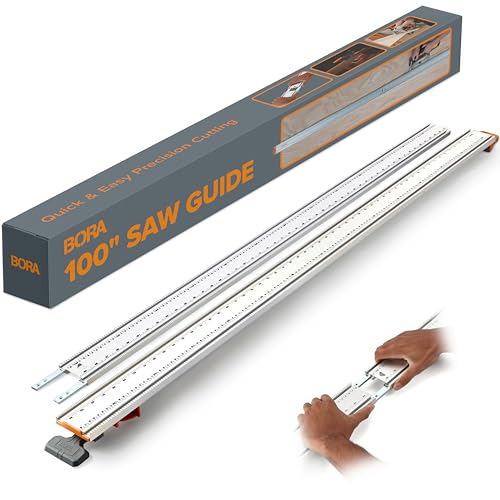
Using a dedicated guide rail like the BORA NGX Circular Saw Guide Rail, 100″ Straight Edge Clamp – Track Saw Rail allows you to clamp the track directly to your sheet goods in seconds. Alternatively, an ultra-affordable option like the Swanson 100″ Cutting Guide, Aluminum Straight Edge Saw/Fence Guide, CG100 provides a rigid, physical metal barrier that prevents your saw from drifting offline.
The main advantage here is that once you finish breaking down your plywood sheets, you can immediately take your circular saw off the guide and use it to cut 2×4 studs, trim fence posts, or perform demolition work. You cannot easily use a track saw for rough framing because its base plate is specifically grooved to ride on a track, making freehand cuts awkward and inefficient.
Cost Over 5 Years
When planning your home workshop budget, it is important to look beyond the initial purchase price and calculate the total cost of ownership over a five-year period.
- The Track Saw Path: A mid-to-high-end track saw kit costs between $300 and $600 upfront. Over five years, you will likely replace the adhesive rubber splinter guard strips on the track two or three times ($20 to $30 per set). Additionally, track saws use specialized, thin-kerf blades (often 160mm or 165mm with specific arbor sizes) that cost $40 to $80 each. If you buy three replacement blades over five years, your total cost of ownership will range from $450 to $850.
- The Circular Saw with Guide Rail Path: If you already own a circular saw, your initial investment is simply the guide rail accessory, which runs between $40 and $90. Standard 7-1/4-inch circular saw blades are incredibly common and inexpensive, often costing just $15 to $30 at any local hardware store. Over five years, assuming you buy four new standard blades and one replacement clamp assembly for your guide, your total cost of ownership will range from $120 to $250 (or up to $400 if you need to purchase a new circular saw at the start).
Which One for Your Home
The right tool choice depends entirely on your living situation, your workspace, and the types of projects you plan to tackle.
Small Apartment or Condo
If you are working on a balcony, in a spare bedroom, or in a tight garage, the track saw is the clear winner. Its superior dust collection means you won’t coat your living space in a layer of fine wood dust. Because you can cut directly on top of a sacrificial foam insulation board placed on the floor, you don’t even need a bulky workbench setup to get perfect results.
Family with Kids and Pets
Safety is the primary concern in a busy household. A track saw is significantly safer because the spinning blade is completely shrouded inside a metal housing until you plunge it into the wood. Once the cut is complete, the blade automatically retracts back into the safety guard. There is also no exposed blade spinning down after you release the trigger, reducing the risk of accidental contact.
Rental Property
If you are renting and need to keep your tool collection portable and highly adaptable, go with a circular saw with a guide rail. A standard circular saw is a foundational tool that you will use for countless quick fixes around a property, from trimming down a gate to building simple outdoor planter boxes. The guide rail can be stored away easily in a closet, and you won’t have to worry about damaging a delicate, expensive track system during moves.
Long-Term Home
If you own your home and plan to spend the next several years tackling major interior upgrades—such as building custom walk-in closets, installing kitchen cabinets, or crafting fine hardwood furniture—invest in a track saw. The professional-grade cuts it delivers will directly translate to higher-quality finishes that add genuine aesthetic and resale value to your home.
FAQ
Can I turn my regular circular saw into a track saw?
You can achieve very similar straight-line accuracy by using a universal sled adapter on a guide rail, but it will never be a true track saw. A standard circular saw lacks the plunge mechanism, the built-in splinter guard, and the specialized dust shroud that make a dedicated track saw so clean and precise.
Do I need to clamp a track saw rail to the wood?
In most cases, no. Track saw rails feature high-friction rubber strips on the bottom that grip the wood securely, preventing the track from shifting during a cut. However, for short cuts, slick materials, or angled bevel cuts, using specialized track clamps is highly recommended for safety.
Are track saw blades different from circular saw blades?
Yes. Track saw blades are typically smaller (often 160mm or 165mm) and have a thinner kerf (the width of the cut) to reduce strain on the motor and prevent tear-out. They also have specific arbor holes that may not fit standard circular saws.
Is it hard to align a circular saw guide rail?
It requires a bit of measurement. Because a standard circular saw blade sits several inches away from the edge of the saw’s shoe, you must measure and offset your guide rail by that exact distance to ensure your cut lands on your pencil mark. Dedicated track saws eliminate this step entirely, as the edge of the track is the exact cut line.