Key takeaways
- Half-fold storage reduces the floor length occupied between work sessions.
- The maker lists a conventional 4 mph walking-speed ceiling.
- Remote and FootSense controls offer distinct options for pace adjustment.
A good under desk treadmill needs to fit the space beneath a raised desk, offer a controllable walking pace and leave enough belt behind your feet for a natural stride. Advertised motor horsepower matters less than usable belt length, full machine dimensions, user-weight rating and whether the unit folds. We compared five specific models for desk workers who want movement between meetings, rather than a substitute for a full running treadmill.
Quick Verdict: WalkingPad C2 is our Best Overall for a compact walking workstation because its half-fold mechanism and 4 mph top speed are documented, with a 220-pound capacity caveat. Our selections use published specifications as of October 2026, not our own laboratory testing; confirm the price and desk clearance before ordering.
As an Amazon Associate we earn from qualifying purchases.
By DIY Ideas 4 Home Editorial Team
The Best Under Desk Treadmills Reviewed
We selected these 5 specific retail models from current US manufacturer listings, technical specifications and published operating instructions as of October 2026. The assessment is editorial and based on documentation rather than claims of detailed research. The listed prices describe the observed configuration and may change at checkout. Where makers advertise a large coverage figure, the matching air-change rate or running-speed condition is stated instead of silently treating all claims as equivalent.
| Product | Best For | Key Spec | Listed Price (October 2026) | Watch Out For |
|---|---|---|---|---|
| WalkingPad C2 | Best Overall | 4 mph; 220 lb user limit | $449 | The 220-pound limit excludes some otherwise suitable office walkers. |
| UREVO SpaceWalk E1L Pro | Best for Higher User Capacity | 0.6 to 4 mph; 350 lb maximum | $179.99 | Its 36.2-inch belt length may restrict longer walking strides. |
| Egofit Walker Pro-M1 | Best for Tiny Offices | fixed 5% incline; short walking platform | $399 | The short belt limits confidence for people with long strides. |
| WalkingPad Z1 | Best for Fold-Away Storage | 4 mph; folding low-profile deck | $299 | Buyers still need to verify the selected variant’s full size. |
| Sunny Health & Fitness SF-T7945 | Best for Simple Controls | 0.5 to 3.75 mph; remote and display | $399.99 | Fifty-inch full length takes more room than smaller office pads. |
WalkingPad C2: Best Overall
Best For: Buyers who prioritize balanced everyday performance and can accept its main trade-off.
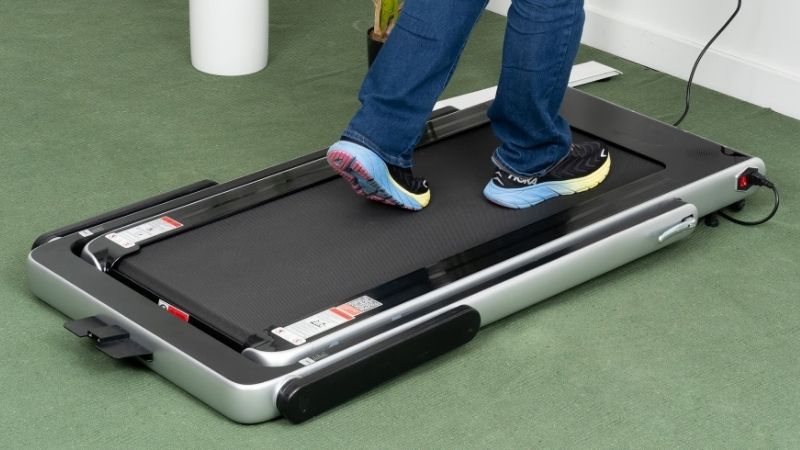
The C2 is the clearest choice when a walking desk must become an ordinary office again at the end of the day. Folding changes storage logistics: a flat nonfolding pad can dominate the floor, while a compact half-fold device can move to a closet without taking up its full operating length. Unlike the UREVO incline machine, this is principally a level walking solution, not an attempt to add training resistance during typing.
WalkingPad’s product page for the C2 states a walking range up to 4 mph and a maximum user weight of 220 pounds. Its listed October 2026 US price was $449. The company specifies FootSense speed adjustment alongside remote and app control. Those options matter if you dislike bending to reach controls mid-call, although beginners should first become comfortable with manual speed changes rather than relying on automatic foot-position control.
The manufacturer’s size chart lists a folded footprint of approximately 32.5 by 20.4 inches and a 55-pound net weight. That is much heavier than a lightweight suitcase despite the word portable, and you still need level flooring and space to deploy the deck safely. Check the recommended maintenance schedule in WalkingPad’s documentation, especially belt centering and lubrication, before placing the machine beneath a heavy sit-stand desk.
Pros:
- Half-fold storage reduces the floor length occupied between work sessions.
- The maker lists a conventional 4 mph walking-speed ceiling.
- Remote and FootSense controls offer distinct options for pace adjustment.
Cons:
- The 220-pound limit excludes some otherwise suitable office walkers.
- At $449 it costs more than the compact UREVO choice.
Who Should Buy It: Choose C2 when the desk doubles as another workspace; choose UREVO SpaceWalk E1L Pro if higher published weight capacity is more important.
UREVO SpaceWalk E1L Pro: Best for Higher User Capacity
Best For: Buyers who prioritize higher user capacity and can accept its main trade-off.
This compact model offers a substantially higher stated load limit than WalkingPad C2 while keeping the price much lower. For a buyer who needs a generous manufacturer-specified weight margin but has a modest office budget, that changes the choice. Its advertised incline capability can be useful away from a keyboard, yet a steep incline is not the same as a safe ergonomic posture when handling a mouse.
UREVO’s SpaceWalk E1L Pro specifications give a 0.6 to 4.0 mph range, a 350-pound maximum load and an incline specification of up to 12 percent. The manufacturer’s US listing showed $179.99 in October 2026. Its 36.2-inch-long and 15.2-inch-wide running area is relatively short, so users with a long stride should not assume that high load capacity also means greater walking room.
At 42.9 inches long, 19.3 inches wide and 4.5 inches tall, the machine asks for less storage space than the Sunny Walkstation; UREVO quotes 35.5 pounds of machine weight. The listing includes a remote, cord and lubricant, while the manual explains upkeep. Before buying, check whether the quoted incline is adjustable in your desired use mode and whether a desk at its maximum height stays stable when you step uphill.
Pros:
- Manufacturer lists a 350-pound maximum with compact 35.5-pound construction.
- Speed starts at 0.6 mph for gradual acclimation while working.
- The US product page lists the package at $179.99.
Cons:
- Its 36.2-inch belt length may restrict longer walking strides.
- Incline sessions can make typing and screen ergonomics more difficult.
Who Should Buy It: Buy this for capacity and an inexpensive short-deck format; consider Sunny SF-T7945 for an uncluttered flat work pad with larger stated length.
Egofit Walker Pro-M1: Best for Tiny Offices
Best For: Buyers who prioritize tiny offices and can accept its main trade-off.
The Walker Pro-M1 has a sharply different purpose from a long-deck treadmill: it prioritizes a small office footprint and an uphill walking feel. Someone using a laptop stand in a cramped studio can find that more relevant than a nominally faster motor. Its fixed incline also makes the device a poor universal choice: the slope stays part of every walking session rather than disappearing when the work becomes demanding.
Egofit’s US product page listed the new gray configuration at $399 in October 2026 and identifies its five-percent fixed incline, remote control and app connectivity. The running surface has been described by the maker in its documentation as approximately 34 inches long and 16.5 inches wide. This is shorter than the belt on the Sunny model, and the abbreviated stride is more likely to matter to tall users than the digital feature list.
The Walker Pro is roughly 38.4 inches in overall length according to published model specifications, which helps explain how it fits where many other treadmills cannot. Its relatively narrow and short walking deck requires deliberate placement under the desk, and an incline changes the height of your feet relative to your keyboard. Egofit’s manual deserves particular attention for safe starting position, maintenance and how the machine behaves after the remote is misplaced.
Pros:
- Approximately 38-inch overall length suits difficult-to-furnish office corners.
- Five-percent fixed incline adds a distinct walking challenge.
- An app and handheld remote allow pace control without reaching down.
Cons:
- The short belt limits confidence for people with long strides.
- An always-inclined platform may not suit delicate keyboard work.
Who Should Buy It: Choose Walker Pro-M1 for a restricted footprint and incline preference; buy WalkingPad C2 instead when folding flat after work matters more.
WalkingPad Z1: Best for Fold-Away Storage
Best For: Buyers who prioritize fold-away storage and can accept its main trade-off.
The Z1 earns its place because the cost of storing a treadmill is often measured in hallway congestion rather than dollars. It has a folding arrangement aimed squarely at people who cannot leave equipment on the floor all day. Compared with the C2, the attraction is a lower listed price and emphasis on a lighter, slimmer build, not an assertion of superior motor strength or long-duration durability.
WalkingPad’s current US under-desk collection lists the Z1 at $299 and a maximum walking speed of 4 mph. That is enough for casual walking while reading or speaking, and there is no reason to choose a seven-mile-per-hour hybrid solely to type emails. The Z1 is marketed as slim and portable, but speed and storage should be considered alongside its precise weight limit and unfolded dimensions for the particular variant selected.
WalkingPad’s Z1 product page gives a folded cabinet measuring 31.8 by 22 by 5.4 inches and an unfolded size of 56.1 by 22 by 4.1 inches, at a machine weight of 51 pounds. A folded height of 5.4 inches may suit the space below some beds, while the 56.1-inch operating length requires a clear walkway. The specified 242-pound user limit is also higher than the C2’s 220 pounds, a meaningful distinction for some shoppers. The higher-priced C2 has more thoroughly documented control modes in the comparative chart and could be worth its premium to some buyers.
Pros:
- Listed $299 manufacturer price is below WalkingPad C2 pricing.
- Four-mile-per-hour maximum suits ordinary walking rather than running.
- Folding design addresses households without permanent exercise-floor space.
Cons:
- Buyers still need to verify the selected variant’s full size.
- The compact design is not a replacement for rail-supported running.
Who Should Buy It: Choose Z1 if storage is the main obstacle; choose Egofit Walker Pro-M1 when minimal in-use length is the greater constraint.
Sunny Health & Fitness SF-T7945: Best for Simple Controls
Best For: Buyers who prioritize simple controls and can accept its main trade-off.
Sunny takes a less gadget-driven route than models advertising adaptive pace or gamified training. A large display and a remote are useful when you want to start walking, see elapsed time and continue working without app setup. This straightforward approach can be an advantage in shared spaces where the next person might not have the previous user’s phone or account.
The SF-T7945 product page states a 0.5 to 3.75 mph speed range, describes the included remote and a 14 by 5-inch readout for time, distance, speed, steps and calories. Sunny lists $399.99 in its US shop as of October 2026. The ceiling is a little slower than C2’s 4 mph, but a walking desk ordinarily calls for controlled slow movement, not the highest attainable speed.
Sunny’s listing and retailer specification information place the machine at approximately 50 inches long, 21.5 inches wide and 6.5 inches high. It will demand more under-desk floor length than the shorter Egofit. Measure the remaining desk-base depth as well as the height underneath any drawer or crossbeam, and leave access for the power plug. Owners should follow the care and belt-adjustment guidance for the SF-T7945 instead of assuming a thin walking pad is maintenance-free.
Pros:
- The 14-by-5-inch display provides visible session information without a phone.
- Maker-stated 0.5 mph minimum permits a gentle starting pace.
- Simple remote operation avoids mandatory smart-home connectivity for basic control.
Cons:
- Fifty-inch full length takes more room than smaller office pads.
- The $399.99 manufacturer price undercuts neither UREVO nor Z1.
Who Should Buy It: Buy SF-T7945 for simple, visible controls and a longer deck; choose WalkingPad Z1 for a foldable unit to store after each workday.
How to Choose an Under Desk Treadmill
Pick a device for the work it must do in your home, rather than comparing a single advertised maximum. Read the manufacturer manual for clearance, service and electrical safety and confirm the specification for the precise US model. The following criteria are intended to prevent a common buying mistake: a product can look impressive in a comparison table but fail the particular room or workspace in which it will operate.
Measure usable walking surface and desk clearance
The belt is the space under your feet, not the motor housing or plastic edge. Check both its length and width, then add clearance so a slightly misplaced stride does not end against furniture. Someone who naturally takes long steps needs more belt even when using the same slow speed as a shorter user. Do not infer comfort from the machine’s external dimensions alone. A standing desk also needs enough rise to accommodate the treadmill deck height and shoes.
Compare weight rating with real walking needs
A quoted capacity is a manufacturer limit, not a prediction of stability, motor life or suitability for every gait. WalkingPad C2 lists 220 pounds, while UREVO E1L Pro states 350 pounds: those published numbers are a meaningful screening difference. Select a comfortable margin rather than purchasing exactly at the limit. Consider frequency of use too: several hours of gentle walking every weekday creates a different maintenance demand from a short session twice weekly.
Choose between folding and flat storage
Half-fold machines reduce stored length but introduce a hinge and an unfold routine. Flat pads roll more easily beneath some couches but can extend across the whole room when the workday ends. The C2 and Z1 make sense where floors need to be cleared each evening. The Sunny SF-T7945 suits a station with permanent space. Confirm total machine mass before assuming you can lift equipment onto a shelf; a 55-pound unit is not effortless.
Use conservative speed and basic safety habits
Begin at a low speed, have a stable desk and keep cables well clear of the belt. A walking pad without a handrail is for deliberate walking, not hands-free sprinting or distracting phone calls that demand looking away from your feet. Follow each maker’s emergency-stop and lubrication instructions. Do not let children or pets near moving belts, and avoid extension-cord arrangements that conflict with the manual. If you have balance problems, seek a machine and setup with appropriate support.
Frequently Asked Questions
A few practical questions usually emerge after the model comparison. These answers clarify limits and common buying mistakes without treating advertising statements as independent performance tests.
Can you type comfortably on a walking pad?
Some people can type at a gentle, consistent speed after practice, but mouse precision usually becomes harder as speed or incline increases. Begin slowly during low-stakes tasks and stop walking for complicated spreadsheets or video presentations that demand steady hands.
Will a walking pad fit under any standing desk?
No. Check the treadmill height, desk rise, crossbar placement, power-cord exit and free space behind the belt. Compare the complete under-desk footprint rather than the advertised folded size.
Do you need treadmill lubricant?
Many walking pads require belt lubrication and occasional tracking adjustment, but the fluid and schedule vary by model. Read the specific user manual; using an unsuitable lubricant or overtightening the belt can damage a unit.
Is a walking pad good for running?
Most low-profile under-desk models here are designed for walking. Even a stated top speed of 4 mph does not give the rail support, deck length and impact capacity of a running treadmill. Use a machine expressly rated for running instead.
Final Thoughts
Before you buy, mark the treadmill’s full length on the floor with painter’s tape and raise the desk to its working height while standing on a platform of the same thickness. The WalkingPad C2 remains the Best Overall because its folding storage and walking-speed specification address the typical home-office compromise. If its 220-pound limit is insufficient, the UREVO SpaceWalk E1L Pro is the more relevant comparison rather than forcing the C2 to fit.