Key takeaways
- Unbox foam 48 to 72 hours before you plan to sleep on it. Compressed foam needs time to reach full loft, and rushing it means you’re judging a topper that isn’t finished expanding.
- Skip the fitted sheet for the first night if you can. A tight sheet compresses foam and masks how the topper actually contours.
- Rotate the topper head to foot every couple of months to spread wear the way you’d rotate tires.
- If you sleep on your stomach, go thinner than you think. Deep contouring lets the pelvis drop and hyperextends the lumbar spine.
What's inside
If you’ve ever knelt on a subfloor for three hours laying tile and then spent the night trying to find one position that doesn’t ache, you already understand the mechanics at play in a mattress. A bad back is usually a support problem, not a softness problem. Your spine wants to stay in roughly the same neutral line it holds when you’re standing well: shoulders and hips sinking just enough, lumbar curve filled in, nothing hyperextended. An old mattress that’s dished out in the middle breaks that line, and a rock-hard one leaves your lower back bridging an air gap. A topper is the cheapest way to correct either fault without replacing the whole bed.
Think of it the way you’d think about shimming a wobbly workbench: you’re not rebuilding the bench, you’re correcting the geometry with a thin layer in the right place. Below we’ll cover how to diagnose what your bed is actually doing wrong, how to pick foam density and thickness accordingly, why cooling and cover fabric matter more than the marketing suggests, and how to install a topper so it stays put. Our recommended picks are just below.
As an Amazon Associate we earn from qualifying purchases.


🛒 Best Price Today on Amazon
Prime members get fast, free shipping on everything above, plus member-only deals. New members get a 30-day free trial — cancel anytime.
Diagnose Your Current Mattress Before You Buy
Grab a broom handle or a straight 4-foot level and lay it lengthwise down the middle of your bare mattress. Any daylight under the center means the core has compressed and your hips are dropping into a hollow. That’s a sag problem, and thin toppers won’t fix it, they’ll just follow the dip. If the level sits flat but the surface feels like plywood, you’ve got a firmness problem, and that’s exactly what a topper solves. A second test: lie on your back and slide your hand under your lumbar curve. If it slips through easily, you’re unsupported. If it’s pinched tight, the bed is pushing you into an arch.
Match Thickness To The Problem You Found
Two inches is a surface tweak, useful for taking the edge off a firm bed or a dorm slab. The Sleepyhead Twin XL 2 Inch topper is built for exactly that job, with cooling gel foam and a washable cover for a bed that gets a lot of abuse. Three inches is the sweet spot for most adults with back pain: enough depth to let the shoulder and hip sink while the lumbar region stays supported. Both the JSELF 3 Inch Gel Memory Foam topper, with its wave-textured pressure-relief surface, and the 3 Inch Ultra-Fluffy Memory Foam topper with air mesh sides sit in that range. Go to five inches, like the SHOUREN 5 Inch Gel Memory Foam topper, when your mattress is genuinely too firm or you’re a side sleeper with broad shoulders who needs real contouring depth.
Foam Versus Fiber Fill: Different Tools
Memory foam responds to heat and pressure, so it molds and holds. That’s what redistributes load away from pressure points. Down-alternative fiber fill, like the 1000GSM Extra Thick Pillow Top pad, compresses under weight but springs back and doesn’t contour the same way. Fiber toppers add plush comfort and are excellent for guest beds or for softening a firm surface, but for structural back support foam does more work. If you want both, some pillow-top designs layer fiber over a denser base.
Don’t Ignore Heat And Cover Fabric
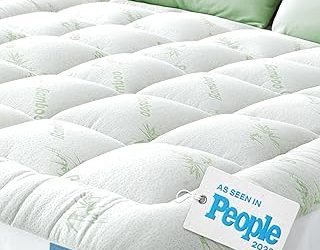
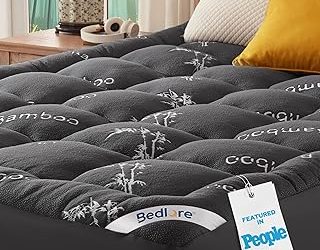
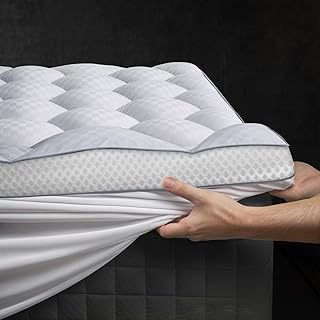
Foam traps heat, and overheating wakes you up, which means more tossing and more time in positions that strain your back. Look for gel infusion, open-cell structure, or perforated designs. Breathable covers matter too. The BEDLORE Viscose Bamboo topper leans on bamboo-derived fabric for airflow and moisture handling, a sensible pick for hot sleepers who still want a thick pillow-top feel. CertiPUR-US and Oeko-Tex certifications, listed on both the JSELF and Sleepyhead models, tell you the foam and textiles have been tested for emissions and restricted substances.
Install It So It Stays Put
A topper that migrates all night is worse than none. Check the skirt depth against your actual mattress: measure from the top surface to where the box spring begins, then confirm the stated pocket range covers it. Six to twenty-one inch pockets, like those on the Ultra-Fluffy and 1000GSM models, handle almost anything. Strap-based systems such as the SHOUREN four-way straps anchor at the corners instead. Non-slip backings help on smooth mattress covers.
Tips
- Unbox foam 48 to 72 hours before you plan to sleep on it. Compressed foam needs time to reach full loft, and rushing it means you’re judging a topper that isn’t finished expanding.
- Skip the fitted sheet for the first night if you can. A tight sheet compresses foam and masks how the topper actually contours.
- Rotate the topper head to foot every couple of months to spread wear the way you’d rotate tires.
- If you sleep on your stomach, go thinner than you think. Deep contouring lets the pelvis drop and hyperextends the lumbar spine.
Frequently Asked Questions
Will a topper fix a sagging mattress?
No. A topper conforms to whatever is beneath it, so a dip in the core will telegraph straight through. Plywood under the mattress is a temporary patch at best. If the level test shows a hollow, budget for a new mattress and use the topper on top of it.
Is firmer better for back pain?
Not automatically. Research generally points toward medium-firm as the best starting point. Too firm leaves your lumbar curve unsupported; too soft lets your hips sink out of alignment. The goal is a level spine, not maximum resistance.
How long do foam toppers last?
Three to five years for most, depending on density and body weight. Watch for permanent body impressions that don’t recover within a few hours of getting up. That’s the signal the cell structure has broken down.
Can I wash a memory foam topper?
Never put foam in a washing machine. Spot clean with mild detergent and let it air dry fully. Removable, washable covers, like the ones on the Sleepyhead and BEDLORE models, are the practical solution.
Conclusion
Treat this like any other repair: measure first, identify the actual fault, then pick the material that addresses it. A three-inch gel memory foam topper solves the most common complaint of a bed that’s too firm for comfortable alignment, five inches handles severe firmness or heavier side sleepers, and fiber pillow-tops add plush comfort where support isn’t the issue. Give the foam a few nights to break in and your body a couple of weeks to adjust before you judge the result.