You pull the starter rope or press the switch and wonder, why won’t my snow blower start? On a gasoline machine, an incorrect control setting, stale fuel, or a faulty spark plug is often to blame. On a cordless model, a depleted or temperature-protected battery or an incorrect start sequence may be the issue. Corded machines introduce outlet and extension-cord problems. Your power source determines the first check.
Quick Answer: Stop the machine and identify whether it uses gasoline, a removable battery, or a power cord. Check the safety key and start controls, then fuel quality or electrical supply, before investigating ignition or frozen auger parts. Do not run a gas engine in a garage, even with the door open. Disconnect the power source before clearing an obstruction, and seek service for leaks, damaged wiring, or stubborn jams.
As an Amazon Associate we earn from qualifying purchases.
By DIY Ideas 4 Home Editorial Team
Why Your Snow Blower Will Not Start: Common Causes
A silent motor and an engine that cranks but never fires are different clues. Briggs & Stratton’s 2026 snow blower troubleshooting guidance points owners toward the starting controls, fuel, spark plug, and carburetor. For cordless units, the EGO SNT2400 owner’s manual identifies battery condition and control timing instead. Use this chart to choose the first sensible inspection.
| Symptom or Sign | Likely Cause | First Check | DIY or Pro |
|---|---|---|---|
| Gas engine does not fire after storage | Old gasoline or restricted carburetor | Age of fuel and fuel valve | Basic fuel checks DIY; carburetor service if needed |
| Gas engine does not fire and controls look off | Missing key, choke or primer error | Model-specific starting sequence | DIY |
| Engine cranks but still will not ignite | Loose or worn spark plug connection | Spark plug lead and plug condition | Basic inspection DIY; ignition repair pro |
| Battery snow blower stays unresponsive | Low charge, temperature protection or control timing | Battery latch, indicator and start procedure | DIY checks; electronics repair pro |
| Corded snow blower is completely silent | No outlet power or damaged cord | GFCI, outlet, cord and switch sequence | Basic checks DIY; wiring repair pro |
| Auger seems locked after wet snow freezes | Ice or debris blocks moving parts | Visual inspection with power isolated | Clear with specified tool; damaged auger pro |
1. Starting Controls Are Set Incorrectly
A gas snow blower can have fuel and spark yet fail to fire if its ignition key is missing, a fuel valve is closed, or the choke is set incorrectly for a cold start. Many engines also have a primer button or throttle setting. Toro’s Residential Help Topics calls for fresh fuel, the key in the On position, a closed choke for applicable cold starts, and firm priming without overpriming. The number of primer presses is determined by the particular engine manual, not by a rule for every snow blower.
Pay attention to what actually happens when you try the machine. A rope starter that pulls normally but produces no attempt to fire suggests a combustion or control problem. An electric-start button that does nothing may instead indicate the starter’s power supply, especially on a gas machine fitted with a plug-in starter motor.
2. Old Fuel Prevents Proper Combustion
Gasoline left through the off-season can lose its ability to support reliable starting and leave deposits in a carburetor. Briggs & Stratton’s Small Engine Problem Solving Tips, updated April 2026, says untreated fuel can begin breaking down after about a month. Toro advises checking for fuel less than 30 days old in its single-stage snow thrower troubleshooting guide. Treat that as a conservative manufacturer practice rather than a universal expiration date for every gasoline blend and storage condition.
If the engine runs briefly on its first attempt but then stalls, restricted fuel flow is one possibility. A clogged carburetor, obstructed fuel-cap vent, or closed fuel valve can produce overlapping symptoms. Fresh gasoline may resolve an age-related issue, but it cannot reliably dissolve a severely blocked carburetor without further service.
3. Spark Plug, Oil or Fuel Vent Problems
On gasoline engines, the spark plug must fire at the correct time to ignite the fuel mixture. Briggs & Stratton’s January 2026 starting video explains that a plug found wet with gasoline can suggest fuel is reaching the combustion chamber, while a dry plug can point toward fuel delivery. Neither observation alone proves a specific failed part. A cracked insulator, worn electrode, loose plug cap, or incorrect plug gap can prevent ignition.
Toro’s operator troubleshooting table also lists oil that is too low or too high and a restricted fuel-cap vent as possible contributors to hard starting on certain engines. Check the level with the machine positioned as its manual requires, and do not bypass any low-oil protection or improvise ignition wiring to make the engine run.
4. A Cordless Battery or Start Lockout
Battery machines have no carburetor or spark plug, so gas-engine repairs do not belong in their diagnostic path. EGO’s SNT2400 56V owner’s manual explains that this model requires a secured battery, a timed safety-button operation, and an auger-trigger press while an indicator flashes green. Missing that timing can make an otherwise charged snow blower appear dead.
Cold-weather protection is another possibility. The same EGO manual says a battery at about -4 degrees F or colder may prevent proper starting and directs owners to let the battery warm indoors for at least 10 minutes before trying again. That temperature and interval apply to the cited model; follow the temperature and charging limits for your own battery. Do not heat a lithium-ion pack with a hair dryer or place it near a heater.
5. The Corded Machine Has No Electricity
For a corded snow blower, begin at the outlet rather than disassembling the motor. A tripped ground-fault circuit interrupter, unseated extension-cord connection, worn cable, or incorrect safety-switch sequence can keep the machine silent. Snow Joe’s SJ625E operator’s manual specifies a 15-amp motor, recommends GFCI protection, and requires an outdoor-rated extension cord of sufficient gauge. Its cable recommendations apply to this model, not automatically to every corded snow blower.
Check the power circuit with a safe device only after removing the snow blower plug. If the extension cord is cut, crushed, warm at the connectors, or wet internally, stop and replace it with one meeting the manufacturer’s requirements. Do not tape over exposed conductors or try repeated resets when a GFCI continues to trip.
6. Ice or Debris Locks the Auger
Wet snow can refreeze around the auger or impeller after a machine sits outdoors. Some battery snow blowers detect the obstruction and refuse to engage, while an engine-driven machine may stall under load. The EGO SNT2400 troubleshooting table specifically lists a frozen auger among no-start causes. That does not mean every machine’s starter is mechanically coupled to the auger, so avoid forcing the recoil rope on the assumption that ice is the only problem.
The U.S. Consumer Product Safety Commission’s snow thrower safety guidance, Release 90-028, warns against putting hands into the discharge chute or auger housing. Residual force can move machinery after shutdown. Inspect from a safe distance only after stopping the engine and disconnecting its spark-plug lead, removing a cordless battery, or unplugging a corded model as appropriate.
How to Fix a Snow Blower That Will Not Start
Work through these checks from least invasive to most technical. A simple control mistake can mimic an expensive engine failure, and a dead outlet can look like a burned-out electric motor. Keep the operator’s manual nearby because start interlocks, oil specifications, and fuel systems vary substantially between machines.
Step 1: Shut Down and Inspect Safely
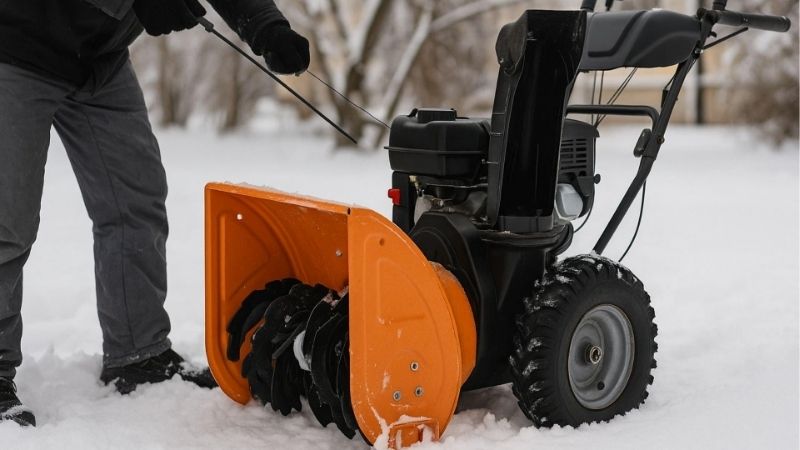
Release the controls and turn the machine off. For a gasoline model, remove the ignition key and disconnect the spark-plug wire before touching components; allow the engine and muffler to cool. For a cordless model, remove the battery pack. For a corded one, unplug it from the outlet. Check for packed snow, sticks, bent auger parts, leaking gasoline, and damage to the starter cord without inserting fingers into moving-part openings.
If the chute or auger contains ice, use the supplied clean-out tool or the procedure identified by the maker only after power is isolated and all parts have stopped. Letting packed snow thaw in a suitable safe area may help, but never use an open flame or force a jammed auger. The CPSC specifically recommends a stick or purpose-built clean-out tool, never a hand. After inspection, reinstall all guards before any later start attempt.
Step 2: Repeat the Correct Start Sequence
Reconnect or reinstall the power source only when covers, cables, and moving parts are ready for operation. If your unit is gas-powered, check the key, engine switch, fuel shutoff, choke, primer, and throttle against the actual manual. On the Toro models described in its help guide, the cold-start sequence uses the choke and primer, while a warm restart may not need those settings. Repeated aggressive priming can flood an engine and make starting harder.
Try the recommended procedure in a clear outdoor location. Gas engines must never be run in a garage, shed, or other enclosed area. The CDC’s Carbon Monoxide Poisoning Basics, reviewed in January 2026, explains that combustion exhaust can cause serious poisoning even when a garage door is open. If a gas engine smells strongly of fuel after failed starts, stop, allow vapors to dissipate outdoors, and consult the manual’s flooded-engine procedure before trying again.
Step 3: Replace Questionable Fuel
Check the age and appearance of gasoline in the tank. If it has been stored for months without appropriate treatment, plan to remove it following your owner’s manual, local waste rules, and the fuel-container instructions. Do this outdoors with the engine cool, away from cigarettes, flames, electric sparks, and hot surfaces. Use an approved fuel container and avoid spills. If you are not comfortable handling gasoline or cannot safely drain the system, have a service shop do it.
Refill with fresh fuel that meets the engine maker’s gasoline and ethanol requirements. Open the fuel valve if fitted. Check the fuel cap for a blocked vent according to the manual, without operating the machine with an unsecured or damaged cap. Attempt the correct start sequence once more. A machine that still refuses to run, or dies almost immediately despite fresh fuel, may need carburetor service rather than a string of repeated pulls.
Step 4: Check Ignition and Engine Oil
With the gas engine switched off, cooled, and isolated, inspect whether the spark-plug boot sits securely. Remove the plug only if your engine manual provides a service procedure you can follow. Look for fouling, cracked ceramic, a damaged terminal, or visible wear. Replace it only with the specified part and gap; a part that happens to screw into the cylinder head is not necessarily the correct heat range or electrode design.
Check the engine oil level as directed by the engine maker, including how the dipstick should be seated during measurement. Briggs & Stratton’s 2026 starting guidance suggests progressing from fuel and plug checks to a proper ignition test if the engine still will not fire. Never hold an unplugged spark plug against the engine in your hand while cranking. A suitable spark tester and trained handling are safer than improvised methods. Leave coil wiring or compression diagnosis to a small-engine technician.
Step 5: Restore Battery Power Correctly
For cordless machines, check the charger status, battery charge indicator, and the latch that holds the pack in place. Use only the approved battery and charger for your model. Remove any battery displaying a fault, swelling, physical damage, or unusual heat, and follow the manufacturer’s response instructions. A low battery may power the lights but still be unable to engage the auger under load.
If a pack has been left in extreme cold, bring it into an indoor location permitted by its manual and allow its temperature to return to the specified operating range naturally. On EGO SNT2400 equipment, the manual describes a safety-button hold and an auger-trigger press during a flashing indicator. Other manufacturers may use a different interlock. If the machine runs after a proper charge and corrected starting sequence, there is no reason to buy a replacement pack solely because it initially seemed unresponsive.
Step 6: Check the Cord, Outlet and Interlock
For corded equipment, unplug before checking the extension cord. Look for insulation damage, loose plugs, moisture, and a disconnected cord restraint. Check the outlet’s GFCI or circuit breaker following safe household electrical practice. The Snow Joe SJ625E manual specifies 14 AWG cable for lengths up to 50 feet and 12 AWG for runs over 50 feet through 100 feet, using suitable outdoor-rated cords. Those numbers are specific to that manual; always select cord size for the current draw and limits of your own machine.
Reconnect to a suitable dry, protected outlet only after the cord and unit pass inspection. Press the start button and hold the control bar exactly as the maker illustrates. If a different working appliance confirms an energized outlet but the blower remains silent, stop troubleshooting at the external connections. Opening a sealed switch assembly or bypassing an interlock introduces electrical and moving-part hazards better handled by an authorized repair center.
Products That Help
The Briggs & Stratton 84003327 Ignition Tester is a named in-line spark diagnostic tool offered by the engine manufacturer’s official store. It may help a qualified owner distinguish an ignition issue from a fuel issue on a compatible gasoline engine; check the part listing and engine manual before buying. The brand’s U.S. store listed it at $20.71 as of October 2026, but current pricing and suitability can change. A basic charger-status inspection is more relevant for cordless machines, and a plug-in tester will not diagnose a lithium-ion battery.
STA-BIL Storage Fuel Stabilizer 22214 is the 32-ounce version identified on Gold Eagle’s product page. For future storage, Gold Eagle specifies approximately 1 fluid ounce for each 2.5 gallons of fresh gasoline and describes conditional protection for up to 24 months. The manufacturer explicitly says its stabilizer will not turn old gasoline into fresh fuel. Buy it for preventive fuel storage if allowed by your engine manual, not as a guaranteed solution to a carburetor already blocked by deposits.
When to Call a Pro
Stop and seek professional service when the recoil starter is locked after ice and debris have been ruled out, the engine has a persistent fuel leak, the plug lead or ignition wiring is damaged, or the gas machine repeatedly fails with fresh fuel and correctly set controls. Carburetor disassembly, compression work, switch repairs, and battery electronics are not sensible first-time repairs during a snowstorm. Also stop if a corded unit repeatedly trips a breaker or GFCI, if a battery pack shows physical damage, or if the auger is bent.
Have the model number, engine designation, fuel age, symptom, and actions already taken ready for the dealer. Tell the technician whether the machine is silent, cranks without firing, fires once and dies, or powers on but does not turn its auger. Those distinctions make the diagnosis more useful than describing the failure simply as a machine that will not start.
Frequently Asked Questions
Once the first external checks are complete, these questions help you decide whether another safe inspection is useful or whether the equipment needs repair. They also prevent gasoline-engine advice from being applied to electric machines.
Should I Spray Starting Fluid Into the Engine?
Not as a routine first response. Aerosol starting aids are flammable, and some engine makers restrict their use. A machine that does not respond to its documented choke, primer, and fresh-fuel procedure needs diagnosis rather than repeated chemical spraying. Consult the engine manufacturer’s instructions and a service technician before using any starting aid. Never spray it near hot exhaust, sparks, or an indoor work area.
Why Does It Start and Die After a Few Seconds?
A gas machine that fires briefly and then stalls may have restricted fuel delivery, stale gasoline, or a choke setting that is no longer appropriate as the engine warms. Observe the controls and any fuel leaks without reaching toward the hot engine. On a battery blower, a motor that engages and then stops can signal protection against overheating or a jam. Separate the symptom by power source before purchasing replacement parts.
What if the Starter Rope Will Not Pull?
Do not yank harder. A recoil starter can bind because of a damaged starter mechanism, internal engine damage, or a mechanical obstruction in a particular drive design. Turn the machine off, isolate the spark-plug wire, and inspect only the outside of the auger housing and starter mechanism. If the rope remains locked after permitted external checks, arrange professional inspection. Forcing the rope can worsen the fault and cause injury.
How Do I Avoid the Same Problem Next Storm?
After each use, follow the manufacturer’s shutdown and snow-removal instructions to reduce refreezing around the auger. Store battery packs within the temperature range in their own manual, and check the charge before a forecast storm. For gas equipment, avoid aging untreated gasoline through the off-season; Toro’s guidance uses a less-than-30-day freshness check for certain machines. Our snow blower maintenance guide covers seasonal oil, wear-part, and storage work in more detail.
Final Thoughts
For a snow blower that will not start, identify its power system and look for the least invasive explanation first: a control that is off, gasoline that has aged, a discharged battery, or a cord without power. If safe external checks and the model-specific starting procedure do not restore operation, document the symptoms and take the machine to an authorized shop rather than defeating a safety switch or probing live wiring. Before buying a plug, tester, battery, or fuel additive, confirm the exact model and the part’s intended use. That single compatibility check can prevent another frustrating no-start morning.