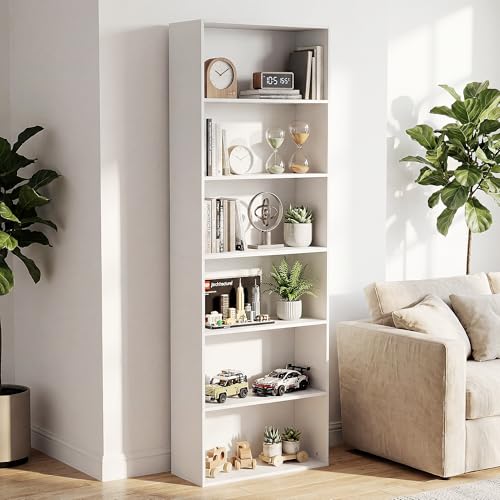
The best bookshelf overall is the GRUSIGN 71″ Tall 6-Tier Bookshelf, with the Sauder 5-Shelf Bookcase in Select Cherry as the runner-up. The GRUSIGN wins on usable vertical storage and open access, while the Sauder brings a warmer finish and a more traditional office look.
Here’s the problem most home office buyers run into: bookshelves are sold on looks, but they fail on physics. Flat-pack shelves sag under a row of hardcover manuals, thin hardboard backers rack out of square, and a 71-inch tower with a 9-inch footprint becomes a genuine hazard when you’re rolling a chair around it all day. This guide is written from the workbench — I’ve assembled, reinforced, and in a couple of cases rebuilt these units. Below you’ll find a comparison table, the five buying criteria that actually predict whether a shelf survives, honest picks by use case, and the small DIY upgrades that turn a budget bookcase into something that feels custom.
Our top picks





As an Amazon Associate we earn from qualifying purchases at no extra cost to you.
Quick Comparison
| Product | Best For | Standout Feature | Rating |
|---|---|---|---|
| GRUSIGN 71″ 6-Tier Bookshelf | Maximum open storage | 71″ height with wide, evenly spaced tiers | Highly rated |
| Furinno LUDER 5-Tier | Tight budgets and tight walls | 9.4″ depth, tool-light assembly | Highly rated |
| Sauder 5-Shelf Bookcase | Traditional office aesthetics | Select Cherry finish, adjustable shelves | Well rated |
| SUNMORY 6-Tier Tree Bookshelf | Corners and awkward gaps | Tree silhouette plus closed cabinet | Well rated |
| Sweetcrispy 5 Shelf Bookcase | Display and mixed storage | Open frame that reads light in small rooms | Well rated |
How to Choose a Bookshelf
- Shelf span and thickness: Sag is a function of span, not price. Anything wider than about 30 inches of unsupported particleboard will bow under books. A 1/4-inch plywood strip glued to the shelf’s front edge stiffens it dramatically.
- Backer panel quality: The thin back panel is the shelf’s shear wall. If it’s stapled hardboard, plan to swap it for 1/4-inch plywood and screw it every six inches — this single change eliminates most wobble.
- Depth versus your room: Standard hardcovers need roughly 9–11 inches. Narrow units like the LUDER fit behind a door swing; deeper units eat floor space you’ll notice when your chair rolls back.
- Anchoring hardware: Any unit over 50 inches tall needs a wall strap into a stud. Check whether an anti-tip kit is included, and keep a stud finder and 2.5-inch screws on hand regardless.
- Fixed or adjustable shelves: Adjustable shelves let you fit binders, printers, or a small paper tray. Fixed shelves are more rigid but lock you into whatever the designer assumed you own.
The Best Bookshelfs Reviewed
Best Overall: GRUSIGN 71″ Tall 6-Tier Bookshelf
Six generous tiers at 71 inches give you the most linear shelf space of anything here, which makes it the right call for anyone consolidating reference books, files, and gear onto one wall. The white finish keeps a tall unit from feeling heavy, and the frame takes wall anchoring cleanly — do that before you load it.
Best Budget: Furinno LUDER 5-Tier Bookshelf
At 9.4 inches deep and just under 52 inches tall, the LUDER is the shelf for renters, students, and anyone filling a narrow wall gap on a small budget. Assembly is genuinely quick; add a dab of wood glue in the cam-lock holes and felt pads underfoot and it punches well above its price.
Best Premium: Sauder 5-Shelf Bookcase, Select Cherry
Sauder’s engineering and finish quality show in the adjustable shelves and the warmth of the Select Cherry laminate, making this the pick for a client-facing office or a room with existing wood furniture. It’s the most convincing “built-in” candidate if you later add a baseboard trim strip.
Best for Corners and Small Spaces: SUNMORY 6-Tier Tree Bookshelf
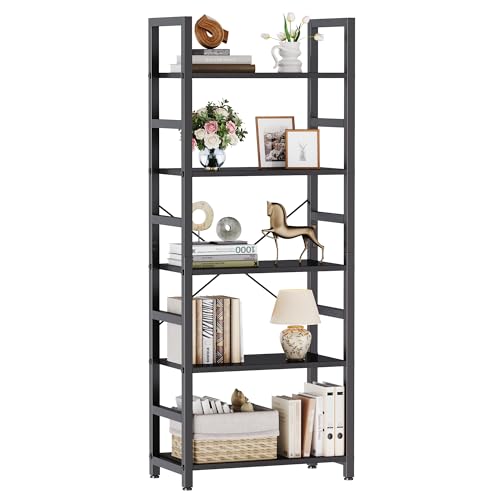
The staggered tree layout tucks into corners and dead zones where a rectangular case won’t fit, and the closed cabinet at the base hides cables, chargers, and the clutter you don’t want on display. Best for lighter loads — paperbacks, plants, and decor rather than a legal library.
Best for Open Display: Sweetcrispy 5 Shelf Bookcase
Its airy open frame keeps sightlines clear, which matters in a small home office where a solid wall of shelving would feel oppressive. Choose it if you’re mixing books with photos, speakers, and objects rather than maximizing raw capacity.
Frequently Asked Questions
Do I really need to anchor a bookshelf to the wall?
Yes, for anything above roughly 50 inches. Tall, narrow cases have a small footprint and a high center of gravity once loaded. Locate a stud, use the supplied strap or an L-bracket, and drive a 2.5-inch screw into solid wood.
How do I stop shelves from sagging?
Reduce the unsupported span or add stiffness. Glue and clamp a 1/4-inch plywood or hardwood strip along the front edge of the shelf, or add a center support post. Distributing heavy books across lower shelves also helps.
Can I upgrade the look of a flat-pack bookcase?
Easily. Peel-and-stick veneer or a coat of bonding primer plus enamel transforms laminate. Adding a simple face frame of 1×2 poplar and painting it to match the wall makes the unit read as built-in cabinetry.
What tools should I have before assembly?
A #2 Phillips screwdriver (not a drill on full torque, which strips particleboard), a rubber mallet, a small square to check for racking, wood glue, and a stud finder. Twenty dollars of tools prevents most assembly complaints.
Final Thoughts
For most home offices, the GRUSIGN 71″ 6-Tier delivers the best storage-per-square-foot and takes reinforcement well, while the Sauder Select Cherry is the choice when finish quality matters more than raw capacity. If you’re outfitting a small or temporary space, the Furinno LUDER remains the smartest low-cost buy — especially with an hour of DIY stiffening and a wall anchor.