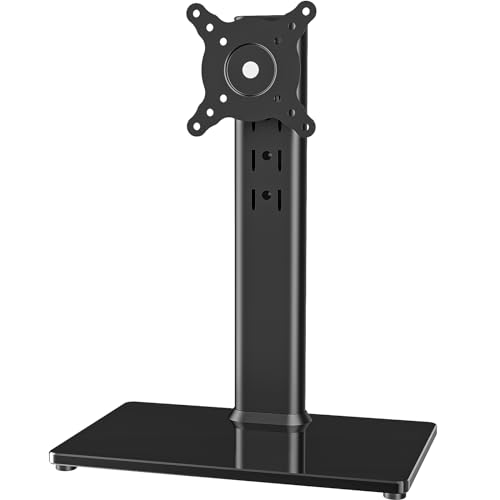
After building, drilling, and re-clamping more desk setups than I care to admit, the best overall monitor stand is the Single LCD Free-Standing Desk Stand Mount Riser (HT05B-001), with the HUANUO FlowLift Dual Monitor Stand as the runner-up.
Here’s the problem most of us hit: you finally get the desk right — maybe a slab of butcher block on a standing frame, maybe an L-shaped corner build — and then a factory monitor foot eats the middle third of it. Stock stands don’t raise high enough, they don’t swivel, and they turn your keyboard tray into a cable nest. This guide covers what actually matters when you’re mounting to a DIY or semi-custom desktop: clamp jaw capacity, grommet options, VESA compatibility, real load ratings, and when a free-standing base beats a clamp entirely.
Our top picks


As an Amazon Associate we earn from qualifying purchases at no extra cost to you.
Quick Comparison
| Product | Best For | Standout Feature | Rating |
|---|---|---|---|
| Single LCD Free-Standing Desk Stand (HT05B-001) | Most desks, no drilling | Weighted base holds up to 77 lbs | See card above |
| HUANUO FlowLift Dual Monitor Stand | Two-screen setups on a budget | C-clamp or grommet mount included | See card above |
| WALI Computer Monitor Stand for Desk | Laptops and non-VESA screens | 44 lb riser platform | See card above |
| ErGear Single Monitor Arm | Ultrawide monitors | Tool-free VESA plate, 13–34″ | See card above |
| gianotter Dual Monitor Stand Riser | Desk storage and organization | Built-in drawer and pen holders | See card above |
How to Choose a Monitor Stand
- Measure your desktop thickness first: Most C-clamps top out around 2.4″. A 1.5″ butcher block is fine; a doubled-up plywood edge or a thick live-edge slab may not be, and that’s when a free-standing base wins.
- Check the rear edge, not just the surface: Clamps need flat, unobstructed access underneath. Aprons, cable trays, and standing-desk crossbars are the usual culprits — measure before you buy.
- Match VESA and weight honestly: Confirm 75×75 or 100×100 on your monitor’s back, then weigh the panel without its stand. Arms rated for 19.8 lbs sag at 22 lbs, no matter what the box says.
- Decide if you’ll drill a grommet: A 2″ hole saw and ten minutes gives you the most rigid mount possible and a clean cable path. If the desktop is a rental or a laminate you’d rather not cut, skip it.
- Plan cable routing before assembly: Route through the arm channels while it’s still loose on the bench. Retrofitting cables through a tightened gas-spring arm is a genuinely miserable job.
The Best Monitor Stands Reviewed
Best Overall: Single LCD Free-Standing Desk Stand Mount Riser (HT05B-001)
This is the pick for anyone with a desktop they don’t want to clamp or cut — thick slabs, glass tops, or a corner desk where the rear edge is unreachable. The 77 lb base capacity means it stays planted even with a heavy 32″ panel, and you still get swivel, rotation, and height adjustment.
Best Budget: HUANUO FlowLift Dual Monitor Stand
Best for makers running two 13–32″ screens who want mounting flexibility without overspending. It ships with both a C-clamp and a grommet base, so if you drill a pass-through later, you don’t buy new hardware.
Best Premium: WALI Computer Monitor Stand for Desk
Ideal if your setup includes a laptop, an all-in-one, or an older monitor with no VESA holes. The 44 lb platform is stiff enough to double as a small shelf, and it creates usable storage underneath for a keyboard or notebook.
Best for Ultrawide Monitors: ErGear Single Monitor Arm
Built for 13–34″ screens, this is the one to grab if you run a single wide panel and reposition it often. Tool-free VESA mounting makes the install genuinely fast, which matters if you’re still tweaking desk layout.
Best for Small Desks: gianotter Dual Monitor Stand Riser With Drawer
A smart choice for compact or shared workspaces where every square inch counts. The integrated drawer and pen holders replace a desktop organizer, and the riser lifts both screens without any clamping or drilling.
Frequently Asked Questions
Can I clamp a monitor arm to a DIY plywood desktop?
Yes, if it’s at least 3/4″ thick and reasonably dense. Add a hardwood or steel backer plate under the clamp to spread the load and prevent the veneer from crushing.
Do monitor arms work on standing desks?
They do, and they’re arguably better there — the monitor moves with the desktop. Just confirm the clamp clears the frame’s rear crossbar.
How do I know my monitor is VESA compatible?
Look for four threaded holes in a square on the back, 75mm or 100mm apart. If the stand hides them, remove it; if there are none, use a riser like the WALI instead.
Riser or arm — which should I build around?
Arms if you want ergonomic height and reach adjustment. Risers if you want storage, a fixed comfortable height, and zero hardware commitment.
Final Thoughts
For most home office builds, the Single LCD Free-Standing Desk Stand (HT05B-001) is the safest and most flexible choice since it ignores desk thickness entirely. Go with the HUANUO FlowLift for a clamped or grommeted dual-screen setup, or the WALI riser if your screen has no VESA holes at all.