You are standing in the tool aisle, or scrolling through online listings, staring at a common DIY crossroads: a round-padded sander that spins, and a pointed, iron-shaped sander that vibrates. Both promise to transform your rough, peeling, or outdated wooden surfaces into smooth, paint-ready masterpieces. However, choosing the wrong tool for your specific home project can result in ruined furniture corners, endless manual hand-sanding, or unsightly swirl marks that show through your fresh coat of stain.
As we look at the home improvement landscape in 2026, the focus has firmly shifted toward efficient, dust-controlled DIY restoration. Homeowners are opting to restore high-quality vintage furniture and architectural trim rather than buying cheap, disposable alternatives. To do this successfully, you need the correct abrasive tool. The real decision comes down to a balance of surface area, precision, and material removal speed. Let us break down the differences between the versatile random orbital sander and the precise detail palm sander to help you make the right investment for your home.
Our top picks

 DEWALT Random Orbit Sander
- 3-Amp motor spins the pad at 8,000 -…
- Separate counterweight design reduces vibration for improved comfort
- Improved dust-sealed switch protects against dust ingestion for…

As an Amazon Associate we earn from qualifying purchases at no extra cost to you.
Quick Verdict
If you are refinishing large, flat surfaces like dining tables, doors, or open shelving, buy a random orbital sander. Its dual-action rotation prevents swirl marks and strips material quickly. However, if your projects involve intricate furniture with tight 90-degree corners, chair spindles, or decorative trim, buy a detail palm sander. Its pointed triangular pad reaches where round sanders physically cannot. Most homeowners tackling a mix of projects eventually own both, but starting with the one that matches your immediate project scale will save you hours of manual labor.
Side by Side
To help you visualize how these tools compare across key ownership metrics, we have compiled a direct side-by-side comparison. These values reflect standard consumer-grade corded electric models typically used in residential workshops.
| Feature | Random Orbital Sander | Detail Palm Sander |
|---|---|---|
| Comfort & Weight | 2.5 to 3.5 lbs; requires a firm two-handed or palm grip on larger models. | 1.5 to 2.2 lbs; ultra-lightweight, easily operated with one hand. |
| Durability | High; robust motors (2.0 to 3.0 amps) designed for sustained pressure. | Medium; smaller motors (1.0 to 1.2 amps) prone to overheating if forced. |
| Price Range | $30 to $150+ (varies by brand and speed settings). | $20 to $70 (generally highly affordable). |
| Maintenance | Low; periodic replacement of the circular hook-and-loop backing pad. | Moderate; the pointed tip of the backing pad wears down quickly. |
| Space Needed | Moderate footprint; requires storage space for 5-inch discs. | Very compact; fits easily into shallow utility drawers. |
| Look & Profile | Industrial, cylindrical body with a prominent top-grip handle. | Sleek, low-profile iron-shaped design that fits the palm. |
| Resale Value | Moderate to High; always in demand by general woodworkers. | Low to Moderate; often viewed as a specialized hobbyist tool. |
| Best For | Broad flat surfaces, rapid paint removal, and ultra-smooth finishing. | Sharp corners, window moldings, chair legs, and intricate crafts. |
Where Random Orbital Sander Wins
The primary advantage of the random orbital sander lies in its unique mechanical movement. Unlike standard orbital sanders that simply vibrate in a circle, a random orbital sander utilizes a dual-action drive. The pad spins in a circle while simultaneously oscillating in small ellipses. This means the abrasive particles never travel the exact same path twice, virtually eliminating the risk of leaving circular swirl marks—often called “pig-tails”—on your wood. This makes it the undisputed champion for preparing wood for stain or clear polyurethane, where scratch marks are easily highlighted.
Power is another major checkmark in the win column. These machines typically feature motors ranging from 2.4 to 3.0 amps, providing the torque required to strip multiple layers of old paint, varnish, or rust. When you have a massive mahogany dining table to strip down to the bare grain, a 5-inch circular pad covers surface area quickly and evenly, ensuring you do not accidentally create valleys or uneven spots in the wood.
For homeowners looking for an affordable entry point, the SKIL 5” Random Orbital Sander with Cyclonic Dust Box & 3pc Sanding Sheet – SR211601, Multicolor (priced at $37) offers excellent dust separation to keep your workspace clean. If your projects involve varying wood densities—such as soft pine trim followed by a hard oak tabletop—upgrading to a professional-grade tool like the DEWALT Random Orbit Sander, Variable Speed, 5-Inch (DWE6423), Power Source Corded Electric (priced at $79) allows you to dial down the speed to prevent burning the wood fibers while benefiting from a highly durable build.
Where Detail Palm Sander Wins
While a random orbital sander is a powerhouse, it has a glaring physical limitation: it cannot reach into a corner. Because the pad is a 5-inch circle, attempting to sand a 90-degree corner—such as the inside of a drawer, a built-in bookshelf, or a paneled door—leaves an unsanded triangle in every single corner. This is where the detail palm sander, often called a “mouse” or “iron” sander, shines.
The triangular design allows you to press the pointed tip directly into tight corners, sanding flush against perpendicular walls. Furthermore, detail sanders are exceptionally lightweight and compact. Because they only vibrate and do not spin, they are much easier to control with a single hand, making them the ideal choice for vertical surfaces, overhead door frames, and delicate window moldings where a heavier sander would cause rapid hand and arm fatigue.
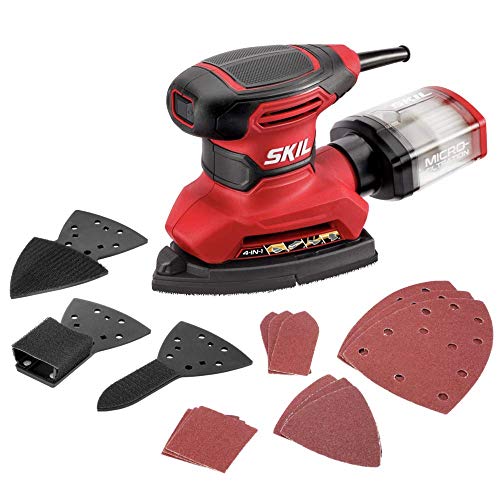
If you are working on highly complex pieces, tools like the SKIL Corded Multi-Function Detail Sander with Micro-Filter Dust Box 3 Additional Attachments & 12pc Sanding Sheet- SR232301 (priced at $39) provide specialized finger attachments that slip into tiny slots and slats, such as those found on window shutters. For those who only need a reliable tool for occasional crafting or quick furniture touch-ups, the WEN 6301 Electric Detailing Palm Sander (priced at $21.32) offers an incredibly cost-effective solution that outperforms manual hand-sanding blocks by a landslide.
Cost Over 5 Years
When calculating the true cost of ownership, looking solely at the purchase price of the tool is a common mistake. The real long-term expense of any sanding system lies in its consumables: the sandpaper sheets.
Random orbital sanders use industry-standard 5-inch, 8-hole hook-and-loop discs. Because this format is used by professionals and DIYers alike worldwide, these discs are manufactured in massive quantities. You can easily purchase bulk packs of 100 discs in various grits online for $15 to $25, bringing the cost per sheet down to roughly $0.15 to $0.25. Furthermore, because the pad rotates, the wear is distributed relatively evenly across the entire surface of the disc.
In contrast, detail palm sanders use specialized triangular sheets. Because these shapes are often proprietary to specific tool brands, they are rarely sold in ultra-cheap bulk packs. You can expect to pay $0.50 to $0.90 per sheet. More importantly, detail sanders suffer from uneven wear. The pointed tip of the triangle does 90% of the work when you are sanding corners, meaning the tip will wear down to the bare backing pad while the middle and rear of the sheet remain perfectly intact. This forces you to discard the entire sheet prematurely.
Over five years of moderate residential use (assuming 4 to 5 medium home projects per year):
- Random Orbital Sander: $60 initial tool investment + $40 in bulk sanding discs = $100 total cost.
- Detail Palm Sander: $30 initial tool investment + $90 in specialized triangular sheets (due to accelerated tip wear) = $120 total cost.
Which One for Your Home
Your living situation, family makeup, and long-term homeownership goals should heavily influence which tool you choose first.
Small Apartment
If you live in an apartment, space is limited, and you likely do not have a dedicated garage workshop. Your sanding will likely take place on a balcony or a small kitchen table. A detail palm sander is quiet, incredibly compact to store in a closet drawer, and highly manageable for small-scale decor flips. However, if you do opt for a random orbital sander, prioritize one with an integrated cyclonic dust box to prevent fine wood dust from coating your living space.
Family with Kids and Pets
For active households, safety and quick cleanup are paramount. Fine wood dust can linger in the air and settle on floors where children and pets play. In this scenario, a random orbital sander is the better choice because its round dust ports are designed to connect directly to a standard shop vacuum. This active extraction pulls up to 90% of the dust straight out of the air before it can settle in your home.
Rental Home
As a renter, you are unlikely to be sanding down built-in cabinets, baseboards, or outdoor decks. Your projects will primarily consist of restoring thrifted furniture, picture frames, and small wooden crafts. A detail palm sander gives you the precision required to restore delicate vintage items without the risk of aggressively sanding through thin veneers, which a high-powered orbital sander can do in seconds.
Long-Term Home
If you own your home, you will eventually face projects like refinishing a backyard deck, sanding down staircase treads, or painting exterior doors. A robust, variable-speed random orbital sander is an essential foundation for your home toolkit. It handles the heavy-duty surface preparation that home maintenance demands. You can easily supplement it with cheap manual hand-sanding blocks for the rare tight corners until you decide to invest in a secondary detail sander.
FAQ
Can I use a random orbital sander to sand into tight corners?
No. Due to its circular pad design, a random orbital sander physically cannot reach into a 90-degree corner. Attempting to force the edge of a round pad into a corner will result in ugly scuff marks on the adjacent vertical surface and will damage your sander’s backing pad.
Why does the sandpaper keep flying off my detail sander?
This is usually caused by heat buildup. If you press down too hard on a detail sander, the friction melts the tiny plastic hooks on the tool’s backing pad, preventing the sanding sheet from sticking. Always let the weight of the tool do the work, and replace the backing pad if the hooks are worn smooth.
Is variable speed a necessary feature for home projects?
While not strictly necessary for basic pine projects, variable speed is highly recommended if you work with delicate wood veneers, plastics, or old painted surfaces. Lowering the speed prevents the sander from generating excessive heat, which can melt paint and glue or quickly sand straight through thin finishes.
Do detail palm sanders use standard sandpaper sheets?
No. Detail sanders require pre-cut, hook-and-loop triangular sheets that match the specific hole configuration of your sander’s dust extraction ports. Attempting to cut standard rectangular sheets to fit will block the dust holes and lead to rapid dust buildup on your workpiece.