Key takeaways
- Flattening one face and squaring one edge takes 30 seconds per board instead of 10 to 15 minutes with a hand plane.
- Opens up rough-sawn lumber, which typically costs 30 to 50 percent less per board foot than S4S stock.
- Glue joints on panels close up tight with no visible line, because both edges are truly straight and square.
- Pairs with a planer to produce boards of exact thickness with two flat, parallel faces.
- Spiral cutterheads leave a surface that needs only light sanding at 150 grit.
- Benchtop models run on a household 15-amp circuit and store on a shelf when not in use.
- Removes twist and cup that a table saw or planer alone cannot fix, since those tools reference the existing surface.
The Short Answer
No, you do not need a jointer for small woodworking projects, with one condition: you are buying pre-milled S4S lumber (surfaced four sides) or you are willing to flatten a face and square an edge with a hand plane or a router jig. If instead you want to buy rough-sawn hardwood at half the price of S4S boards, or you are gluing up panels wider than 12 inches and need seamless joints, a benchtop jointer in the $270 to $330 range pays for itself within a few projects. For boxes, small shelves, cutting boards, and picture frames built from home-center boards, skip it and put the money toward a good square and a sharp plane.
What You Actually Get
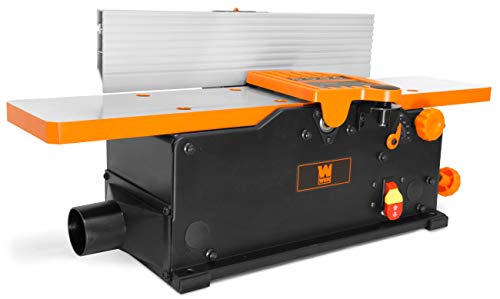
A benchtop jointer is a cast-iron or aluminum table, 28 to 30 inches long and 6 inches wide, split into an infeed and outfeed side with a spinning cutterhead between them. You set the infeed table 1/32 to 1/16 inch lower than the outfeed, push a board across, and the cutterhead shaves the high spots until the face is flat or the edge is straight and square to the fence. That is its entire job, and no other tool does it as quickly.
Our top picks

As an Amazon Associate we earn from qualifying purchases at no extra cost to you.
Two typical examples: the WEN JT630H, a 10-amp 6-inch model with a spiral cutterhead at about $273.83, and the CRAFTSMAN CMEW020, also 10-amp and 6-inch at about $329, rated for up to 22,000 cuts per minute. Both run on a standard 120V outlet, weigh 35 to 45 pounds, and take up roughly 30 by 20 inches of bench space. The spiral head on the WEN uses small carbide inserts that you rotate when they dull rather than replacing straight knives, which reduces tear-out on figured wood. Straight-knife models are cheaper to buy but knives cost $20 to $40 a set and need careful alignment.
The 6-inch width is the real constraint. You can flatten a board up to 6 inches wide in one pass. Wider boards require ripping them down or using the jointer only for edges and flattening faces another way. Length is limited too: with 28 to 30 inches of total table, boards over about 4 feet become hard to control and tend to come out with a slight taper.
Pros
- Flattening one face and squaring one edge takes 30 seconds per board instead of 10 to 15 minutes with a hand plane.
- Opens up rough-sawn lumber, which typically costs 30 to 50 percent less per board foot than S4S stock.
- Glue joints on panels close up tight with no visible line, because both edges are truly straight and square.
- Pairs with a planer to produce boards of exact thickness with two flat, parallel faces.
- Spiral cutterheads leave a surface that needs only light sanding at 150 grit.
- Benchtop models run on a household 15-amp circuit and store on a shelf when not in use.
- Removes twist and cup that a table saw or planer alone cannot fix, since those tools reference the existing surface.
Cons
- Costs $270 to $330 for a machine that does exactly one thing.
- Six inches of width leaves out many common hardwood boards, which are sold at 7 to 10 inches.
- Short tables make boards longer than 4 feet difficult to joint accurately.
- Loud, typically 95 to 105 dB, and throws chips fast enough to need a dust collector or shop vac with a 2-1/2 inch port.
- Setup is fussy: the outfeed table must be dead level with the knives, and the fence needs squaring with a reliable square.
- Kickback and finger injuries are real risks on a tool that exposes a spinning cutterhead; push blocks are mandatory.
- Aluminum-table budget models can flex under a heavy board, giving a slight concave result.
Who Should Buy It
Woodworkers who want to build furniture from rough lumber, glue up panels for tabletops or cabinet sides, or produce parts that must be square for joinery like mortise-and-tenon or box joints. If you are buying more than about 50 board feet of hardwood a year, the savings from rough stock roughly cover the jointer within two years. It also belongs in the shop of anyone frustrated by gaps in glue-ups or drawers that will not sit square, since those problems almost always trace back to stock that was never truly flat.
Who Should Skip It
Anyone building small projects from S4S poplar, pine, or oak bought at a home center. Those boards arrive at a consistent 3/4 inch thickness with edges square enough for most work, and a table saw with a good blade cleans up the rest. Skip it too if your shop is a shared garage bay or an apartment balcony where a 40-pound, 100-dB machine has no permanent home, or if you enjoy hand-tool work and already own a No. 5 or No. 7 plane. Finally, if you have not yet bought a table saw or a planer, a jointer should not come first; both of those tools contribute more to a small shop.
Cheaper Alternatives
| Option | Cost | Trade-off |
|---|---|---|
| Buy S4S lumber | 30-50% more per board foot | No milling needed, but limited species and widths, and boards may still cup after purchase |
| Hand plane (No. 5 or No. 6) | $60-$200 | Silent and unlimited in width, but requires sharpening skill and 10-15 minutes per board |
| Table saw straight-line jig | $10-$30 in plywood and clamps | Produces a straight edge but cannot flatten a face or remove twist |
| Router with a straightedge or jointing bit | $30-$60 for bit and guide (router assumed) | Excellent for edges up to 8 feet; useless for faces |
| Planer sled | $20-$40 in MDF, shims, and hot glue | Flattens faces of any width your planer accepts, but slow to set up per board |
| Track saw or circular saw with guide | $50-$400 | Fast straight edges on sheet goods and long boards; edges need cleanup for glue joints |
FAQ
Can a planer replace a jointer?
Not by itself. A planer makes the second face parallel to the first, so if the first face is cupped or twisted, the planer copies the defect. A planer sled with shims lets you flatten a face, and many small-shop woodworkers use that method instead of buying a jointer.
Is a 6-inch jointer big enough?
For edges, yes; almost any board’s edge is under 6 inches. For faces, it handles roughly 60 to 70 percent of hardwood boards sold at retail. Wider boards can be ripped in half, jointed, and glued back together, which is standard practice.
How much does a benchtop jointer weigh and how loud is it?
Most 6-inch benchtop models weigh 35 to 45 pounds and run at 95 to 105 dB at the operator’s position. Hearing protection is not optional, and clamping or bolting the base to a bench eliminates most of the vibration.
Are spiral cutterheads worth the extra money?
For anyone jointing figured or reversing-grain wood, yes. The staggered carbide inserts shear rather than chop, cutting tear-out sharply, and each insert has four edges that you rotate rather than replace. Shopping in 2026, spiral heads have become common even on sub-$300 machines, so the premium over straight knives is often under $50.