Key takeaways
- Stops the drop-and-search cycle. Screws, nails, and bits stay on your forearm instead of rolling under the workbench or into the lawn.
- Faster ladder work. Hanging drywall, curtain rods, or a ceiling fan goes noticeably quicker when you are not climbing down for one more screw.
- Cheap enough to be disposable. At $4 to $10, it costs less than most single drill bits.
- Keeps small parts organized during disassembly. Pull six screws out of a laptop or a faucet handle and they stay in order on your wrist.
- Works with gloves. The magnets pick up parts you would otherwise fumble with a gloved hand.
- Doubles as a retrieval tool. Sweep your wrist over the floor or inside a cabinet to grab a dropped screw you cannot see.
The Short Answer
Yes, as long as you regularly work somewhere your pockets, a tray, or a bench are not within arm’s reach: on a ladder, under a sink, inside a cabinet, or flat on your back under a car. At $5 to $10, a magnetic wristband costs less than the box of screws you will stop dropping. If you work at a bench and every fastener already lives in a parts tray six inches from your hand, the wristband solves a problem you do not have and will spend most of its life in a drawer.
What You Actually Get
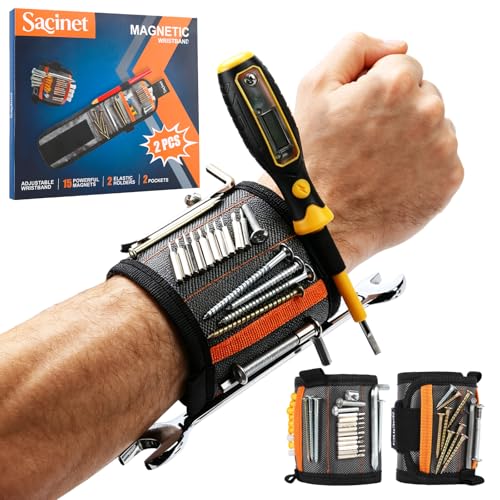
A magnetic wristband is a padded fabric or ballistic-nylon cuff, typically 3 to 3.5 inches wide, with a row of small neodymium magnets sewn into a strip across the top. Most current models carry 10 to 15 magnets, each roughly 1/2 inch in diameter, which together will hold a few dozen drywall screws, a handful of 3-inch deck screws, a couple of drill bits, and a small nut driver at the same time. The strap closes with a hook-and-loop band that adjusts from roughly 6 to 10 inches to fit most adult wrists, and the underside is usually a mesh or foam pad so the magnets do not press directly on your skin.
Our top picks

As an Amazon Associate we earn from qualifying purchases at no extra cost to you.
The two products most shoppers compare show how little separates the field. The Allinside band, about $5, has 15 magnets and an adjustable strap. The 2-pack from the “Gifts for Men and Women” listing, about $8, gives you two bands with 15 magnets each plus two small zippered pockets for non-magnetic items such as plastic anchors, wire nuts, or a pencil. Per band, that works out to about $4, and having a second one for a helper or the toolbox is genuinely useful.
Weight is around 2 to 3 ounces, so you forget it is on after a few minutes. Holding power varies with the number and grade of magnets: a decent 15-magnet band will carry a 1/2-inch socket or a 3/8-inch bolt without dropping it if you move your arm quickly, but it will not reliably hold a full-size tape measure or a 6-inch adjustable wrench. Think of it as a third hand for small parts, not a holster.
Pros
- Stops the drop-and-search cycle. Screws, nails, and bits stay on your forearm instead of rolling under the workbench or into the lawn.
- Faster ladder work. Hanging drywall, curtain rods, or a ceiling fan goes noticeably quicker when you are not climbing down for one more screw.
- Cheap enough to be disposable. At $4 to $10, it costs less than most single drill bits.
- Keeps small parts organized during disassembly. Pull six screws out of a laptop or a faucet handle and they stay in order on your wrist.
- Works with gloves. The magnets pick up parts you would otherwise fumble with a gloved hand.
- Doubles as a retrieval tool. Sweep your wrist over the floor or inside a cabinet to grab a dropped screw you cannot see.
Cons
- Useless for non-ferrous fasteners. Brass, aluminum, stainless steel (most 304 and 316 grades), and plastic anchors do not stick. The zippered pocket on some models is the workaround.
- Snags on metal you did not intend to grab. The band will attach itself to a steel vise, a drill chuck, or a filing cabinet as you walk past.
- Not safe near electronics or magnetic media. Keep it several inches away from mechanical hard drives, credit cards, hotel keycards, and pacemakers.
- Limited capacity. Overload it with a dozen 3-inch screws and the ones on the edge slide off when you bend your wrist.
- Warm and slightly bulky. A 3.5-inch padded cuff on a hot day is noticeable, and it can catch on a sleeve.
- Cheap stitching wears. Bands under $5 sometimes lose a magnet through the seam after a few months of hard use.
Who Should Buy It
Buy one if you do overhead or ladder work, install anything in a cabinet or ceiling, work on cars or appliances where fasteners tend to disappear, or simply hate crawling around looking for the screw you just dropped. It is also a near-perfect gift for a DIYer, which is why so many of them ship in gift boxes. The two-pack is the better value for most homes in 2026 because one band can live in the tool bag and the other in the garage. Anyone who assembles a lot of flat-pack furniture will appreciate holding all the cam locks and screws in one place while flipping panels around.
Who Should Skip It
Skip it if you work almost exclusively at a bench with a parts tray in reach, if the fasteners in your trade are mostly stainless or brass (marine, plumbing, and some outdoor work), or if you already use a magnetic bit holder and a tool belt with a screw pouch. People who wear a mechanical watch on the same wrist should also pass, or move the watch: strong neodymium magnets can magnetize a movement and throw off its timekeeping.
Cheaper Alternatives
| Option | Cost | Trade-off |
|---|---|---|
| Magnetic parts tray (4- to 6-inch steel dish) | $4 to $10 | Holds far more and sticks to a fender or steel shelf, but stays where you put it instead of coming with you up the ladder. |
| Nail apron or tool-belt screw pouch | $5 to $15 | Carries hundreds of fasteners of any material, but you still dig for each one and cannot hold loose bits. |
| Magnetic bit holder on the drill | $5 to $12 | Holds one or two screws on the tip so you can drive one-handed; does nothing for the other 30 in the box. |
| Small zippered pocket sewn onto a shirt or a wrist sweatband | $0 to $5 | Free if you have a sweatband, works with non-magnetic parts, but you cannot see or grab a specific screw quickly. |
| Magnetic strip screwed to the ladder or bench edge | $8 to $15 | Great fixed storage for bits and driver tips; not portable. |
FAQ
How many screws can a magnetic wristband hold?
A 15-magnet band comfortably holds 20 to 40 standard 1.25-inch drywall screws, or roughly 8 to 12 3-inch deck screws, plus a few drill bits. Long, heavy fasteners are the first to slide off when you bend your arm, so keep the biggest ones in the middle of the magnet strip.
Will it damage my phone or smartwatch?
Modern phones with flash storage are not harmed by these magnets, but the magnetometer used by the compass can act strangely while the band is within an inch or two. Smartwatches are generally fine. Mechanical wristwatches are the real risk; wear the band on the opposite arm.
Can I wash a magnetic wristband?
Yes. Hand-wash in warm water with a little dish soap and let it air-dry. Do not put it in a dryer; the heat can weaken the adhesive in models where the magnets are glued rather than sewn, and neodymium magnets lose strength if they get above roughly 175 degrees Fahrenheit.
Is the two-pack worth it over a single band?
Usually. At about $8 for two versus $5 for one, the per-band price drops to about $4, and the extra pockets on the two-pack version handle plastic anchors and other items the magnets cannot grab. Keep the second one in the car or give it to whoever holds the ladder for you.