Key takeaways
- Reliable duplex feeder that minimizes manual intervention
- Mature software suite with cloud and local destination options
- Price sits well above mid-range competitors for similar throughput
Scanners are one of those home-office purchases where the wrong choice costs you hours every month. You want to digitize a stack of invoices, archive tax documents, scan a photograph, or pull inventory numbers off barcodes, and the device you pick determines whether that process takes seconds or becomes a frustration you abandon. The gap between a capable scanner and a mediocre one shows up in feed reliability, software polish, and how well the machine handles mixed document sizes without jamming.
The eight machines here span desktop workhorses, portable options for travelers, flatbeds for photos, and a dedicated barcode reader. We compared published specifications, pricing, and recurring owner feedback to separate genuinely useful devices from those that look good on paper but fall short in daily use. The best scanners 2026 has to offer range from under thirty dollars to just under four hundred, so there is a right answer for almost every budget and workload.
As an Amazon Associate we earn from qualifying purchases at no extra cost to you. Product prices and availability are accurate as of the date shown and are subject to change.




Quick Picks
| Product | Best for | Price |
|---|---|---|
| ScanSnap iX2500 | High-volume home-office scanning | $379.99 |
| Canon Canoscan Lide 300 | Occasional flatbed use on a budget | $69.99 |
| Tera Barcode Scanner | Small-business inventory and checkout | $29.97 |
| Epson Workforce ES-400 II | Small office duplex document workflows | $352.95 |
| Epson Workforce ES-50 | Traveling professionals | $146 |
| Brother DS-640 | Compact mobile scanning from home | $134.99 |
| Canon CanoScan LiDE 400 | Photo archiving and mixed-media projects | $97.99 |
| ScanSnap iX1300 | Wireless duplex scanning without bulk | $279.99 |
How We Picked
Three criteria carried the most weight. First, feed and scan reliability: a scanner that jams on multi-page PDFs or misreads duplex pages wastes more time than it saves. Second, software experience: owners consistently rate bundled applications, cloud integration, and setup friction as decisive factors, especially for non-technical users. Third, value relative to workload: a $380 scanner must outperform a $130 one by a margin that justifies the gap for the person buying it. Portability and form factor served as a tiebreaker for the mobile category.
The 8 Best Scanners 2026 in 2026
ScanSnap iX2500 Wireless or USB High-Speed Document Scanner
This is the default answer for anyone processing dozens of pages daily from a home office. The iX2500 combines wireless and USB connectivity with a high-speed auto document feeder that handles duplex jobs without manual flipping. Owners praise the ScanSnap software ecosystem for its one-touch workflows to email, cloud folders, and searchable PDFs.
- Reliable duplex feeder that minimizes manual intervention
- Mature software suite with cloud and local destination options
- Price sits well above mid-range competitors for similar throughput
Skip this if you scan fewer than twenty pages weekly or need flatbed capability for photos and bound books. The dedicated document-feeding design cannot handle those media types.
Canon Canoscan Lide 300
A flatbed option that handles single-sheet scanning, PDF creation, copying, and direct-send tasks with minimal fuss. At under seventy dollars it serves as an entry-level digitizer for tax paperwork, school projects, and the occasional photograph. Setup is straightforward via USB, and the autoscan feature picks modes automatically based on content type.
- Lowest cost of entry for flatbed scanning with sensible defaults
- Compact footprint fits on a crowded desk without complaint
- No wireless option, so the cable must stay connected
Pass on this if you regularly scan stacks of loose pages; single-sheet flatbed loading becomes tedious beyond a handful of documents per session.
Tera Barcode Scanner Wireless 1D Laser Cordless Barcode Reader
Not a document scanner, but a purpose-built tool for small retailers, warehouse helpers, and inventory managers who need fast 1D barcode reads. The two-in-one wireless and USB wired mode covers both checkout-counter freedom and a stable tethered connection. The battery-level indicator eliminates surprise downtime mid-shift.
- Dual wireless and wired operation with clear battery status
- Price under thirty dollars removes most adoption friction
- 1D laser only; cannot read 2D codes like QR or Data Matrix
Skip this if your barcode inventory includes 2D codes or if you need any document-scanning capability at all.
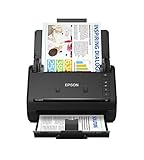
Epson Workforce ES-400 II High-Speed Color Duplex Desktop Document Scanner
Aimed squarely at small offices that process contracts, medical forms, or multi-page reports in volume. The ES-400 II delivers fast duplex capture and a robust ADF designed for mixed paper weights. Epson’s bundled utilities handle batch naming, OCR, and PDF/A archival formats without third-party software.
- High-speed duplex feeding suits concentrated batch sessions
- Handles varied paper sizes and weights without repeated manual adjustment
- Larger desktop footprint compared to compact alternatives
Consider skipping this if your workspace is tight or if your daily volume rarely exceeds a few pages; the capacity would go unused.
Epson Workforce ES-50 Compact and Lightweight Mobile Document Scanner
Built for consultants, real-estate agents, and field workers who need to capture signed contracts or receipts away from a desk. The ES-50 draws power over USB, requires no AC adapter, and fits in a laptop sleeve alongside other essentials. Duplex scanning means two-sided pages finish in one pass.
- Genuinely portable: small, light, and bus-powered
- Duplex scanning in a mobile form factor saves time on contracts
- Single-sheet ADF can feel slow during large batch jobs
Skip this if the majority of your scanning happens at a fixed desk; a full-size feeder will be more comfortable and faster for that setting.
Brother DS-640 Compact Mobile Document Scanner
Brother’s compact duplex scanner competes directly with the ES-50 for the mobile slot. It folds flat, connects via USB without an external power brick, and includes OCR software for converting scans into searchable text. Owners who travel light report it as a reliable companion for receipts, IDs, and short contracts.
- Folds compactly and works on USB bus power alone
- Included OCR software adds searchable-PDF output without extra cost
- Feed capacity for batch jobs is modest by design
Not ideal as a sole scanner if you routinely digitize long documents; the limited ADF means repeated sheet loading.
Canon CanoScan LiDE 400 Slim Scanner
At under an inch thick, the LiDE 400 stores nearly flat and pulls up to 4800 dpi optical resolution, making it the photo-archiving option in this roundup. The slim profile belies solid flatbed performance for prints, slides with the optional adapter, and textured art. USB-only connection keeps the hardware simple.
- High optical resolution suits photo and art reproduction
- Extremely slim and easy to stow between uses
- No wireless or network capability
Skip this if your primary need is multi-page document capture; the flatbed-only design is wrong for that job.
ScanSnap iX1300 Wireless or USB Double-Sided Color Document Scanner
The iX1300 sits between the mobile units and the iX2500, offering wireless duplex scanning at a price well below the flagship. It captures double-sided color documents in one pass and connects over Wi-Fi or USB. ScanSnap’s one-touch button panel and companion app make it approachable for users who want simplicity over configuration depth.
- Wireless duplex scanning at a mid-range price point
- Streamlined button interface reduces learning curve
- Smaller ADF than the iX2500 for continuous large batches
Skip this if you need flatbed media handling or if your volume justifies stepping up to the iX2500’s larger feeder.
Buying Guide
Feeder Type and Duplex Capability
The single most consequential choice is between an automatic document feeder and a flatbed. An ADF pulls sheets in a stack, which transforms scanning a twenty-page contract from a tedious process into a one-touch job. Duplex means the machine captures both sides simultaneously or in one pass, cutting your active time roughly in half for two-sided documents. Flatbeds remain necessary for bound books, photographs, receipts with varying thicknesses, and fragile originals that an ADF could damage.
Connectivity and Software Ecosystem
Wi-Fi adds flexibility but introduces a network-configuration step that USB does not. If your scanner sits beside your workstation, USB is simpler and often faster. Where software matters most is destination automation: the best scanners let you send a scan straight to a cloud folder, a searchable PDF archive, an email, or an OCR pipeline with a single button. Owners frequently cite software quality as the differentiator between two scanners with similar hardware specs.
Throughput Volume and Duty Cycle
Match the scanner’s rated daily page capacity to your actual habits. Scanning three contracts per week does not require a machine rated for five hundred pages. Overbuying wastes budget, while underbuying leads to jamming, overheating warnings, and shortened lifespan. Review the manufacturer’s recommended monthly duty cycle against your realistic weekly volume, and choose a device with at least fifty percent headroom above your average.
Our Verdict
The ScanSnap iX2500 is our top pick for anyone whose workflow involves more than occasional single-page captures. Its combination of wireless freedom, reliable duplex feeding, and polished software justifies the price for daily-use home offices. The budget pick is the Canon CanoScan LiDE 300 at under seventy dollars: it handles flatbed tasks capably and requires no learning curve. If your need is strictly portable scanning away from a desk, the Epson ES-50 wins that specific scenario because its bus-powered, pocketable design outclasses every other option here for travel.
FAQ
Do I need a scanner if I have a smartphone camera?
A phone can capture a single receipt in seconds, but it introduces distortion, uneven lighting, and manual cropping that slow you down across multi-page jobs. Dedicated scanners produce flat, evenly lit, correctly scaled output automatically, which matters when you are building a searchable archive or sharing professional documents.
What is the difference between optical resolution and interpolated resolution?
Optical resolution reflects the sensor’s true ability to distinguish detail, while interpolated resolution is software-generated between captured points. For document text and standard prints, optical resolution in the 600 dpi range is sufficient. Only photo reproduction or fine-art scanning benefits from pushing optical resolution higher.
Are barcode scanners compatible with point-of-sale software?
Most modern POS platforms accept 1D USB-HID barcode input without special drivers, so a reader like the Tera connects and functions immediately. However, if your inventory includes items with only 2D codes, you will need a reader that supports that symbology, and 1D-only devices cannot substitute.
How long do consumer scanners typically last?
With regular use within the rated duty cycle, ADF rollers are the first wear item and can last several years before needing replacement. Flatbed lamps and LED arrays rarely fail before the device becomes functionally outdated. Keeping the glass and feed path clean significantly extends service life across all types.