Key takeaways
- Fast continuous scanning with reliable auto-duplex
- Wi-Fi and USB options reduce cable clutter
- Proprietary software locks some features behind registration
Most people searching for a document scanner online are trying to solve one of two problems: they either need a physical device that feeds paper into a computer quickly, or they want software that turns a phone photo into a clean PDF. This roundup covers the first category — dedicated hardware scanners — because they remain the most reliable way to produce searchable, properly oriented digital files from stacks of invoices, contracts, and receipts that software on a phone handles inconsistently.
The market is crowded, and the gap between a good scanner and a mediocre one shows up in three places: paper-handling reliability (does it jam on thin receipts or crumpled pages?), duplex speed (how fast can it scan both sides of a page without you flipping anything?), and bundled software quality. A scanner that costs $500 but ships with bloated, slow software can be a worse daily tool than one that costs $135 with a clean, no-nonsense app. Owner feedback across hundreds of reviews on retail sites makes these differences clear, and that is what guided our comparisons for this guide.
Our top picks



As an Amazon Associate we earn from qualifying purchases at no extra cost to you.
Quick Picks
| Product | Best for | Price |
|---|---|---|
| ScanSnap iX2500 | Small office throughput | $379.99 |
| Epson WorkForce ES-50 | Lightweight portability | $146 |
| Brother DS-640 | Best value compact | $134.99 |
| Canon CanoScan LiDE 300 | Flatbed versatility | $69.99 |
| Epson WorkForce ES-400 II | Fast duplex desktop | $352.95 |
| ScanSnap iX1600 Receipt Edition | Receipt-heavy workflows | $520 |
| Canon imageFORMULA R10 | USB-powered mobile use | $183.90 |
| ScanSnap iX1300 | Wireless home office | $279.99 |
How We Picked
We narrowed this list by weighing four factors: price-to-throughput ratio, duplex capability, physical footprint relative to intended use, and the consistency of owner-reported reliability over time. A scanner that earns high marks on specs but generates frequent complaints about paper jams or software crashes was excluded from our shortlist. We also prioritized devices that work well with common document management needs rather than specialty hardware that only suits one narrow workflow.
The 8 Best Document Scanner Online in 2026
ScanSnap iX2500
The iX2500 is Fujitsu’s answer to the home office that processes moderate volumes without wanting a full-size enterprise unit. It combines a high-capacity feeder with wireless and USB connectivity, making it flexible for environments where you might scan from a laptop at the desk or push files to a network drive.
- Fast continuous scanning with reliable auto-duplex
- Wi-Fi and USB options reduce cable clutter
- Proprietary software locks some features behind registration
Skip this if you scan fewer than a dozen pages per week; the footprint and price are overkill for casual use, and cheaper options cover the same workflow.
Epson WorkForce ES-50
The ES-50 targets the traveler who needs to scan boarding passes, hotel folios, and short contracts on the road. It is genuinely compact, fits in a jacket pocket, and runs on USB power alone — no separate adapter needed.
- Smallest footprint in this roundup
- USB-powered design means one less cable
- Small feeder capacity requires frequent reloading
Skip this if you regularly scan multi-page documents in one sitting; the tiny tray will frustrate you quickly.
Brother DS-640
At $134.99, the DS-640 sits at an attractive price point for a compact duplex scanner. It handles double-sided pages automatically and includes a decent bundled software suite for OCR and cloud export. The build feels slightly less refined than the ScanSnap options, but functionally it delivers the same core experience for significantly less money.
- Automatic duplex at a low price
- Includes useful OCR software
- Noise during feeding is noticeable
Skip this if silent operation matters — it is louder than comparable units and may distract in shared workspaces.
Canon CanoScan LiDE 300
The LiDE 300 is a flatbed, not a sheet-fed scanner, and that distinction defines its use case. It excels at scanning bound documents, fragile originals, books, and photos that a feeder cannot handle. USB-powered and extremely slim, it stores vertically on a shelf when not in use.
- Handles bound or delicate originals that feeders cannot
- Lowest price in this list at $69.99
- One-page-at-a-time manual operation
Skip this if your primary need is multi-page contract digitization; the manual process will slow you down.
Epson WorkForce ES-400 II
The ES-400 II is built for desktop throughput. Its 50-sheet ADF and fast duplex scanning make it suitable for accounting offices or anyone batch-scanning invoices and receipts in large volumes. Connectivity includes USB, Ethernet, and Wi-Fi, so it can serve a small team without sharing a computer directly.
- High-capacity feeder for batch scanning
- Ethernet option supports shared network use
- Larger footprint limits placement options
Skip this if you need portability; it is clearly a desktop device meant to stay in one location.
ScanSnap iX1600 Receipt Edition
Designed explicitly for expense-heavy professions — freelancers, consultants, field engineers — the iX1600 Receipt Edition pairs fast duplex scanning with optimized handling of small paper formats like thermal receipts. The included software auto-crops and enhances faint receipt text, which is a genuine time-saver over generic OCR.
- Purpose-built for receipt and small-document handling
- Excellent software presets reduce post-scan editing
- At $520, the most expensive option here
Skip this if your documents are all standard letter or A4 size; the receipt-specific features do not justify the premium.
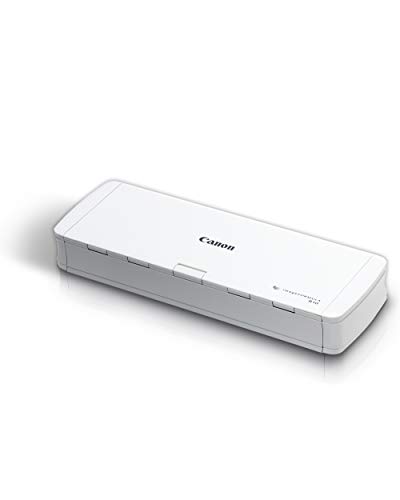
Canon imageFORMULA R10
The R10 occupies a useful middle ground: portable enough for mobile use, yet capable of duplex scanning via a small sheet feeder. USB power means it runs from a laptop port during travel. The white colorway is a cosmetic distinction; internally it shares the platform with Canon’s other compact offerings.
- Compact and USB-powered for true mobile use
- Duplex scanning in a small form factor
- Feeder capacity is modest
Skip this if you batch-scan regularly; you will be reloading the tray more often than you prefer.
ScanSnap iX1300
The iX1300 sits below the iX2500 in ScanSnap’s lineup and represents a strong mid-tier choice for wireless home offices. It scans duplex, connects over Wi-Fi or USB, and integrates with common cloud services. For the price, it delivers most of what the higher-end models offer without the larger paper tray.
- Wireless convenience at a reasonable price
- Reliable duplex handling for home workloads
- Plastic construction feels less premium
Skip this if you need a high-volume ADF; the tray fills quickly and requires pauses during long jobs.
Buying Guide
Sheet-Fed vs. Flatbed
Sheet-fed scanners pull pages through rollers and a light path automatically, which is what you want for multi-page documents. Flatbeds require you to place each page by hand but can handle bound books, fragile originals, and odd sizes. If your workflow is contracts, invoices, or forms, go sheet-fed. If it includes books, passports, or aged paper, get a flatbed or a hybrid.
Automatic Duplex and Feeder Capacity
Duplex means both sides scan without manual flipping. Every device in this list except the LiDE 300 supports it. Feeder capacity determines how many sheets you can load at once — anything under 20 sheets means you will reload frequently during multi-page jobs. For batch scanning, prioritize a 40-sheet or higher tray and a continuous-mode duplex mechanism.
Connectivity and Software Ecosystem
USB is universal but ties the scanner to one machine. Wi-Fi and Ethernet allow shared access or wireless placement. The software that ships with a scanner matters as much as the hardware: look for one-touch profiles (scan to email, scan to cloud folder, scan to OCR PDF) and verify whether the app requires account registration or subscription. A locked-in ecosystem can become frustrating if you change computers or operating systems.
Our Verdict
Our top pick is the ScanSnap iX2500 at $379.99 — it balances speed, duplex reliability, and flexible connectivity better than any other unit here. The budget pick is the Brother DS-640 at $134.99, which delivers automatic duplex and solid software at the lowest price in its class. If your primary task is scanning bound documents or fragile originals, the Canon CanoScan LiDE 300 wins regardless of the other options, because no feeder can do what a flatbed does safely.
FAQ
What is the difference between a document scanner online tool and a hardware scanner?
Online tools typically accept a photo upload and return a cleaned PDF using software algorithms. Hardware scanners use optical sensors and controlled lighting to capture every detail on paper, producing sharper text and consistent color. For anything legal, financial, or archival, a hardware scanner produces more reliable output.
Do I need duplex scanning?
If your documents are printed on both sides — contracts, booklets, multi-page forms — duplex saves substantial time. Without it, you scan all front sides, flip the stack, and scan again, risking misalignment and orientation errors. Most modern scanners handle it automatically, so it is a worthwhile baseline feature.
How much should I spend on a document scanner?
For occasional home use under $150 is sufficient; the Brother DS-640 and Canon LiDE 300 cover that range. For regular office or freelance work involving dozens of pages daily, expect to invest $250 to $500 for faster throughput and better paper handling. Spending more than that makes sense only for specialized receipt or high-volume batch needs.
Can a scanner work without installing software?
Most scanners support TWAIN