Key takeaways
- Pro: Scans a 4×6 print in roughly two seconds, making thousand-photo jobs feel manageable.
- Pro: No computer required for basic operation—files land on an SD card or USB drive.
- Con: Limited to 4×6 and similar small prints; larger photos or documents are out of scope.
Most people reaching for a picture scanner in 2026 are facing the same wall: a shoebox of fading prints, a drawer of slides, or a family archive that has outlived the hard drive it was last copied to. The goal is simple—turn physical photos into clean digital files fast enough that the project actually gets finished this weekend rather than next year. What separates a worthwhile scanner from a frustrating one comes down to how much manual intervention it demands per image. A scanner that crops, deskews, and outputs usable JPEGs automatically turns a 400-photo job into an afternoon. One that requires you to drag a marquee around every frame in software will not see the light of day more than once.
The eight models below span roughly $68 to $559 and cover distinct use cases: standalone photo-only feeds, high-speed duplex document-and-photo machines, flatbeds that double as occasional scanners, and dedicated film-and-slide units. Prices are listed where published; where a specific retail price is unavailable, the table notes it. None of these machines is objectively best for every household, but each solves a particular bottleneck—speed, resolution, or the ability to handle fragile originals without glass contact.
As an Amazon Associate we earn from qualifying purchases at no extra cost to you. Product prices and availability are accurate as of the date shown and are subject to change.




Quick Picks
| Product | Best for | Price |
|---|---|---|
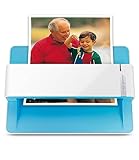
| Plustek ePhoto Z300 | Fast 4×6 photo batch scans | $219.99 |
| Epson FastFoto FF-680W | High-volume duplex photo and document scanning | $559 |
| Canon CanoScan LiDE 300 | Budget flatbed with auto-scan workflow | $69.99 |
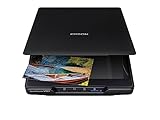
| Epson Perfection V19 II | Entry-level flatbed photo restoration | $67.99 |
| Canon CanoScan LiDE 400 | Space-constrained desks needing larger bed area | $97.99 |
| Epson Perfection V39 II | Mid-tier flatbed with high optical resolution | $117 |
| AMBIR Photo Scanner Bundle | Auto-crop scanning plus cleaning workflow | $149.95 |
| KODAK Slide N Scan | Digitizing 35mm slides and film without a PC |
How We Picked
We narrowed this list on four criteria: per-image scan speed for the dominant media type the device handles, output resolution and whether it is optical or interpolated, the degree of automation in cropping and straightening (the single biggest factor in whether a large archive project gets completed), and platform compatibility. Price per photo scanned over a typical 500-image project was also considered—$68 flatbeds win on upfront cost, while $559 duplex machines win on hours saved.
The 8 Best Picture Scanner in 2026
Plustek Photo Scanner ePhoto Z300
The Z300 is the go-to choice for anyone whose archive is dominated by 4×6 prints and who wants to feed them in a continuous stream with zero software setup. Its CCD sensor handles up to 400 dpi, and the auto-crop and deskew logic works on each sheet as it passes through the feed slot.
- Pro: Scans a 4×6 print in roughly two seconds, making thousand-photo jobs feel manageable.
- Pro: No computer required for basic operation—files land on an SD card or USB drive.
- Con: Limited to 4×6 and similar small prints; larger photos or documents are out of scope.
Skip it if your collection includes anything larger than a wallet print or if you need document scanning alongside photos.
Epson FastFoto FF-680W
This is the scanner you buy when the project is genuinely large—think ten thousand prints plus back-of-photo notes, letters, and receipts that deserve the same digitization pass. Duplex feeding at a steady pace means the physical sorting is the bottleneck, not the machine.
- Pro: Dual-sided capture in a single pass preserves handwritten annotations on print backs.
- Pro: Wi-Fi connectivity and a high-capacity input tray reduce the constant reloading that slows smaller machines.
- Con: The price places it firmly in the prosumer tier; overkill for a few hundred prints.
Skip it if your archive is under five hundred photos or if you only need flatbed-quality edge-to-edge fidelity on delicate originals.
Canon CanoScan LiDE 300
At $69.99 the LiDE 300 removes almost every excuse not to start digitizing. It scans flatbed-style with an AUTOSCAN button that launches the last-used profile, which is handy for repeatable small batches.
- Pro: USB-powered—no wall adapter, one cable to a laptop, done.
- Pro: Built-in buttons for PDF, Copy, Send, and AUTOSCAN keep the workflow mouse-free.
- Con: Optical resolution is adequate for standard prints but leaves little margin for large enlargements or film.
Skip it if you need to scan more than a handful of photos per sitting or if slide and negative support matters.
Epson Perfection V19 II
The V19 II is the cheapest flatbed on this list and earns its spot by pairing a low price with 4800 dpi optical resolution—meaningful headroom for cropping and mild restoration. Epson’s bundled software handles dust and scratch removal with a single checkbox.
- Pro: 4800 dpi optical resolution is unusual at this price and gives real flexibility on output size.
- Pro: Compact footprint fits a small desk or a shared household shelf.
- Con: No automatic document feed; every photo is placed manually on the glass.
Skip it if your priority is throughput on hundreds of prints rather than per-image quality on a curated selection.
Canon CanoScan LiDE 400
The LiDE 400 updates the 300’s formula with a thinner profile and a slightly larger effective scan area, reaching roughly letter-size originals. For households with mixed media—photographs, pages of text, occasional magazine clippings—it handles more in one device than the 300 can.
- Pro: Ultra-slim design (under half an inch thick) stores behind a monitor or in a drawer without hassle.
- Pro: 4800 dpi optical resolution matches the flatbed tier’s best, suitable for modest enlargements.
- Con: Flatbed-only workflow means batch-scanning dozens of prints is tedious compared to a feed model.
Skip it if your primary task is volume photo digitization; look at the Z300 or FastFoto instead.
Epson Perfection V39 II
The V39 II sits above the V19 II in build quality and bundled software, with the same 4800 dpi optical resolution. Its slightly sturdier lid and wider glass area make it more comfortable for people who scan oversized prints or pages alongside photographs.
- Pro: High optical resolution and Epson’s restoration suite produce clean files with minimal manual editing.
- Pro: A few steps up in panel and button layout from the V19 II, reflecting better long-term usability.
- Con: No film holder or transparency adapter; slides and negatives remain unsupported.
Skip it if you need film scanning or if the $50 gap over the V19 II cannot be justified for your volume.
AMBIR Photo Scanner with Photo Cleaning Kit Bundle
AMBIR targets the household that wants a simple feed scanner but also needs to deal with dusty, smudged, or slightly curled prints before they go through the glass. The included cleaning kit and bundled restore software address that pre-scan step, which many feed-only machines ignore.
- Pro: Auto-crop and deskew plus a cleaning workflow reduce the number of retouch passes afterward.
- Pro: 300/600 dpi options cover both archival quality and quick-share resolution without re-scanning.
- Con: Software bundle adds a learning step; some users prefer the plug-and-play simplicity of competing models.
Skip it if your prints are in good physical condition and you want the fastest possible unattended scan sessions.
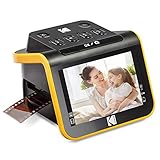
KODAK Slide N Scan Film & Slide Scanner
The Slide N Scan exists for one specific job: digitizing 35mm slides, 110 and 126 film without connecting to a computer. A 5-inch LCD lets you preview and trigger scans directly on the unit, and the 22-megapixel sensor produces prints from small frames at usable sizes.
- Pro: Standalone operation with on-device preview eliminates the setup friction that stops many people.
- Pro: Handles three film formats, covering most casual consumer negatives from the ’70s through the ’90s.
- Con: Cannot scan printed photographs—only film media passes through its slots.
Skip it if your archive is primarily prints rather than slides or negatives; pair it with a feed or flatbed unit for full coverage.
Buying Guide
Scan Speed and Feed Type
If your collection exceeds a few hundred prints, per-image throughput dominates every other spec. A feed scanner like the Z300 processes roughly a print every two seconds, while a flatbed requires you to lift the lid, place, align, close, and click for each image. Over a thousand-photo job that difference is many hours. Duplex machines such as the FastFoto go further by capturing both faces of a sheet in one pass, halving reload time and preserving any writing on the back of a print.
Optical Resolution and Output Flexibility
Flatbeds on this list offer up to 4800 dpi optical resolution, which matters when you plan to crop tightly or reprint an image larger than its original size. Feed scanners typically top out near 600 dpi—sufficient for screen viewing and standard reprints but limiting if you enlarge beyond the source dimensions. A good rule of thumb: 300 dpi gives a faithful digital copy for archiving; 600 dpi allows modest cropping; 1200 dpi and above are for restoration work where you rebuild a damaged corner from clean pixels.
Automation: Crop, Deskew, and Restore
Manual cropping in photo software is the silent killer of digitization projects. Look for scanners that detect photo borders automatically and correct slight tilts as the sheet feeds. Auto-deskew matters most when you are scanning prints with visible white borders—without it, every output file arrives at a two-to-three-degree angle and needs a correction pass. Models that bundle a cleaning kit or one-click dust removal also save the extra editing cycle, which compounds across hundreds of images.
Our Verdict
The Plustek ePhoto Z300 is our top pick for the broadest photo-only audience: it removes almost every manual step between a shoebox and finished JPEGs, and the price sits in a comfortable middle ground. If you want a flatbed to start small, the Canon LiDE 300 is the clear budget pick—under seventy dollars, USB-powered, and capable enough to handle a first archive without frustration. However, if your project includes thousands of photos alongside documents and you value the time saved above the upfront cost, the Epson FastFoto FF-680W becomes the smarter purchase within the same year simply because the hours you do not spend reloading sheets outweigh the price difference.
FAQ
Can a flatbed photo scanner digitize slides and negatives?
Only if the manufacturer includes a dedicated film holder and the unit’s sensor is sensitive enough for transparency scanning. None of the flatbeds listed here carry that hardware, so a separate film scanner such as the KODAK Slide N Scan or a higher-tier flatbed with a transparency adapter is required.
How many megapixels should I look for in a picture scanner?
Megapixels are a less useful metric than optical dpi for flatbeds because resolution depends on the area scanned. A 4800 dpi optical flatbed produces well over a hundred megapixels on a 4×6 print. For feed scanners, 600 dpi is the practical ceiling and is sufficient for screen use and standard reprints.
Do I need Wi-Fi for a picture scanner?
Wi-Fi adds convenience if you want to scan without being tethered to a desk, but most photo scanning benefits from a wired connection because large batch files transfer faster and more reliably over USB. The FastFoto is the only model here with built-in wireless, and it still offers USB for bulk transfers.
What is the best way to store digital photo archives after scanning?
Follow the three-two-one rule: keep three copies of every file, on two different storage types, with one copy off-site. After a scanning session completes, back up the folder to an external drive and to a cloud service. Flatbeds at 4800 dpi can produce very large files, so budget drive space accordingly for thousand-photo collections.