Key takeaways
- Pro: Fastest paper handling in the compact-to-mid desktop range, ideal for heavy daily loads
- Pro: Reliable duplex that genuinely reduces manual intervention on multi-page contracts
- Con: Noticeably larger footprint than ES-C series; it will dominate a small desk corner
Anyone managing a home office eventually hits the same wall: a growing stack of invoices, contracts, receipts, and paperwork that needs to live digitally. An epson document scanner solves this better than a flatbed or a phone camera because it feeds pages through automatically, captures both sides in one pass, and spits out searchable PDFs or organized image files without your hovering over the glass.
What separates a worthwhile scanner from a frustrating one comes down to a few practical factors: how fast it actually runs through your typical document pile, whether the auto document feeder handles mixed paper weights without jamming, and whether wireless connectivity works reliably when the unit sits across the room. This roundup, put together for 2026, compares published specifications and aggregated owner feedback across eight Epson models spanning every price tier so you can match the right scanner to your workload and desk space.
Our top picks




As an Amazon Associate we earn from qualifying purchases at no extra cost to you.
Quick Picks
| Product | Best for | Price |
|---|---|---|
| WorkForce ES-400 II | High-volume duplex scanning at a desk | $352.95 |
| WorkForce ES-50 | Grab-and-go mobile scanning | $146 |
| WorkForce ES-580W | Wireless desktop scanning with speed | $354.99 |
| WorkForce ES-C220 | Compact duplex scanning on USB power | $227.18 |
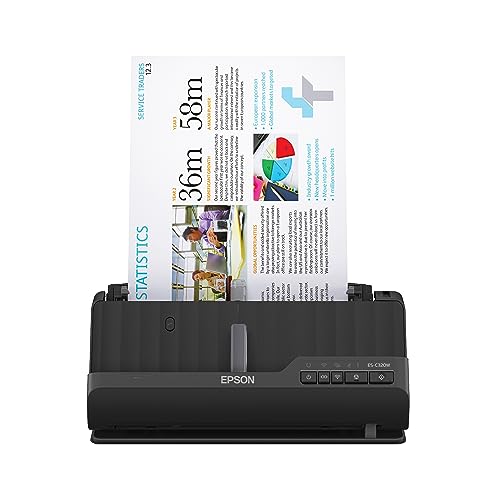
| WorkForce ES-C320W | Wireless compact duplex scanning | $249.99 |
| WorkForce ES-500W II | Top-tier wireless desktop speed | $379 |
| FastFoto FF-680W | Photo and document archiving combined | $559 |
| RapidReceipt RR-620W | Receipt-heavy small business workflows | $429.99 |
How We Picked
We evaluated each scanner on four criteria: throughput speed and ADF capacity (how many pages it swallows before you refill), duplex capability (whether it captures both sides in a single pass or forces a manual flip), connectivity options (Wi-Fi, USB, or both, and whether wireless mode is reliable enough to skip the cable entirely), and physical footprint relative to typical home-office desk space. Owner reviews were consulted primarily for real-world jam frequency, software experience, and noise levels—details that spec sheets omit.
The 8 Best Epson Document Scanners in 2026
Epson WorkForce ES-400 II
For anyone scanning large batches of mixed documents daily, the ES-400 II remains the speed benchmark in this lineup. Its high-speed duplex engine chews through stacks far faster than compact models, and the color scanning output is crisp enough for archival purposes. Owners praise the robust ADF that handles crumpled or mixed-weight paper without the frequent jamming smaller units suffer.
- Pro: Fastest paper handling in the compact-to-mid desktop range, ideal for heavy daily loads
- Pro: Reliable duplex that genuinely reduces manual intervention on multi-page contracts
- Con: Noticeably larger footprint than ES-C series; it will dominate a small desk corner
Skip it if you need something you can toss in a bag or if your scanning volume stays under a few dozen pages per week.
Epson WorkForce ES-50
The ES-50 is the answer to “I need to scan receipts and boarding passes without a full desktop setup.” It draws power from USB, weighs almost nothing, and fits in a laptop sleeve. Mobile professionals and real-estate agents who scan on the fly find it indispensable for quick single-page jobs.
- Pro: Ultra-portable; genuinely pocketable with USB power eliminates the wall-outlet dependency
- Pro: Lowest price entry point for anyone testing whether a dedicated scanner beats a phone camera
- Con: No ADF—every page must be fed manually, making multi-page jobs tedious
Skip it if your workflow involves anything beyond one-to-three-page documents; the manual feed will frustrate you quickly.
Epson WorkForce ES-580W
Wireless freedom meets desktop throughput in the ES-580W. It targets the buyer who wants ES-400 II-level speed without a USB tether across the room, which is a common setup constraint when the router lives on the other side of an office wall.
- Pro: Strong wireless performance with speed that rivals the wired ES-400 II
- Pro: Color duplex scanning that handles ID cards and thin paper without the feeding issues smaller units encounter
- Con: Slightly higher price than the ES-400 II for nearly identical wired throughput; you pay for the Wi-Fi module
Skip it if you always sit within cable-reach of the scanner; the ES-400 II delivers comparable speed for less money.
Epson WorkForce ES-C220
The ES-C220 bridges the gap between the ultra-minimal ES-50 and full-size desktop units. With a 20-page ADF and duplex capability in a compact body, it suits apartment offices where a large scanner is impractical but single-page manual feeding is unacceptable.
- Pro: Small footprint with a genuine ADF—best space-to-capability ratio in the lineup
- Pro: Duplex capture in a compact form avoids the single-side limitation of most travel scanners
- Con: USB-only connectivity; no wireless option means it must sit near your computer
Skip it if cable clutter bothers you or if your desk sits far from your workstation; the ES-C320W adds Wi-Fi for modest extra cost.
Epson WorkForce ES-C320W
Essentially the ES-C220 with Wi-Fi added, the ES-C320W appeals to buyers who want compact duplex scanning plus the flexibility of wireless placement. The $23 premium over its USB-only sibling buys real convenience in multi-room home offices.
- Pro: Wireless flexibility in a footprint barely larger than a hardcover book
- Pro: 20-page ADF with duplex handles typical bill-and-contract batches in one pass
- Con: Owners report occasional Wi-Fi reconnection hiccups after sleep mode, requiring a quick manual nudge
Skip it if you cannot tolerate any wireless quirk; the wired ES-C220 is cheaper and more consistent.
Epson WorkForce ES-500W II
The ES-500W II is the wireless flagship of this group, pairing top-tier speed with Wi-Fi connectivity and a generous ADF. It is built for the home office that handles the volume of a small business—legal document batches, tax-season archives, or multi-department admin work.
- Pro: Highest throughput combined with reliable wireless, eliminating both cable and bottleneck trade-offs
- Pro: Large ADF capacity reduces refill interruptions during marathon scanning sessions
- Con: Highest price in the standard document scanner group; overkill for casual users
Skip it if your weekly volume stays under 100 pages; the ES-580W delivers 80 percent of the performance for $25 less.
Epson FastFoto FF-680W
The FF-680W occupies a unique niche: it scans flatbed-style photos, prints, and standard documents with equal competence. Anyone digitizing a family photo collection while also handling paperwork gets double utility from one device.
- Pro: Dedicated photo mode with color calibration that flatbed or ADF-only scanners cannot match
- Pro: High-speed duplex for documents remains fully capable despite the photo specialization
- Con: Premium price reflects photo features you may never use if your needs are purely document-based
Skip it unless you genuinely need to digitize printed photographs alongside everyday paperwork; otherwise you are subsidizing capability you will not touch.
Epson RapidReceipt RR-620W
The RR-620W is purpose-built for receipt scanning at volume, with AI-powered extraction and a 100-page ADF feeding through at up to 45 pages per minute. The 4.3-inch touchscreen lets you manage jobs without a computer, making it ideal for retail back-offices and accountants who process client receipts daily.
- Pro: AI and cloud integration automate data extraction from receipts—no manual keying afterward
- Pro: Massive 100-page ADF with touchscreen control suits batch processing without constant attention
- Con: Overkill for standard document scanning; the specialized receipt software is the premium you pay for
Skip it if your primary need is general documents rather than receipts and forms; the ES-500W II covers that ground more economically.
Buying Guide
ADF Capacity and Duplex Matter More Than Raw Speed
Promotional page-per-minute figures look impressive on spec sheets, but real-world workflow depends on how often you refill the feeder. A 100-page ADF on the RR-620W lets you load an entire client file and walk away, while a 20-page feeder on the ES-C220 requires pausing mid-batch. Duplex capability compounds this effect: single-pass duplex halves the total time because you never flip pages or re-feed the stack. Prioritize ADF size and duplex over peak speed unless you routinely scan thousands of pages at once.
Wireless Flexibility vs. Wired Reliability
Wi-Fi models (ES-580W, ES-C320W, ES-500W II, FF-680W, RR-620W) free you from cable placement constraints, but owner reports consistently note that wireless reconnection after sleep can introduce small interruptions. USB-only units (ES-400 II, ES-50, ES-C220) never drop a connection mid-batch. If your scanner sits within reach of a port and you value zero-friction reliability, wired is the rational choice. If desk layout demands placement away from your computer, accept the occasional wireless nudge as the trade-off.
Match Form Factor to Your Actual Scanning Volume
Buyers frequently over-purchase speed for their real workload. If you scan under 50 pages weekly—bills, a few contracts, occasional receipts—a compact ADF model like the ES-C220 handles it comfortably. The high-speed desktop units justify their footprint and price only once you exceed 200-300 pages per week or need to batch-process without supervision. Under-buying a mobile unit like the ES-50 for anything beyond single-page jobs creates manual-feed frustration that negates the size advantage.
Our Verdict
For the broadest range of home-office tasks, the Epson WorkForce ES-400 II earns the top spot: its speed, duplex reliability, and ADF handling cover typical workloads without the wireless-quirk compromises or the premium pricing of larger models. On a budget, the ES-50 at $146 is the most accessible entry into dedicated document scanning for anyone whose needs stay genuinely mobile and single-page. If your work involves heavy receipt processing or form extraction, the RR-620W is the only unit here with purpose-built AI tooling that saves meaningful manual data-entry time.
FAQ
Do I need wireless, or is USB enough?
USB is sufficient if your scanner sits within cable reach of your computer and you value uninterrupted connections. Wireless makes sense when desk layout, shared-network printing, or tablet-based workflows require placement flexibility. Most wireless models still support USB as a fallback, so buying Wi-Fi capability does not forfeit a reliable wired connection.
Can these scanners handle ID cards and passport pages?
Desktop units with a straight-through paper path (ES-400 II, ES-580W, ES-500W II) generally handle rigid cards without issue. Compact and mobile models may struggle with thicker card stock or require a dedicated card slot. Check individual model specifications for maximum media thickness before committing if card scanning is a priority.
What software comes bundled with Epson document scanners?
Epson bundles scanning utilities that handle PDF, searchable PDF, and image output across its lineup, with the RR-620W adding dedicated receipt-extraction software. The included tools cover basic to intermediate needs; power users who want OCR integration or custom workflows often pair Epson hardware with third-party document management platforms.
Is a dedicated scanner really better than a phone scanning app?
Phone apps work for one or two pages occasionally, but they cannot match a dedicated epson document scanner on speed, consistency, or duplex throughput. Automated feeding, consistent resolution, and batch PDF output save enough time on a 30-page contract that the hardware difference becomes obvious within your first real use.