Key takeaways
- Best for: Dining, craft tables, garage workbenches, and events where maximum stability is needed
- How they fold: Both leg frames fold flat against the underside of the table, reducing total thickness to about 3 to 4 inches
- Pros: Highest weight capacity, excellent lateral stability, no center leg to hit your knees
- Cons: Heavier, require more floor space when unfolded, not height-adjustable on most models
What's inside
Folding table legs are the hardware that lets a table fold flat for storage and unfold to full height in seconds, and the three main types — trestle, wishbone, and adjustable height — determine how stable, compact, and versatile your table will be.
As an Amazon Associate we earn from qualifying purchases at no extra cost to you.


The 3 Main Types of Folding Table Legs Explained
Choosing the right mechanism matters more than the tabletop itself. The leg type dictates weight capacity, clearance for your knees, how flat it folds, and whether it will wobble on uneven floors.
1. Trestle Folding Legs
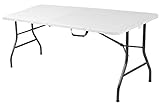
Trestle legs consist of two wide, A-frame or H-frame supports connected by a folding brace or central stretcher bar. They are the most common style on 4-foot to 8-foot banquet tables and utility tables.
- Best for: Dining, craft tables, garage workbenches, and events where maximum stability is needed
- How they fold: Both leg frames fold flat against the underside of the table, reducing total thickness to about 3 to 4 inches
- Pros: Highest weight capacity, excellent lateral stability, no center leg to hit your knees
- Cons: Heavier, require more floor space when unfolded, not height-adjustable on most models
2. Wishbone / Hairpin Folding Legs
Wishbone legs have a single center post that splits into a V or U shape at the floor, resembling a wishbone. Hairpin is a similar single-post design with a thin wire loop. Both are popular for mid-century modern desks, small dining tables, and DIY plywood tops.
- Best for: Small apartments, home offices, minimalist dining tables for 2-4 people
- How they fold: Each leg folds individually inward on a hinge plate; no connecting stretcher
- Pros: Lightest and most compact, clean aesthetic, leaves more legroom
- Cons: Lower weight capacity, more prone to side-to-side wobble if the hinge plate is thin or screws loosen
3. Adjustable Height Folding Legs
Adjustable legs are telescoping trestle or straight-post legs with push-button or twist-lock height settings. They are standard on utility tables marketed as “adjustable height folding tables” from brands like Lifetime, Cosco, and National Public Seating.
- Best for: Multi-use spaces that need to switch between coffee table, desk, and dining height
- How they fold: Fold flat like trestle legs, but include an inner leg tube that slides to change height
- Pros: One table can serve three functions, great for kids’ craft tables that grow with them or standing desk conversions
- Cons: Slightly more wobble at the tallest setting, more moving parts that can wear
| Leg Type | Typical Height Range | Weight Capacity (per pair) | Folded Thickness | Knee Clearance Needed |
|---|---|---|---|---|
| Trestle (Non-Adjustable) | 28-29 inches (standard dining) | 500-700 lbs per pair | 3.0 – 3.5 inches | 25 inches from floor to underside of apron |
| Wishbone / Hairpin | 28 inches fixed | 180-300 lbs per pair | 2.5 – 3.0 inches | 27 inches (open center, no stretcher) |
| Adjustable Telescoping | 22 / 24 / 28 / 30 / 34 / 36 inches | 300-500 lbs per pair | 3.5 – 4.5 inches | Varies by setting; 21 inches at desk-low |
Which Folding Legs Should You Buy? A Decision Matrix
Match your situation to the mechanism, not just the look. Price ranges in 2026 for legs alone (without top) are usually $35–$60 for a pair of basic wishbone legs, $45–$90 for a pair of trestle folding brackets, and $65–$130 for a pair of heavy-duty adjustable height legs.
| Your Situation | Best Pick | Why |
|---|---|---|
| Small apartment or 10×12 ft room that doubles as office and dining | Adjustable height trestle legs | Set at 22-24 inches for a coffee table, 29 inches for dining, 34-36 inches for kitchen counter work. Folds to 4 inches and stores behind a sofa or in a closet. |
| Need a sturdy 6ft or 8ft table for sewing, woodworking, or food prep | Heavy-duty trestle with locking brace | Handles 500+ lbs distributed weight. A 6ft top needs at least 28 inches of clearance on all sides to pull chairs out in a 10×12 room. |
| Renter who wants a DIY plywood or butcher-block desk without drilling walls | Wishbone folding legs | No stretcher means your office chair rolls freely. Easy to remove and take with you when you move. |
| Family with kids and pets | Adjustable or trestle with rounded feet and locking ring | Avoids pinch points from exposed scissor braces, more stable if kids lean on the edge. Choose powder-coated steel over raw steel to resist scratches. |
| Back pain and need to alternate sitting and standing | Adjustable telescoping legs set to 28 and 36 inches | Allows ergonomic heights: 28-30 inches for seated desk work with a 17-19 inch chair, 36 inches for standing prep or laptop use. |
Key Measurements Before You Buy or Build
Folding legs do not fit every top or space. Check these numbers first:
- Standard heights: Dining table 28-30 inches, desk 28-29 inches, counter-height 34-36 inches, coffee table 16-18 inches. Measure your chair seat height — you need 10 to 12 inches between the seat and the underside of the table for comfortable thigh clearance.
- Room fit: For a 10×12 ft room, leave at least 36 inches of clearance from the table edge to the wall so chairs can slide back, and 42 to 48 inches if people need to walk behind seated guests. A 72 x 30 inch folding table needs a room at least 10 ft in one direction to avoid feeling cramped.
- Top size vs. leg span: Folding trestle legs are typically 22 to 28 inches wide. Your top should overhang the legs by 2 to 4 inches on each side for stability. A 24-inch-wide leg set on a 30-inch-wide top is ideal; on a 60-inch-wide top it will feel tippy.
- Weight limits: Most residential folding legs are rated per pair, not per leg. Two pairs (four legs total) on a 6ft table usually support 600-1000 lbs distributed load, but only 150-200 lbs of point load on the center if the top is 3/4-inch plywood without reinforcement.
- Folded storage: Measure your storage spot. A 6ft table with trestle legs folds to about 72 x 30 x 3.5 inches. It will not fit through a 24-inch-wide pantry doorway if you try to carry it sideways.
How to Replace Folding Table Legs
Replacement is straightforward if you reuse the same hole pattern. Most replacement legs come as a complete set with mounting plates, braces, and hardware for tops from 3/4 inch to 1-1/2 inches thick.
What you need: Phillips screwdriver or drill, 3/8-inch socket wrench, tape measure, pencil.
- Step 1: Remove the old legs. Flip the table upside down on a blanket. Unfold and lock the brace, then unscrew the mounting plate from the top. If rivets hold the brace, drill them out and replace with bolts on the new set.
- Step 2: Mark the new position. Place the new mounting plate at least 2 inches from the edge of the top to prevent splitting. For a 72-inch top, set the plates 4 to 6 inches in from each end for even weight distribution. Keep both plates perfectly parallel — measure diagonal corners to verify square.
- Step 3: Predrill and attach. For solid wood, predrill with a 7/64-inch bit. For engineered tops like MDF or particleboard, use coarse-thread screws or T-nuts and avoid over-tightening. Use #10 x 3/4-inch screws for a 3/4-inch top so you do not poke through the surface.
- Step 4: Test the fold. Fold and unfold several times. The brace should snap firmly into the lock cup without forcing. If the leg swings too freely, tighten the pivot bolt 1/4 turn at a time.
How to Fix Wobble and Adjust Height
Fixing Wobble
Most wobble comes from loose hardware, not a bent leg.
- Tighten all pivot points: Check the hinge bolts where the leg meets the plate and where the diagonal brace connects. Add a nylon lock nut if the original nut keeps loosening.
- Level the feet: On uneven floors, add stick-on furniture glides or screw-in leveling feet. Adjustable legs often have a threaded foot pad — turn it clockwise to extend.
- Reinforce a thin top: If the top flexes and makes the table rock, screw a 1×3 inch solid wood cleat across the underside between the two mounting plates. This prevents the screws from pulling out of particleboard.
- Check the locking ring: Trestle braces use a ring that slides over the joint to lock it. If the ring is bent, tap it straight with a mallet or replace the brace — usually $12–$25 per brace.
Adjusting Height
For telescoping adjustable legs, set all four legs to the same numbered hole before loading the table. Extend by pulling the inner tube until the spring button clicks into the detent. Never set legs at different heights to compensate for a sloped floor — level the floor with shims under the feet instead, or the frame will twist.
For fixed wishbone or trestle legs, the only true height change is replacing the legs or adding leg extenders. Screw-on extenders typically add 3 to 5 inches but reduce weight capacity by about 20%.
Material and Durability Trade-Offs
| Material | Durability | Weight | What Wears First |
|---|---|---|---|
| Powder-Coated Steel | High — resists rust, dents, and scratches | Heavy (8-12 lbs per pair) | Plastic lock cup or spring button after 3-5 years of daily folding |
| Bare or Chrome Steel | Medium — can rust in garages or basements | Heavy | Chrome pitting, screws loosening in soft top |
| Aluminum | Medium — lightweight but bends under heavy point loads | Light (4-6 lbs per pair) | Hinge rivets elongating, causing lateral play |
| Solid Wood Trestle Base (folding) | High if hardwood like maple or oak | Very heavy | Hinge mortise cracking if over-tightened |
For assembly and moving, expect a boxed pair of steel trestle legs to weigh 14 to 22 lbs. Doorways are rarely the problem, but narrow hallways can be — a folded 30-inch-wide table needs a 32-inch doorway to turn the corner without scuffing walls. Keep the original brace locks lubricated with a dry silicone spray once a year to keep folding smooth.
FAQ
Can I put folding legs on any tabletop?
Yes, if the top is at least 3/4 inch thick and structurally rigid. Solid wood, plywood, and butcher block are ideal. Thin MDF or hollow-core doors need reinforcement cleats or the screws will pull out.
Why does my folding table sag in the middle?
Sag happens when the top is too thin or the legs are set too close together. For tops longer than 60 inches, add a center support or choose a top that is at least 1 inch thick. Distributed weight sag should be less than 1/4 inch over 6 feet.
Are folding table legs strong enough for a desk with monitors?
Yes. A pair of trestle legs rated at 500 lbs can easily hold a 40-lb desktop plus two monitors and a PC. Use adjustable legs set at 28-29 inches for seated desk ergonomics, and secure cables so they do not snag the folding brace.