Key takeaways
- Leave 24-36 inches between the grill firebox and the table edge. This prevents radiant heat from softening HDPE and keeps stainless comfortable to touch. For a kettle charcoal grill, 36 inches is the minimum if the lid is off and heat is radiating sideways.
- Allow 42-48 inches of working aisle behind you. If your patio is 10×12 feet, a 4-foot folding table (48 x 24 inches) placed perpendicular to a 50-inch wide gas grill still leaves a 48-inch walkway on the opposite side, which is enough to carry trays safely.
- Standard folding table height is 28-29 inches, which matches most grill side shelves (33-36 inches) close enough for sliding trays over without lifting high. For a dedicated prep station, look for adjustable-height models that lock at 34-36 inches to create a true counter-height workspace and reduce back strain.
- Keep at least 12 inches of table overhang free from the grill to avoid dripping grease directly onto the leg hinge, which is the first point to gum up and stiffen.
What's inside
- Stainless Steel vs. HDPE Plastic: Head-to-Head for Grilling
- Heat Resistance: What Actually Happens Next to a Grill
- Grease Cleanup: Which Material Is Easier After a Cook?
- Wind Stability and Safety Next to a Hot Grill
- Decision Matrix: Which Should You Buy?
- Assembly, Moving, and What Wears First
- What to Look For When You Shop in 2026
- FAQ
The best folding table for grilling in 2026 is a stainless steel folding table if you regularly set hot trays, charcoal chimneys, or cast iron directly down next to the grill, and an HDPE plastic folding table if you prioritize lightweight handling, easy grease cleanup, and outdoor weather resistance on a budget.
- Stainless Steel vs. HDPE Plastic: Head-to-Head for Grilling
- Heat Resistance: What Actually Happens Next to a Grill
- Grease Cleanup: Which Material Is Easier After a Cook?
- Wind Stability and Safety Next to a Hot Grill
- Decision Matrix: Which Should You Buy?
- Assembly, Moving, and What Wears First
- What to Look For When You Shop in 2026
- FAQ
As an Amazon Associate we earn from qualifying purchases at no extra cost to you.


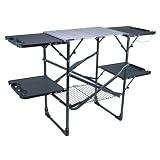
Stainless Steel vs. HDPE Plastic: Head-to-Head for Grilling
These are the two materials that actually hold up next to a hot grill. Wood, bamboo, and fabric-top tables warp, stain, or scorch, while standard resin wicker softens under heat. Stainless steel and high-density polyethylene (HDPE) are the only folding options designed to handle repeated heat and grease exposure.
| Feature | Stainless Steel Folding Table | HDPE Plastic Folding Table |
|---|---|---|
| Heat Resistance | Withstands contact up to 800°F+ without melting; will discolor but not warp. Safe for hot sheet pans and grill grates for short periods. | Softens at 180-250°F. Safe for plates and serving dishes, but hot pans need a trivet or 8-10 inch air gap. |
| Grease & Cleanup | Non-porous, chemical resistant. Wipes clean with degreaser but shows fingerprints and grease film until polished. | Non-porous with textured surface. Hides smudges, resists staining, cleans with soap and water. Textured surface can trap grease in grooves. |
| Weight (4-foot model) | 22-32 lbs | 12-18 lbs |
| Weight Capacity | 300-500 lbs static (evenly distributed) | 300-600 lbs static (evenly distributed) on commercial-grade models |
| Wind Stability | Excellent. Low center of gravity and heavier frame resists tipping in 15-20 mph gusts. | Moderate. Needs locking legs and may need weighting in wind over 15 mph. |
| Outdoor Durability | Rust-resistant if 304 stainless; 201 stainless can pit with salt air. No UV fading. | UV-protected HDPE will not rust, crack, or fade for 5-10 years. Can become brittle after prolonged UV without cover. |
| General Market Range | Usually $120-$280 for 3-4 foot models | Usually $45-$130 for 4-foot models |
| Best For | Searing station, hot holding, serious grillers | Prep, serving, and easy storage for casual grilling |
Heat Resistance: What Actually Happens Next to a Grill
Grill surface temperatures tell you why material matters. A gas grill lid can reach 500-700°F, charcoal chimneys exceed 1000°F at the base, and a fresh sheet pan from the grill can be 350-450°F on the bottom. HDPE is rated for continuous use around 180°F and begins to soften well below the temperature of that pan. It will not catch fire, but it will leave a permanent warp ring or gloss mark if you set hot metal directly on it.
Stainless steel has no such limit for normal grilling. You can set a 450°F half sheet pan directly on 304 stainless without damage, though the steel will be hot to the touch for several minutes afterward. The trade-off is conductivity: the entire top becomes hot, so you still want silicone trivets or a 1-inch air gap if kids are reaching across.
Safe Clearance and Placement Measurements
Do not push any folding table tight against the grill body. For both safety and material life:
- Leave 24-36 inches between the grill firebox and the table edge. This prevents radiant heat from softening HDPE and keeps stainless comfortable to touch. For a kettle charcoal grill, 36 inches is the minimum if the lid is off and heat is radiating sideways.
- Allow 42-48 inches of working aisle behind you. If your patio is 10×12 feet, a 4-foot folding table (48 x 24 inches) placed perpendicular to a 50-inch wide gas grill still leaves a 48-inch walkway on the opposite side, which is enough to carry trays safely.
- Standard folding table height is 28-29 inches, which matches most grill side shelves (33-36 inches) close enough for sliding trays over without lifting high. For a dedicated prep station, look for adjustable-height models that lock at 34-36 inches to create a true counter-height workspace and reduce back strain.
- Keep at least 12 inches of table overhang free from the grill to avoid dripping grease directly onto the leg hinge, which is the first point to gum up and stiffen.
Grease Cleanup: Which Material Is Easier After a Cook?
Both materials are marketed as easy to clean, but they handle grease differently.
HDPE has a slightly pebbled, blow-molded texture. That texture hides light grease spray and small scratches, and you can clean it with warm water, dish soap, and a soft brush. Avoid abrasive pads; they roughen the texture and make future grease harder to release. For heavy pork fat or burger grease, a degreaser left for 2-3 minutes before wiping prevents the film that makes HDPE feel tacky.
Stainless steel is smoother and truly non-porous, so even rendered beef fat wipes off completely. The downside is that every fingerprint, water spot, and thin grease film shows until you buff it. After cooking, wipe with a degreaser, then follow with a damp microfiber cloth wiped in the direction of the grain. Do not use steel wool or chlorine bleach, which pits the surface and creates spots that will rust.
If you grill weekly, HDPE saves time day-to-day. If you grill with heavy marinades, sugary glazes, or do a lot of deep searing where grease pools, stainless saves time long-term because it never absorbs odor or color.
Wind Stability and Safety Next to a Hot Grill
A folding table that slides or tips next to a lit grill is a burn hazard. Weight and leg design determine stability more than top material.
Stainless steel folding tables weigh nearly twice as much as HDPE in the same size, which is a clear advantage on breezy decks or driveways. A 4-foot stainless table at 26-30 lbs with straight legs will stay planted in steady 15-20 mph wind without extra weight. Its lower flex also means trays of meat do not bounce when you close the grill lid.
HDPE tables are lighter, typically 14-17 lbs for a 4-foot model, and many have wishbone or center-pedestal folding legs that flex more. In wind over 15 mph, they can shuffle unless locked. Choose a model with gravity locks or slide-ring leg locks, not just friction locks, and position the table with its long side into the wind to reduce sail effect. If your grilling spot is consistently windy, place a 10-20 lb sandbag on the lower cross-brace or choose a 4-foot HDPE table with a steel frame that adds 4-5 lbs of stability.
For both types, always lock the legs on a level surface. Composite decking, pavers, and concrete are ideal. Grass or gravel amplifies wobble, and a wobbling table next to a 500°F grill should not be used for hot holding.
Decision Matrix: Which Should You Buy?
Match your grilling situation to the right material rather than buying on price alone:
| Your Situation | Best Choice | Why |
|---|---|---|
| You sear on cast iron, use a charcoal chimney, or rest sheet pans with hot meat | Stainless Steel | Direct heat contact without warping; acts as a safe landing zone for 400°F+ items. |
| You grill on a small apartment balcony or need to carry the table through a doorway | HDPE Plastic (4-foot) | 12-18 lbs vs 25+ lbs makes carrying through a 28-32 inch doorway and up stairs realistic. Folds to 3.5 inches thick for closet storage. |
| You grill for a family and need easy cleanup for kids, pets, and frequent use | HDPE Plastic | Stain and odor resistant, hides smudges, soap-and-water cleanup. No polishing needed. |
| You live within 5 miles of the coast or leave the table outside uncovered | HDPE or 304 Stainless Only | HDPE never rusts. 304 stainless resists salt corrosion; avoid 201 stainless in coastal air. |
| You want a permanent outdoor prep station next to a built-in grill | Stainless Steel with adjustable height | More durable under UV and heat, higher heat tolerance, and counter-height (34-36 inches) reduces bending. |
| You host large cookouts and need maximum serving space | HDPE 6-foot (72 x 30 inches) | Lighter to move at 28-35 lbs for a 6-foot size vs 40-50 lbs for stainless, easier for one person to set up. |
Assembly, Moving, and What Wears First
Folding tables require no assembly in most cases, but the realities of moving and storing them matter for grilling use.
Box weight and doorway fit: A 4-foot HDPE table ships at 15-20 lbs and fits through any standard 30-inch interior door when folded. A 4-foot stainless table ships at 25-34 lbs and is awkward for one person on stairs due to the rigid top. If you store the table in a garage and carry it to a patio, measure your storage depth. Folded thickness is 2.5-3.5 inches for HDPE and 3-4.5 inches for stainless with cross-bracing.
What wears first: On HDPE tables, the leg hinge rivets and the textured top edge near the fold seam loosen or chip first after 3-5 years of frequent folding. On stainless tables, the spot welds under the top and the rubber foot caps wear first; caps crack and cause wobble on concrete if not replaced. For both, grease that builds up in the hinge without cleaning will make the legs stiff to lock, so wipe the underside hinge area monthly if you grill weekly.
Weight limits in practice: While many folding tables list 300-500 lb capacity, that is evenly distributed static weight. In grilling use, avoid placing a 100+ lb ceramic kamado grill or a full 20 lb propane tank plus a heavy cooler on one end, which creates point load and can bow HDPE over time. Center heavy items and keep individual point loads under 80-100 lbs.
What to Look For When You Shop in 2026
Beyond material, these specs determine whether a folding table works as a grill companion:
- Frame: Powder-coated steel frame on HDPE models or full stainless frame on stainless models. Avoid all-plastic frames for grilling; they flex under hot trays.
- Leg locks: Look for positive locking rings or push-button locks that click. Simple gravity locks can release if bumped.
- Height: Fixed 28-inch height is fine for serving. For prep next to a 36-inch grill, choose adjustable 22-36 inch height with three or more lock positions.
- Size: A 3-foot (36 x 24 inch) table is enough for tongs, trays, and a cutting board for 2-4 people. A 4-foot (48 x 24 inch) is the most versatile for grilling. A 6-foot is for serving a crowd but blocks patio flow in spaces under 12 x 12 feet.
- Feet: Non-marking rubber feet that swivel slightly help on uneven pavers and prevent scratching composite decking.
- Edge profile: A low 1-inch lip on stainless contains spills better than flat HDPE. For HDPE, a slight perimeter groove helps keep grease from dripping off the side.
If you grill twice a month or less and mainly need a serving surface for plates and drinks, a 4-foot HDPE folding table from established makers like Lifetime or Cosco-style steel-frame models covers the need for usually $45-$90. If you grill weekly, sear hot, or want a table that doubles as an outdoor kitchen landing zone, a 3 or 4-foot 304 stainless folding table for usually $140-$260 pays for itself in heat resistance and longevity.
FAQ
Can I put a hot grill directly on a folding table?
No. Never set a lit charcoal grill, pellet grill, or portable gas grill directly on any folding table. Even stainless tables are not rated to support 100+ lbs of hot grill plus fuel with concentrated heat underneath. Use the table as a side station only, with 24-36 inches of clearance from the firebox.
Will HDPE melt if it is near the grill?
It will not melt from ambient heat at 24+ inches away, but it will soften and warp if a pan over 250°F touches it directly. Always use a trivet, wood cutting board, or sheet pan rack between hot metal and HDPE.
Which size is best if I have a small patio?
For patios under 10×10 feet, a 3-foot folding table (36 x 24 inches) keeps a 42-inch work aisle open. A 4-foot table works if you place it against a wall or rail when not actively plating. Folded, both store upright in 4 inches of wall space.