Key takeaways
- Confirm the minimum height at the vehicle’s specified lifting point, not at the rocker panel or bumper.
- Confirm the maximum height is enough to unload the tire or component you are servicing.
- Use a level concrete floor whenever possible. Asphalt can soften and gravel can allow the base to tilt.
- Use wheel chocks on the opposite axle and set the parking brake when appropriate.
- After lifting, place jack stands under approved support points before beginning work.
- Do not use a bottle jack to push, pull, or straighten equipment sideways.
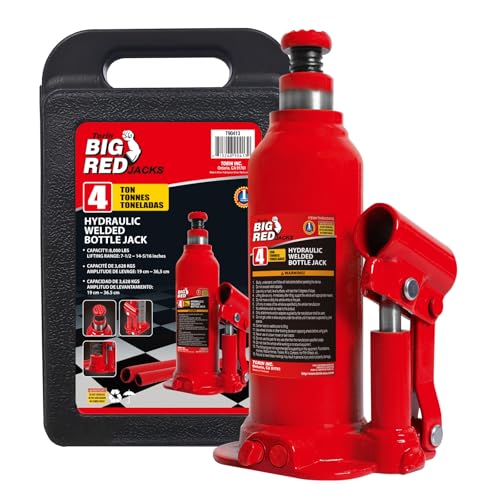
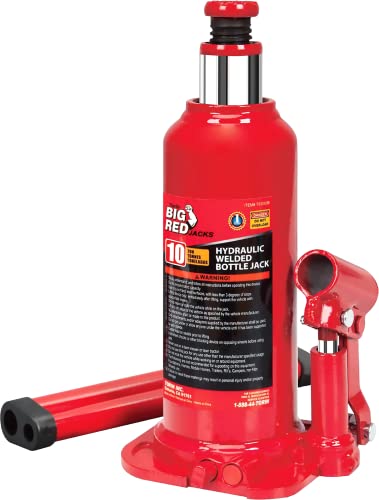
The best bottle jacks are the Hein-Werner 20-ton for heavy trucks and equipment, the Sunex 12-ton for a strong all-purpose shop jack, the Torin Big Red 6-ton for ordinary cars and light trucks, and a compact 2-ton or 4-ton jack when storage space and lifting height matter more than capacity.
A bottle jack is best when you need high lifting force in a small footprint. It is not automatically the right choice for every vehicle: many bottle jacks have a tall minimum height, a narrow base, or too little maximum height to lift a vehicle’s suspension far enough for wheel removal. Check the vehicle’s recommended jacking points and use properly rated jack stands; never work under a vehicle supported only by a hydraulic jack.
Our top picks


As an Amazon Associate we earn from qualifying purchases at no extra cost to you. Ratings are shown as listed on Amazon.
Best bottle jacks by situation
| Best for | Recommended type or model | Capacity | Typical minimum / maximum height | Why it fits |
|---|---|---|---|---|
| Cars and small SUVs | Torin Big Red 6-ton bottle jack | 12,000 lb | About 7.5 / 14.5 in | Useful capacity without the size and cost of a truck jack |
| General garage and light trucks | Sunex 12-ton bottle jack | 24,000 lb | About 9 / 18 in | High capacity and useful extension range for pickups and SUVs |
| Heavy trucks, farm equipment, and trailers | Hein-Werner 20-ton bottle jack | 40,000 lb | About 9.5 / 18 in | Heavy-duty construction and substantial lifting reserve |
| Low-clearance vehicles | Low-profile 2-ton or 4-ton bottle jack | 4,000–8,000 lb | About 5.5–12 in | More likely to fit beneath a car’s specified lifting point |
| Emergency roadside storage | Compact 2-ton bottle jack | 4,000 lb | About 6–11 in | Small enough for a trunk, but limited in height and stability |
Dimensions vary by exact model and production revision, so treat the figures as buying ranges rather than substitutes for the manufacturer’s specification sheet. The critical measurement is the jack’s minimum height compared with your vehicle’s jacking point when the tire is flat.
Head-to-head comparison of the leading choices
Hein-Werner 20-ton: best for heavy loads and repeated shop use
The Hein-Werner 20-ton bottle jack is the strongest choice here for dump trucks, commercial vehicles, loaded trailers, agricultural machinery, and equipment with substantial axle loads. Its high capacity provides a large safety margin when the load is positioned correctly, while its heavier body and broad base are better suited to a shop floor than a roadside kit.
The trade-off is size. A 20-ton jack is commonly around 50–70 lb, depending on the design, and its minimum height is usually too tall for many passenger cars. It also needs a firm, level surface: a large jack can still become unstable if its base sinks into asphalt, gravel, soil, or a cracked garage slab.
Sunex 12-ton: best all-purpose high-capacity bottle jack
A Sunex 12-ton bottle jack is a practical middle ground for pickup owners, SUV owners, trailer maintenance, and home garages that occasionally handle heavier equipment. Its roughly 9-inch minimum height fits many truck axles, and an 18-inch maximum height can provide useful room for suspension work when the jacking point is high enough.
It is usually more manageable than a 20-ton jack while retaining a large capacity reserve. However, 12 tons does not mean you can lift any 12-ton vehicle from any point. The jack supports only the portion of the vehicle transferred through the selected jacking point. Never lift on thin body panels, differentials not approved by the vehicle maker, or suspension parts that can shift.
Torin Big Red 6-ton: best value for ordinary vehicles
The Torin Big Red 6-ton bottle jack is a sensible choice for many cars, crossovers, vans, and light-duty pickups when its dimensions match the vehicle. A roughly 7.5-inch minimum height is more versatile than many larger bottle jacks, while a maximum near 14.5 inches is adequate for some tire changes and brake work.
Its smaller footprint is convenient, but that is also its main limitation. A narrow base is less forgiving on uneven surfaces, and the jack may not reach a truck’s axle or frame at full extension. For frequent work, place a properly sized steel plate or hardwood blocking beneath the base only when the setup remains level and stable; do not improvise unstable stacked materials.
What the numbers mean in actual use
Capacity: choose for the lifted corner, not the vehicle’s total weight alone
As a conservative starting point, calculate the vehicle’s curb weight and assume a jack may carry a substantial share of one end, especially when lifting near one axle. A 4,000-pound car does not need a 4,000-pound jack simply because only one corner is raised, but a 2-ton jack leaves less margin than a 4-ton or 6-ton model. For trucks, trailers, and equipment, follow the manufacturer’s lifting instructions and choose a capacity comfortably above the expected load at that point.
Capacity also affects durability. A larger jack often has a thicker ram and stronger frame, but it is not automatically safer if the base is too narrow or the jack is extended near its limit.
Minimum height: the measurement that prevents a failed purchase
Measure from the ground to the exact approved lifting point with the tire inflated and again with it flat. Add a small allowance for uneven pavement. A jack with a 9-inch minimum height will not fit a 7-inch gap, regardless of its impressive capacity.
Low-profile bottle jacks are useful for sports cars and lowered vehicles, but they commonly sacrifice maximum height. If the minimum is low and the maximum is only 11 or 12 inches, the jack may lift the car without raising the tire clear of the ground. A separate low-profile floor jack may be more suitable for very low vehicles.
Maximum height and extension screw
Look at the hydraulic travel and the adjustable screw extension separately. The screw can close a height gap before pumping begins, but it should not be relied on as a long, unsupported column at full extension. A larger maximum height is valuable for trucks and equipment, yet it also raises the load higher and can reduce stability if the base is not perfectly flat.
Base stability and hydraulic durability
| Feature | What to look for | Practical trade-off |
|---|---|---|
| Base | Broad welded or reinforced footprint, ideally roughly 6 x 6 in or larger on medium and heavy models | More stable, but heavier and harder to store |
| Hydraulic ram | Cleanly machined, straight ram with protected seals and smooth extension | Better longevity; contamination and side loading still cause leaks |
| Release valve | Controlled lowering with a dedicated handle interface | Safer positioning, but lowering remains fast if opened too far |
| Oil system | Serviceable hydraulic oil and a clearly identified fill plug | Maintenance is possible, but incorrect oil or overfilling damages performance |
| Saddle | Large, textured saddle that matches the vehicle’s approved contact point | Better grip, though an oversized saddle may not fit a narrow bracket |
The parts most likely to cause trouble are seals, the release valve, and the ram surface. Store the jack upright, keep the ram retracted, wipe away grit and road salt, and do not use it as a permanent support. A jack that slowly sinks under load should be removed from service rather than “fixed” by repeatedly pumping it.
Clearance and surface checklist
- Confirm the minimum height at the vehicle’s specified lifting point, not at the rocker panel or bumper.
- Confirm the maximum height is enough to unload the tire or component you are servicing.
- Use a level concrete floor whenever possible. Asphalt can soften and gravel can allow the base to tilt.
- Use wheel chocks on the opposite axle and set the parking brake when appropriate.
- After lifting, place jack stands under approved support points before beginning work.
- Do not use a bottle jack to push, pull, or straighten equipment sideways.
Bottom line
Choose the Torin Big Red 6-ton when you need a compact general-purpose jack and its approximately 7.5-inch minimum height fits your vehicle. Choose the Sunex 12-ton for pickups, SUVs, trailers, and heavier garage work. Choose the Hein-Werner 20-ton for commercial or agricultural equipment where construction and capacity matter more than portability. For a low car, start with minimum-height measurements rather than capacity, and consider a low-profile design or floor jack if the bottle jack cannot provide enough maximum lift.